


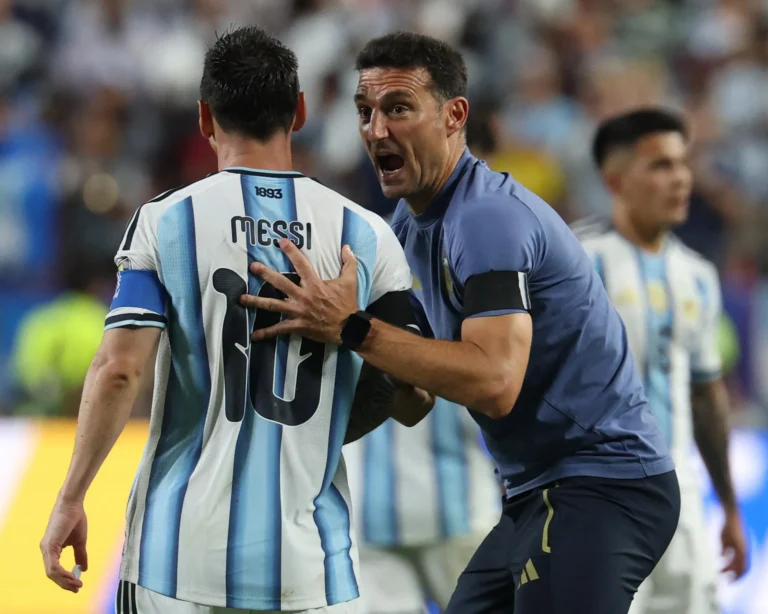
Throughout the World Cup tournament, from the opening match to Saturday’s 3-1 quarter-final victory, Lionel Scaloni has repeatedly faced one question: what does he believe is the legacy of this Argentina team?
Having served as Argentina’s head coach for nearly eight years, Scaloni’s personal legacy is already established, as are those of many players who took the field against Switzerland. He has brought an end to a nearly thirty-year trophy drought, secured the nation’s third World Cup, and won two Copa Américas. Now acclaimed as Argentina’s most successful coach, his controversial appointment is now seen as a masterstroke.
While Scaloni often sidesteps the question, he provided a heartfelt response on Friday, referencing a viral video that emerged after Argentina’s stunning comeback against Egypt in the round of 16. In the clip, a ten-year-old Argentinian boy passionately expresses what it means to be Argentine, highlighting the nation’s fighting spirit.
“The training staff and the players, we play football to see these things,” Scaloni remarked. “Things that come from the heart. It’s incredible – a kid that age says that. If this team has a legacy, that’s what we want. That tomorrow, kids like that think that they can be here playing [for the national team] in the future.”
Throughout the tournament, Scaloni’s squad has inspired fans, though they have likely taken years off their supporters’ lives due to their habit of leaving things until the last moment, often giving up leads, and heavily depending on Lionel Messi, their perennial star. They faced elimination twice against teams they were heavily favored to defeat, nearly falling to Cape Verde in the Round of 32.
On Saturday, Argentina exhibited their classic style once more. They scored early and appeared to be in command against a Switzerland side that struggled to provide a challenge. Messi, seemingly in control, had limited involvement, contributing only with a well-placed corner for the opening goal. For a fleeting moment, it seemed the Argentine fans might finally catch their breath.
However, a chaotic ten-minute period in the second half saw Argentina falter. A single defensive lapse allowed Switzerland to equalize with a simple give-and-go that should have been easily defended. Even after a questionable red card against a Swiss player gave Argentina a numerical advantage, they struggled to secure the win. For once, Messi looked mortal, squandering two excellent opportunities as the match extended into extra time.
It was a moment of brilliance from Julian Álvarez, who had been largely quiet throughout the match, that propelled Argentina forward. His perfectly struck curling shot allowed Argentine fans to finally relax, and their joy escalated when Lautauro Martínez sealed the victory with a third goal just before the final whistle. These moments served as a reminder that Messi, who had been uninvolved in the buildup to the goal, does not always need to carry the team alone.
Following the match, a cluster of Argentinian reporters gathered to interview the key players. Even in their triumph, the dialogue was filled with terms like sufrir and costar, reflecting the emotional toll of their journey.
“Every game in the World Cup, we are seeing that they’re like this,” Álvarez stated post-match. “Sometimes it’s our turn [to suffer], but it’s also the same for our opponents. Tons of extra time, all of that. Whatever the case is, we know we will fight till the end. As long as we win, it’s fine.”
Scaloni commented, “To make the World Cup semi-finals you have to suffer. We did it in Qatar as well … Ultimately we always find the solutions, and in the end tonight we made it possible.”
This duality of Argentina characterizes their recent World Cup experiences: moments of extraordinary brilliance interspersed with sheer chaos. In just three days, they will confront their greatest challenge yet in the semi-finals against England in Atlanta, reigniting one of football’s most intense rivalries, steeped in history, politics, and controversy. This match recalls the legendary clashes between Maradona and Shilton, Beckham and Simeone, but will also feature Messi, who is eager to leave his mark on this storied rivalry.
Scaloni, perhaps aware of the historical significance of the encounter, attempted to downplay the stakes. Ironically, his words may have amplified them. “This is just a football game, OK?” he declared. “That’s what I can say. It is a football game and we will be playing against a very tough opponent with an excellent coach. And this is a football game. And that is all.”
Argentina will face England after having played 120 minutes in two of their last three knockout matches, with only three days of rest. Scaloni believes that these struggles are what forge resilience. His squad, though imperfect, has shown they can withstand repeated challenges and remain standing. However, the path ahead promises to be far more treacherous than those they faced against Cape Verde, Egypt, or Switzerland. If they can maintain their form against England, they will then meet either Spain or France in the final.
“This is part of our blood,” Scaloni remarked. “It is part of our DNA. [These struggles] bring peace of mind. We are more experienced and we know what it feels like to be dominated by the opponent, to have an equalizer. Today we kept our composure, the team knew how to remain calm, and we will never give up.”
- World Cup 2026
- Switzerland
- Argentina
- World Cup
- analysis