


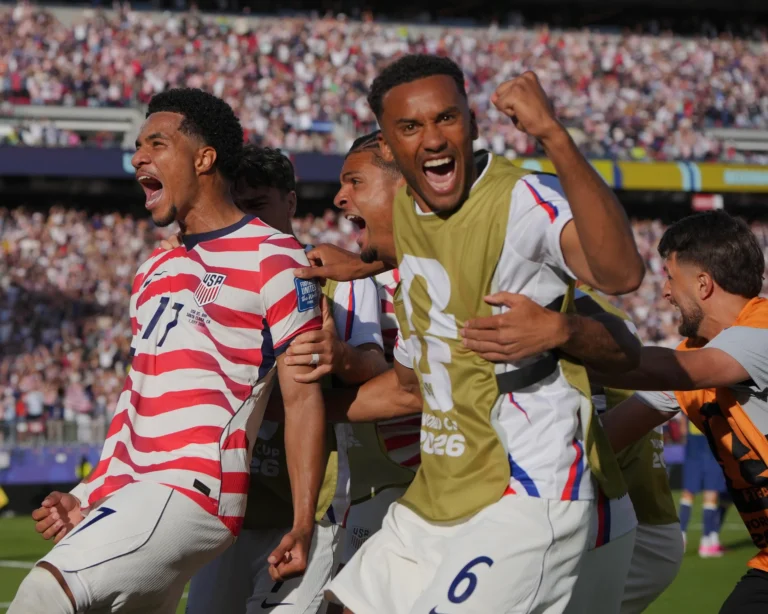
The US men’s national soccer team is on the verge of a historic achievement. With one more victory needed to match their best performance in World Cup history, they are displaying an extraordinary level of skill and determination at this crucial moment. Their recent victory against Bosnia and Herzegovina has set the stage for American soccer to shine brightly in the national consciousness.
For loyal fans of US soccer, supporting this team at such a pivotal time is an obvious choice. Any hesitation feels as trivial as deciding whether to take a breath.
However, many newcomers to this journey might only tune in to watch the team during the World Cup, if at all. Among these individuals, a considerable number may feel uncomfortable cheering for a US national sports team. This unease is understandable. Over the past year, they have witnessed the US baseball team’s overt military propaganda, which has tarnished its image. Just weeks ago, the US men’s hockey team was seen mingling with political elites at the Olympics, all while numerous crises unfolded back home. They welcomed these figures into their locker room for drinks, while the US women’s team, also gold medalists, faced criticism.
This discomfort is further intensified by various non-sporting issues that might hinder many Americans, or potential Americans, from rallying behind their national team. Many may reflect on the missteps of the US government over recent years, or even further back, to the nation’s origins. Despite some claims that the US is the “greatest country in the world” one must question how many lives have been affected or lost due to governmental actions. While your concerns are valid, I encourage you to hold onto those truths while also embracing others.
Global Perspectives on National Pride
First, it’s important to recognize that the US is not alone in facing such dilemmas. Consider how many Germans felt unable to celebrate their team’s successes for decades following World War II. For a more current example, look at Iran, where fans struggle with Team Melli’s role in society, particularly given its connections to a repressive regime that has forced many to flee. When the Iranian national team plays, do they represent the government or the Iranian people, who are among the most kind-hearted and enthusiastic football fans globally? Observers in stadiums during this summer’s matches concluded that it is the latter. Fans booed the national anthem, wore protest shirts, and obscured the flag’s emblem. Yet, when Iran scored, stadiums in Los Angeles and Seattle erupted in celebration.
In the US, one might wonder why we should cheer for our national team during a time when our government faces disapproval both domestically and internationally. How can we overlook ICE raids, military interventions abroad, and the mistreatment of fellow Americans, all in pursuit of a fleeting sense of patriotism for just 90 minutes, plus stoppage time, and possibly penalties?
Reasons to Support the Team
There are many compelling reasons to support this particular squad. They embody the diversity that defines our nation; their unique American spirit has been shaped by a coach who proudly claims to be “200% Argentinian.” It is essential to remember that, similar to the Olympics, these athletes excel in their respective fields. They have dedicated years to training and made countless sacrifices to reach the pinnacle of competition. They either live in your country, grew up there, or chose to represent it over other options. Some may even play locally and share your taste in condiments (just wait until you hear about Weston McKennie and ranch dressing). Unlike much of the soccer world, a segment of their lives can be easily related to by Americans, independent of government actions.
Ultimately, my strongest argument for supporting this team is that you are not merely supporting the players. The athletes, coaches, and staff, along with their varied political beliefs, are transient. They will come and go; some will shine while others may struggle, and you may align with one’s politics while disagreeing with another’s. Eventually, they will make way for a new generation. It is ironic that fans and journalists fixate on these individuals when the true appeal lies in something far greater.
The Power of Community
In international soccer, the allure often stems from the people around you—those whose names you might know and whose happiness and well-being are important to you. It exists in being part of a larger crowd, all experiencing the same emotional highs, waiting for that moment to erupt in joy, reminiscent of the scene in Washington, D.C., a monument to patriotism, albeit one that often feels hollow.
The US men’s soccer team experienced its first viral moment 16 years ago when Landon Donovan scored against Algeria in the 2010 World Cup. Many remember Donovan’s name because of that goal, and some might also recall that Tim Howard delivered the crucial pass. However, I suspect that the most vivid memories from that moment do not center around the specifics of the play. Instead, people remember where they were, who they were with, and how they celebrated that glorious, euphoric moment.
So, if you are looking for a reason to cheer for the US men’s national team, I urge you, especially on this Fourth of July, to look around you. If there is a moment of triumph when the team faces Belgium on Monday, thousands nearby will experience the pure joy that only sports can consistently provide. These individuals will be your neighbors, friends, co-workers, the cashier at your grocery store, and the kitchen staff at your favorite restaurant. They have been part of your life long before this US run, and they will remain thereafter. You may find little in common with many of them, yet these moments are special because they can bring you closer. They foster a unity of ideals that may not have existed before.
Each week during this World Cup, the US men’s team has illustrated their interpretation of those ideals. This is a free country; you have the option to reject them.
But when joy is at stake, why would you?