


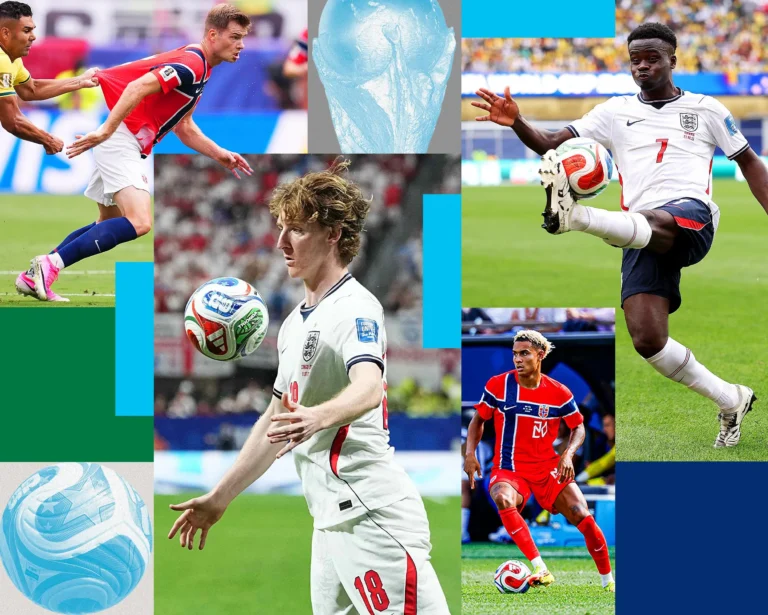
As England prepares to face Norway, the spotlight will undoubtedly shine on Harry Kane and Erling Haaland, whose presence on the pitch is assured. Both players are likely to find the back of the net, but the real intrigue lies in the selection of wingers by Thomas Tuchel and Ståle Solbakken.
Throughout the summer, neither team has fielded the same starting wide forwards, creating an air of uncertainty. For England, Anthony Gordon and Marcus Rashford have taken the left side, while Arsenal’s Noni Madueke and Bukayo Saka have occupied the right.
“All four of the wingers are competing against each other at the highest level,”
Tuchel remarked following the opening match against Croatia. The competition is intense, as none of the quartet have played more than 57% of the available minutes during the World Cup or made more than three starts out of five matches.
Tuchel appears to be grappling with his preferred duo, experimenting with five of the potential six combinations, with Gordon and Rashford not paired due to their shared preference for the left flank. His in-game choices have likely been influenced by the match score, leading him to substitute his wide players earlier in each game.
Jarell Quansah’s red card during the match against Mexico had significant implications. Following the defender’s sending off in the 54th minute, Saka was replaced, resulting in England adopting a wingless formation.
A noticeable trend has emerged: in England’s last three outings, the starting wingers were those who finished the previous match. This strategy may reflect Tuchel’s tactical adjustments based on the style of play required against specific opponents.
Gordon has emerged as a key player, leading the squad in average ball carry length at the World Cup with 14.9 meters, while Madueke tops the list for total distance carried per 90 minutes, reaching 255.8 meters. Rashford stands out as the leading England winger for carries of at least five meters that culminated in a shot, netting one against Croatia.
Saka has also made his mark, creating more goal opportunities after carries than all but two players in the tournament, one of whom is Norway’s own Andreas Schjelderup. Schjelderup’s only start came when Solbakken made ten changes for the final group stage match against France. He assisted Haaland for both goals in the game against Brazil, potentially securing his position in the lineup against England.
Solbakken has taken a more structured approach to utilizing wingers compared to Tuchel. The pairing of Antonio Nusa and Alexander Sørloth began three of the four matches considered as ‘first-team’ fixtures, while Schjelderup and Oscar Bobb completed each of those encounters.
Notably, all four assists from these players originated from the left side, making it crucial for whoever plays as England’s right-back to disrupt the supply to Haaland.
Norway’s defense faces a multifaceted challenge in countering threats from the flanks, although their primary objective remains the same: neutralizing one of the world’s top strikers. While Kane and Haaland may steal the headlines, the effectiveness of their respective wingers could ultimately determine the match’s outcome.
- World Cup 2026
- Norway
- England
- World Cup
- features