


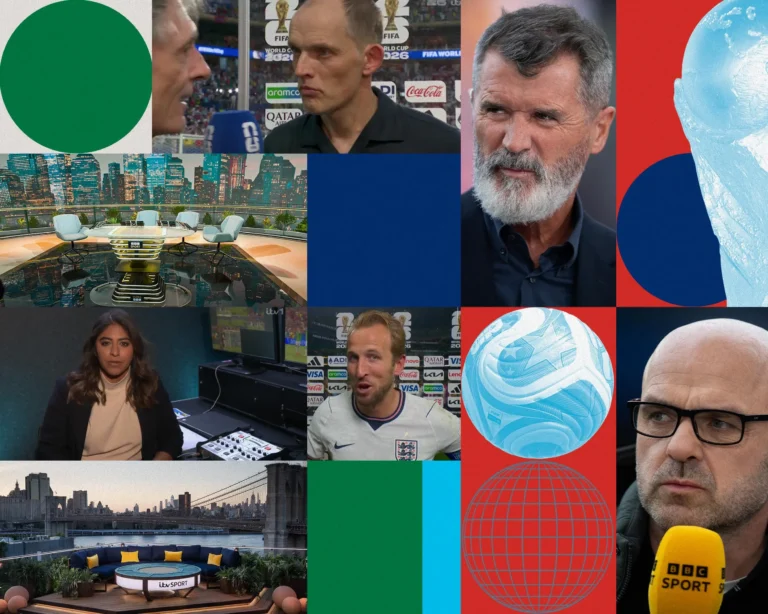

The anticipation for the World Cup final may center on a potential clash between Argentina and Spain, but media enthusiasts in the UK recognize that the real competition lies between the BBC and ITV. As the tournament unfolds, the question remains: which broadcaster emerged victorious across key metrics?
Broadcasting Locations
In preparation for the event, the BBC opted to forgo a physical presence in the United States, instead utilizing a digital studio to create the illusion of broadcasting from iconic locations within the host cities. This decision was a clear indication of their budget constraints. In contrast, ITV established its base in New York, allowing their analysts to present from a location that felt more integrated with the tournament, despite being distanced from the actual games taking place in Mexico, Canada, or the US west coast. Ironically, as soon as the BBC finally sent a team to the US, England’s campaign came to an abrupt end. Winner: ITV
Punditry Analysis
ITV showcased an impressive roster of pundits, featuring notable figures like the famously critical Roy Keane and the engaging Ange Postecoglou, particularly during Australia’s matches. Jobi McAnuff impressed, though he found himself relegated to late-night coverage, and the lively Ian Wright remained a favorite among viewers. ITV even managed to recover from an early misstep involving Emma Hayes, who was humorously dubbed as being placed in the “we don’t have the money we used to”
On the other hand, the BBC struggled to adapt their lineup following Gary Lineker’s departure. Their choice of pundits lacked the same impact, with Micah Richards eliciting mixed reactions from viewers. Among them, former England goalkeeper Joe Hart stood out, while Alan Shearer and Wayne Rooney often appeared as uninspired as an England defense facing Argentine attackers. Winner: ITV
Commentator Performance
Viewers frequently question how certain commentators, alongside former players, are compensated to deliver commentary during significant matches while appearing disinterested and somewhat resentful—this phenomenon has been termed the Mark Lawrenson syndrome. Both Jonathan Pearce (BBC) and Lee Dixon (ITV) fell into this category, contrasting sharply with the invariably enthusiastic Ally McCoist. Ultimately, the BBC boasted a stronger commentator lineup, with Guy Mowbray proving to be a significantly more pleasant listen than Sam Matterface. Winner: BBC
Post-Match Interviews
Post-match discussions on both channels drew attention for vastly different reasons. Harry Kane’s struggle to speak following England’s victory over Mexico at the Azteca provided one of the most amusing interviews for the BBC, one that has since become endlessly remixable. Meanwhile, Gabriel Clarke’s actions after England’s quarter-final against Norway on ITV received criticism. His direct relay of Thomas Tuchel’s critique to Jude Bellingham reopened tensions that had previously existed between the player and his coach. Winner: BBC
Refereeing Insights
Christina Unkel’s contributions for ITV outshone those of Darren Cann for the BBC by a significant margin. Unkel presented her insights clearly and concisely, while Cann’s analyses were often riddled with caveats, rendering them less impactful. Winner: ITV
Theme Music and Titles
Neither broadcaster’s theme music could compare to the iconic