


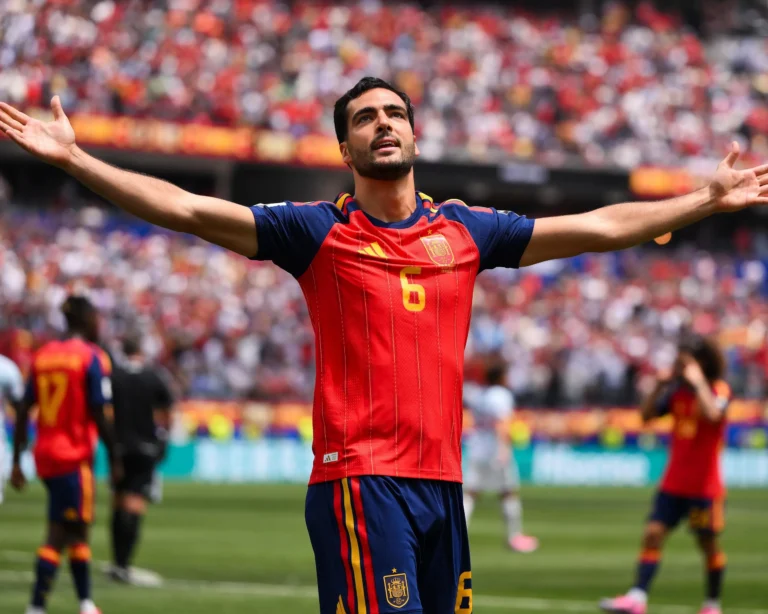
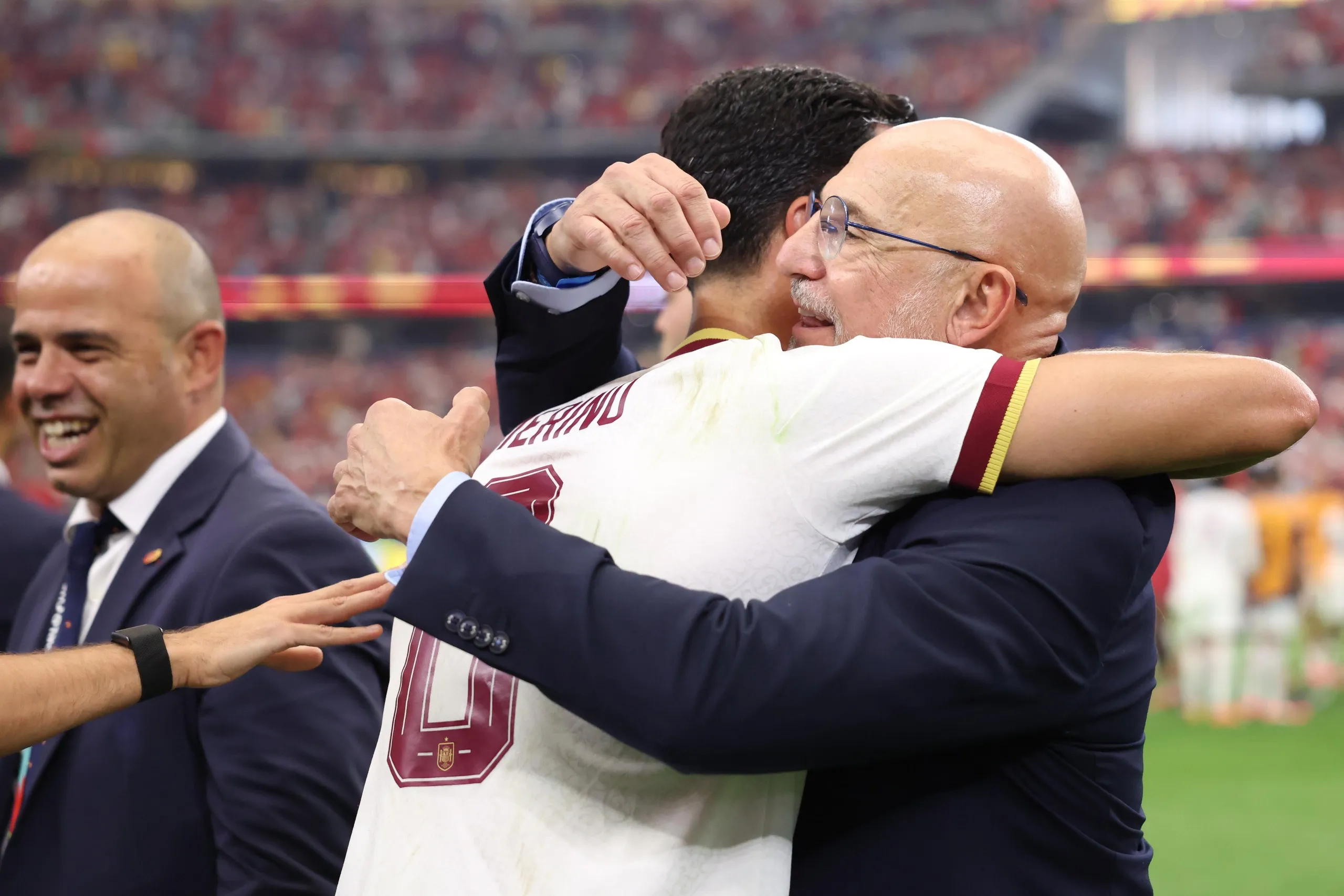
“I look behind me and I see Mikel Merino and I think: ‘I’m calm as can be,’” remarked Luis de la Fuente, as the tension of the match eased. While others may have felt their heart rates spike, the Spain coach maintained his composure. In crucial moments when the clock is winding down, De la Fuente’s demeanor seems to instill confidence in his players, especially in the case of Merino.
On the eve of Spain’s quarter-final clash against Belgium, De la Fuente shared a humorous memory of his childhood. He recalled how only three television events brought his family together: the national team’s matches, Eurovision, and the delightfully absurd game show Un, dos, tres, which had a British counterpart known as 3-2-1. Having witnessed Spain falter at the quarter-final stage multiple times in the past, his laughter contrasted sharply with the gravity of their current situation.
Spain encountered that familiar obstacle again the following day. Despite dominating possession with 68% and outshooting Belgium significantly, the score remained level at 1-1 as the minutes ticked away. In moments of uncertainty, the specter of past failures loomed large, threatening to derail their efforts.
Yet the team pressed forward with determination, seeking a decisive goal without succumbing to panic. Their approach was methodical, marked by a sense of clarity and calm that emanated from the sidelines.
Merino’s presence on the field certainly bolstered that sense of assurance. He has a knack for scoring crucial goals for Spain during major tournaments, netting three in total: one at Euro 2024 and two in this World Cup, all coming as a substitute and all in dramatic fashion at critical moments. Specifically, his goals came in the 119th, 90+1, and 88th minutes, showcasing his flair for the dramatic.
Each goal has been celebrated in a heartfelt manner, as Merino honors his father by circling the corner flag, a gesture reminiscent of his father’s own celebration after scoring a winner for Osasuna 35 years ago. Notably, Merino scored the decisive goal against Germany in the same stadium where his father had triumphed, further linking their legacies. In recent matches, his father, Ángel, was present in Dallas, proudly donning novelty socks emblazoned with an image of Mikel’s earlier goal.
Having played just under two minutes, Merino’s brief appearances against Portugal and Belgium were enough to propel Spain into the quarter-finals and then the semi-finals, marking only the second time the team has reached this stage since their 2010 championship victory. This achievement carries significant weight, as they had not won a knockout game at a World Cup since then.
“I don’t know how I’ll explain it to [my son]: luckily there’s YouTube and internet and I’ll be able to show it to him because it will be hard to do with words,” Merino reflected. “Since they weren’t there in the round of 16 I had to repeat it so they could live it in person. I’m very happy they are here because they are my strength and I am sure that part of the luck I have had in the ball falling to me is because of the good energy they have given me.”
However, Merino’s success is not merely a matter of chance. De la Fuente’s faith in him, despite the midfielder’s injury preventing him from playing for much of the preceding months, is a testament to his abilities. “Mikel is super complete, very versatile. He’s played as a 6, an 8, a 10 and a 9, and he does all of those things so well,” De la Fuente noted. “He can be the best striker, the best second striker, the best midfielder. Why? Because he has exceptional understanding, a feeling for what the team needs and a calmness. He has commitment, solidarity. “The story won’t always end this way. But you do know you’re closer to it because the players know what they have to do, and they’re very good.”
Looking ahead, De la Fuente is aware that not every match will conclude in triumph. Yet he remains optimistic, confident in his players’ understanding of their roles and abilities. “We’re not afraid of France,” he explained.
De la Fuente has made several bold decisions throughout the tournament, including substituting Pedro for Fabián Ruiz, a move that quickly paid off as Ruiz scored the opening goal shortly thereafter. His choice to remove Dani Olmo, who had been a standout performer in the previous match, raised eyebrows until Merino found the net again. The coach has consistently demonstrated a knack for making timely decisions.
After the quarter-final, De la Fuente emphasized that while assessing matches may seem easier in hindsight, his choices are always made with careful consideration. He draws from extensive analysis and a deep understanding of his players, implementing strategies with tranquility.
In a nod to his philosophical side, De la Fuente referenced a line from Marcus Aurelius’s Meditations, which contrasts starkly with the lighthearted memories of Un, dos, tres. His unwavering faith has fostered a sense of ease within the team, allowing them to embrace their role as favorites rather than shy away from it.
“It’s legitimate to think we can beat France; they’ll be as worried as we are.” stated Lamine Yamal. De la Fuente added: “I look at our players and feel calm,” Given their performances thus far in the tournament, France may not be particularly anxious.
“They appreciate that calm, too. If they saw me out of it, beside myself, histrionic, saying wild things, this team wouldn’t respond well to that. This is a team that has heart, the stimuli it responds to are understanding, affection and commitment. That’s what moves us.” De la Fuente concluded. “They appreciate that calm, too. If they saw me out of it, beside myself, histrionic, saying wild things, this team wouldn’t respond well to that. This is a team that has heart; the stimuli it responds to are understanding, affection, and commitment. That’s what moves us.”
If all else fails, there’s always Mikel Merino. What could possibly go wrong?
- Spain
- World Cup 2026
- World Cup
- features