


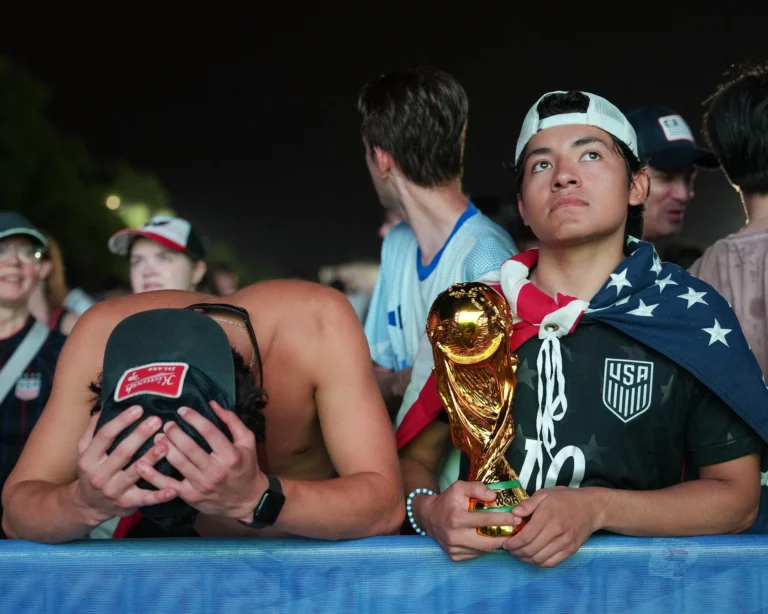
As the United States celebrated a thrilling 3-2 victory over Portugal during the 2002 World Cup, ESPN commentator Jack Edwards took a moment to emphasize the significance of the moment. From his vantage point in Suwon, South Korea, where the tournament’s journey began, he reflected on the historic nature of the achievement, which would ultimately see the US reach the quarter-finals—a pinnacle for the men’s national team.
Edwards passionately stated, “The players on that 1950 team that beat England … this [result] is about the foundation that they laid,” He continued, recognizing the efforts of families across America who have supported soccer through the years, and envisioned the children who would be inspired to chase their dreams after such a victory. “This is about the thousands of American families who have helped this sport grow, and the people in those pockets all over the country who have stuck with soccer. And it’s also for those seven- or eight- or nine-year-old kids, who are going to hear about this result when they wake up in the morning and rush outside, and knock a ball against a wall, and dream of something even greater than this.”
That speech resonated with me throughout this year’s World Cup. It echoed in my thoughts as I witnessed the vibrant displays of red, white, and blue across the West Coast on matchdays. The sentiment struck a chord with me whenever impressive television ratings were reported. I found myself reflecting on it each time I observed groups of eager children alongside their parents, hoping for autographs or simply a moment with their soccer heroes.
In those moments, I couldn’t help but ponder: When will these children experience their own moment of inspiration? Who will be the catalyst for such an event? How will it manifest? The prospect of the opposite scenario had not fully sunk in until now.
What must those young fans have thought after witnessing the US team’s disheartening 4-1 loss to Belgium? What conversations ensued among soccer enthusiasts who had finally convinced their friends to join them for this pivotal match? The families Edwards mentioned—how did they feel? One moment, they were filled with optimism, believing they were on the cusp of a breakthrough, and the next, they faced disappointment.
What motivation could be derived from the team’s lackluster performance? The disorganized offensive plays, missed defensive duties, and the overall absence of composure at critical moments left much to be desired. The disparity in skill and strategy compared to a formidable Belgian squad was alarming. Meanwhile, international fans and analysts celebrated the US team’s downfall.
While the viewing figures for Monday’s match are still pending, it’s worth noting that during a previous primetime broadcast, a record 31 million viewers tuned in. On Monday night, millions—likely tens of millions—were potentially experiencing their first encounter with the US men’s national team, and their initial impression was of a squad unprepared for the challenge.
These viewers were not the long-standing supporters that Edwards described. However, they were likely aware of what it means for a team to compete against a top-tier opponent. They witnessed Mexico, despite their flaws, fiercely battle England. They observed Cape Verde’s brave exit against Argentina, as well as the US’s earlier matches in this World Cup—such as the surreal 4-1 victory over Paraguay and the efficient 2-0 win against Bosnia and Herzegovina.
The upcoming 2026 World Cup was meant to herald a bright future for the US men’s national team program. Yet, the illusion created by this tournament may ultimately reflect a harsh reality: we find ourselves back where we started—performing well against teams we are expected to defeat but still searching for that elusive breakthrough against stronger opponents.
Numerous analyses will emerge regarding the reasons behind the US team’s shortcomings on Monday. However, I am left with a daunting conviction: the United States has squandered the most significant opportunity for growth in American soccer’s history.
What are the consequences when a new wave of potential fans—a living testament to a unique home World Cup—are confronted with something worse than disappointment: utter inadequacy?
We may soon discover the answer.