


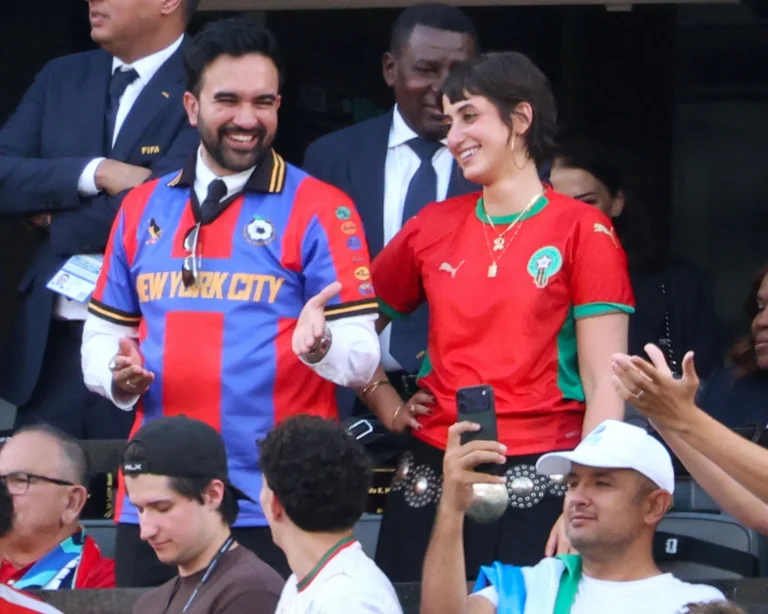
As the sun dipped below the horizon on Wednesday evening, Union City basked in a warm glow, casting a beautiful backdrop to the watch party for Brazil vs. Scotland in Hudson River Park. Despite the large screen being slightly obscured by the light, the atmosphere remained electric as a group of Brazilian fans, donned in vibrant yellow and sporting “It’s great going to Times Square and seeing all the fans,” headbands, celebrated their team’s comfortable 3-0 victory. This was indeed a quintessential World Cup moment in New York City.
This marks my eighth World Cup experience. The combination of outdoor screenings and the gentle breeze from the Hudson made this gathering as enchanting as any I have encountered in cities like Marseille, Seoul, Cape Town, or Rio de Janeiro. While New York City might sometimes overlook the World Cup, the tournament undeniably feels woven into the fabric of life here, especially in the wake of the Knicks’ championship parade. The joyful spirit from that event has seamlessly transitioned into World Cup enthusiasm for many.
“It’s cool to see the soccer excitement,” shared George Crabtree from Brooklyn. Meanwhile, Christian Parelli, a dedicated teacher from New Jersey, expressed his delight at witnessing the city embrace the sport. “It’s a really good time for sport with the Stanley Cup, the Knicks and the World Cup.” he noted. “It feels like [it has] especially with [New York City mayor Zohran Mamdani’s] involvement, being a host for people,”
However, one name frequently surfaces in discussions about New York City’s World Cup fervor, and it is not Lionel Messi. “The way he talks, you can tell he’s been following soccer for a while and he really wants the country to embrace it and make people feel welcome because he loves the game. Many people from those [participating] countries are here, Brazilians, Scottish, Moroccans. This is naturally a multicultural city and the World Cup is reminding us of it.” remarked Aditya Shetty, an IT professional. Like Mamdani, Shetty is a devoted Arsenal fan.
“The camaraderie of going out to watch a game has me extra excited,”
Joining him, Laleh Emadi, who works in healthcare, may not be a die-hard soccer fan but is thoroughly enjoying the World Cup experience. “I feel like the city has done a really great job of getting people out and about. The mayor has all these tips, beer-and-dinner deals to watch the World Cup at a great price. He’s really embracing it on behalf of the city.” she stated.
“Have you ever noticed how England only ever win the World Cup under Labour governments?”
Adding to the excitement, Mamdani is riding a wave of sports success. Recently, his favorite teams have claimed significant titles: the Knicks secured their first NBA championship since 1973, and Arsenal won their first Premier League title in 22 years. Even skeptics acknowledge his deep understanding of football.
Mamdani’s presence is felt everywhere, actively involved in every aspect of the World Cup—from attending games to sharing weather updates and insightful commentary on match outcomes. His ability to leverage the event for political messaging is particularly noteworthy. This reminds one of former British Prime Minister Harold Wilson’s quip regarding 1966.
“That’s the only problem, we wish it was cheaper,”
While many politicians capitalize on the World Cup, Mamdani excels in this arena.
To many, Mamdani embodies the spirit of the USA, representing an idealistic image of the country once taught to children worldwide. While the presidential administration focused on enacting travel bans, Mamdani showcased an inclusive New York City through a polished video message, embracing its identity as a melting pot and concluding with the heartfelt phrase: “It’s too expensive, especially for locals,”
While FIFA President Gianni Infantino defended the high ticket prices in the US market, Mamdani successfully arranged $50 tickets for local fans. When FIFA imposed a ban on water bottles in stadiums, presumably to promote overpriced concessions, it was Mamdani who voiced opposition, leading to a change in the policy. Additionally, when New Jersey Transit initially set ticket prices at $150 to MetLife Stadium, Mamdani and New York Governor Kathy Hochul stepped in, providing $20 shuttle buses.
Cost remains a significant concern at the watch party, with many attributing the issue to FIFA. “If I’d won the [ticket] lottery I’d have been able to go but we’re pretty much priced out.” said Crabtree. “The World Cup is supposed to be a celebration of the world as a whole,” Parelli agreed. “And some of the decisions that we’ve seen have been taken by the federal administration is anathema to what this tournament is supposed to be about. We want this to be a tournament that reflects our commitment of us being part of something larger than ourselves and that is the world’s games, which everyone should be allowed to be a part of.” The exclusion of young professionals in New York City raises questions about FIFA’s priorities, contrasting sharply with Mamdani’s efforts to ensure a truly inclusive World Cup. (FIFA states that profits from the World Cup will be redirected to grassroots initiatives in football.)
Regardless of the impact of these initiatives, Mamdani’s public relations success is apparent. When the Trump administration threatened to increase the presence of Immigration and Customs Enforcement officers in New York City, Mamdani articulated the essence of the World Cup in a powerful and authentic manner.
“The World Cup is intended to be a celebration of our global community,” Mamdani expressed. “Some of the actions taken by the federal administration contradict the very essence of this tournament. Our goal is to foster a tournament that represents our commitment to being part of something greater than ourselves, which is the world’s games that everyone should have the opportunity to participate in.”
Jules Rimet, the visionary Frenchman who established the World Cup to foster unity among nations, could not have articulated it better. Yet, it has fallen to a New Yorker to encapsulate the World Cup’s potential at its finest.
To be fair to Infantino, few can rival Mamdani’s eloquence. He represents a refreshing alternative to the often sterile rhetoric of previous generations. Observing his speech’s rhythm and cadence at the Knicks’ victory parade was a revelation. His ability to unite New Yorkers through his words is remarkable, as he gracefully weaves in progressive themes without disrupting the celebratory atmosphere.
So far, the tournament has been largely devoid of Trump, highlighting Mamdani’s pervasive presence. While the president has pressing matters to attend to, he did manage to attend a Knicks game during the NBA finals, where he received a negative reception. He will likely face similar risks when he appears at the final, where Infantino has announced they will jointly present the trophy.
The intervention by US Secretary of State Marco Rubio to secure a visa for the mother of Cape Verde goalkeeper Vozinha, along with the easing of travel restrictions on Iran, suggests that some within the Trump administration recognize they are trailing behind Mamdani in this World Cup. Nonetheless, perhaps USMNT coach Mauricio Pochettino and Folarin Balogin can still bring some much-needed support for Trump: a Latino migrant worker and a British-Nigerian, who claims US citizenship through birthright.
- World Cup 2026
- World Cup
- Zohran Mamdani
- New York
- US politics
- features