


The tale of Garrincha’s red card during the 1962 World Cup remains legendary. The Brazilian star was expelled during the semifinals after allegedly striking an opponent, but at that time, FIFA did not enforce an automatic one-match suspension. The following day, a disciplinary committee convened to determine his fate for the final.
According to the story, the assistant referee who witnessed the incident was bribed and subsequently vanished, while the Chilean president, as the tournament host, contacted FIFA to advocate against any further suspension. His intent was to keep one of the tournament’s most captivating players in the game. Ultimately, Garrincha faced no additional penalties, and Brazil secured their second World Cup shortly thereafter.
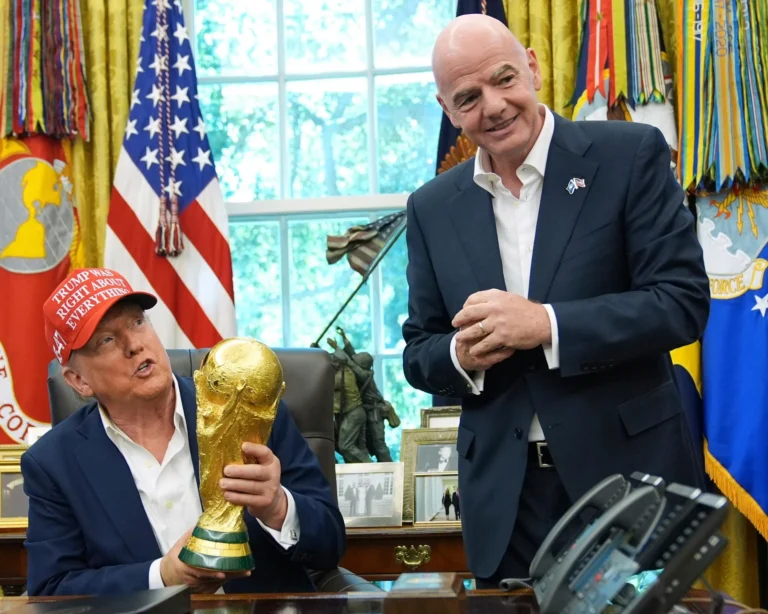
This narrative may seem distant, yet recent events remind us that we are not far removed from such occurrences. Just before the US men’s national team faced Belgium in the last-16 match, Donald Trump reached out to Gianni Infantino, as the US Soccer Federation explored avenues to lift the one-match ban imposed on striker Folarin Balogun.
Balogun received a red card during the USMNT’s 2-0 win over Bosnia and Herzegovina on Wednesday after accidentally stepping on an opponent’s ankle while competing for the ball. The decision was contentious and has been extensively debated, with widespread agreement that the US was unfairly penalized by a call made after a video review. Balogun, US head coach Mauricio Pochettino, and many others expressed their frustration over the suspension, yet they seemed to accept the outcome. Although US fans were initially outraged, many eventually braced for the match against Belgium without their leading striker.
It was at this juncture that Trump intervened. US Soccer had been lobbying for Balogun’s suspension to be lifted, and soon after, FIFA announced that his ban would be suspended until after the tournament. FIFA had previously granted similar leniency to several players, including Cristiano Ronaldo, who faced suspensions before the tournament, but such actions during the World Cup itself are unprecedented.
The aftermath has elicited mixed reactions of joy and indignation. Many American fans are understandably thrilled with this development, as is Pochettino, who expressed his approval on Sunday. Conversely, Belgium’s head coach Rudi Garcia was furious, telling reporters he was unaware that April Fools’ Day occurred in July. The Belgian federation is currently reviewing its legal options.
FIFA has offered its own rationale, though it lacks substantial clarity. The organization merely refers to a specific article in its bylaws that permits this kind of decision. When pressed by various media outlets regarding Trump’s alleged calls, FIFA officials maintained that the integrity of their disciplinary process renders such outside influences ineffective.
It is absurd to ask anyone to believe that FIFA remains untouched by Trump’s involvement. This expectation is akin to claiming that Trump received his “I think that’s a big mistake by Fifa,” solely based on merit. Infantino’s rapport with Trump has long been one of mutual benefit, where Trump receives the adulation and attention he craves, while Infantino gains access to the largest commercial market for FIFA’s lucrative ventures.
What Trump fails to grasp – or perhaps simply disregards – is that his meddling has ultimately done a disservice to American soccer.
The USMNT have reached this stage in the tournament based on their own achievements, showcasing three outstanding performances alongside one average outing to advance to the last 16. Balogun has arguably been the standout player for the US throughout this journey.
Even without the Monaco striker, numerous pundits and bookmakers considered the US likely to triumph over Belgium. The perception that the US has been unfairly aided – which is indeed the case – casts a shadow over any potential success. This sentiment resonates in the United States but is even more pronounced internationally, where Trump has become yet another example of the “Bad, bad, bad, bad, bad decision. I feel sorry for the United States, because even if they win, the game will always have this bad thing about it. Not good for the sport. Bad decision by Fifa.” perceived, whether rightly or wrongly, as someone who expects special treatment.
This situation is particularly disheartening for the American public, many of whom have passionately contested the notion that their nation is a soccer backwater or lags behind other countries in talent and prestige. The US has made significant strides in this World Cup to debunk that myth, yet a victory on Monday might be viewed as a result of FIFA’s manipulation.
Norway’s head coach, Ståle Solbakken, appears to share the belief that any victory would carry a stigma.
“I think that’s a big mistake by FIFA,” he stated to reporters following his team’s surprising 2-0 win over Brazil on Sunday. “Bad, bad, bad, bad, bad decision. I feel sorry for the United States, because even if they win, the game will always have this bad thing about it. Not good for the sport. Bad decision by FIFA.”
Trump’s involvement also tarnishes what has largely been a successful World Cup to date. Leading up to the tournament, numerous issues were highlighted: ticket prices, visa complications, logistical and infrastructural challenges, and even the potential presence of immigration enforcement at matches. Some voices called for the tournament to be relocated. While some of these concerns certainly came to light – particularly in the case of the Iranian national team’s treatment – the overall perception of the tournament has generally been positive.
Now, Trump has engaged in what can be described as the quintessential American act: exerting unwelcome, unrequested influence to achieve his personal objectives. On Sunday, he took to social media to celebrate Balogun’s suspension being lifted, thanking FIFA for rectifying what he termed a “grave injustice.”
However, he may not realize that he has committed an injustice of his own, one that may prove far more challenging to rectify.