


The comic strip Calvin and Hobbes features a whimsical game called Calvinball, where rules are ever-changing and often nonsensical. Players may encounter bizarre elements such as a “competitions starting before that date may implement the changes earlier or delay their implementation until no later than the start of the next competition” and the score can be whimsically noted as “when a player is shown a yellow/red card but the offence for which the card was shown was committed by another player of either team” This playful chaos mirrors the current state of refereeing in the World Cup, where Fifa’s inconsistent regulations have left fans and officials bewildered.
During the early years of Major League Soccer, the term Calvinball was used derogatorily as the league grappled with complex player acquisition issues. Salary-cap regulations were often enforced inconsistently; for instance, if the colorful Jorge Campos desired a Ferrari while in Los Angeles, the league would accommodate him. Similarly, teenage sensation Freddy Adu entered the draft but was ensured a spot with DC United due to family preferences.
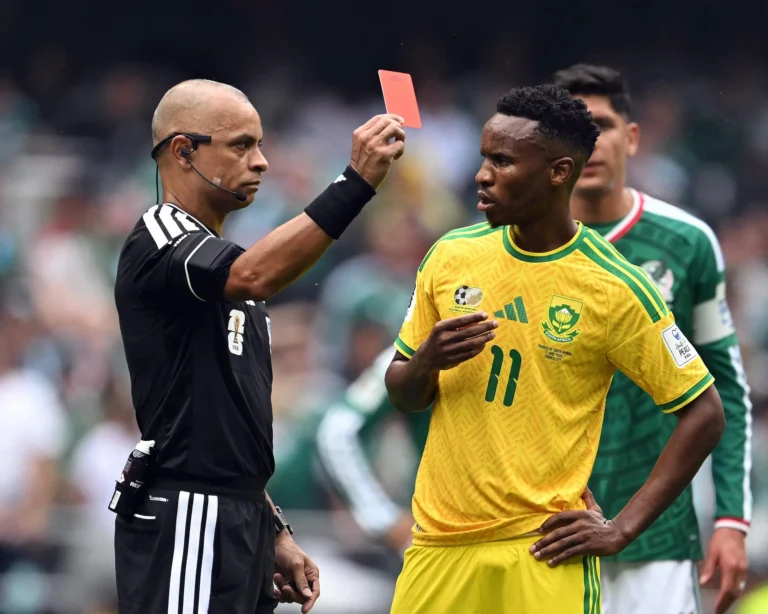
World Cups, even those not marred by controversies like the recent red card rescinding of a host nation’s star player, evoke a sense of Calvinball. The convergence of diverse teams and referees often leads to varying interpretations of rules. A foul deemed obvious by European officials may elicit indifference from referees from different regions.
Fifa exacerbates this confusion by mandating that new rules take effect during the World Cup rather than after its conclusion. While Fifa only holds half the voting power at the International Football Association Board, it can decide when to implement rule changes. This year, new laws were officially introduced on July 1, but since the World Cup qualification process began prior to that date, Fifa’s insistence on immediate enforcement of untested laws seems unnecessary.
Some changes are straightforward; for example, the implementation of five substitutions instead of three in 2022 was clear-cut. Similarly, goalline technology, which had been trialed before the 2014 World Cup, was easy for fans to understand.
However, some alterations introduced at the World Cup have profound implications, often catching fans by surprise. VAR technology made its debut in the 2018 World Cup, preceding its adoption in major European leagues, and seemingly minor rule changes can dramatically alter game outcomes.
Consider Paraguay’s Miguel Almirón, who fell during a match against the USA, leading to a yellow card for defender Tim Ream. Previously, standard fouls weren’t subject to review, but under the revised laws, the “covering their mouth when communicating with an opponent in a provocative, derisory or inflammatory manner or situation” clause now allows for review if a player is incorrectly carded for another’s infraction. Consequently, Almirón’s deception resulted in Ream’s yellow card being rescinded, and he himself received a booking for simulation.
In the quarter-finals, Breel Embolo of Switzerland faced a similar fate when a yellow card issued to Argentina’s Leandro Paredes was later overturned, resulting in Embolo’s ejection and leaving his team with ten players in a crucial match.
The changes concerning mistaken identity were outlined in an Ifab circular following their annual meeting in late February, and a subsequent meeting added further adjustments, including a new offense for players who cover their mouths when communicating provocatively with opponents. Almirón’s actions in Paraguay’s second game led to his dismissal, prompting a fiery outburst from a commentator.
Moreover, recent modifications have opened doors to misinterpretation. For example, players must exit the field within ten seconds of being signaled for a substitution, but this can lead to questionable excuses for prolonged departures, such as feigned injuries.
Referees are tasked with assessing whether to allow play to continue for minor injuries or to halt the game for serious ones. Throughout the tournament, there have been numerous instances where play continued while injured players remained on the ground, leaving both teams and officials in a state of confusion. The traditional sportsmanship of returning the ball to the opposing team after an injury is increasingly rare.
Some laws appear to have been forgotten entirely. For instance, players who remove their shirts in celebration receive a yellow card, even if the goal is disallowed, yet Egypt’s Mostafa Ziko did not receive a card after scoring against Argentina, despite the goal being ruled out later.
This World Cup has also seen a lack of enforcement regarding protocols for halting matches due to homophobic chants from the stands. Mexico faced penalties in the past for similar issues, yet despite the chants being audible enough to evade broadcaster censorship, no warnings or fines have been issued.
While officials overlook blatant infractions, they have been overly meticulous about others. Croatia’s equalizer against Portugal was disallowed after a sensor indicated that Igor Matanovic had made contact with the ball, despite teammate Josko Gvardiol being onside at the moment of the pass. The ruling: no goal. Had Matanovic sported a different hairstyle, the outcome might have been different.
Such contentious decisions have led many fans to question the very existence of VAR. However, the technology itself isn’t the issue; the challenge lies in human judgment. For instance, the initial ruling against USA’s Folarin Balogun sparked ongoing debate, with the crux being whether the laws of physics should take precedence over game rules.
Ultimately, Fifa and Ifab must prioritize clear communication regarding the laws of the game. The handball regulations, having undergone numerous revisions, have become convoluted, akin to a game of telephone where the original message is lost in translation.
Perhaps it’s time for Fifa to reassess the proliferation of rule changes during a globally televised event, as the resulting confusion continues to grow.
- World Cup 2026
- World Cup
- Video assistant referees (VARs)
- comment