


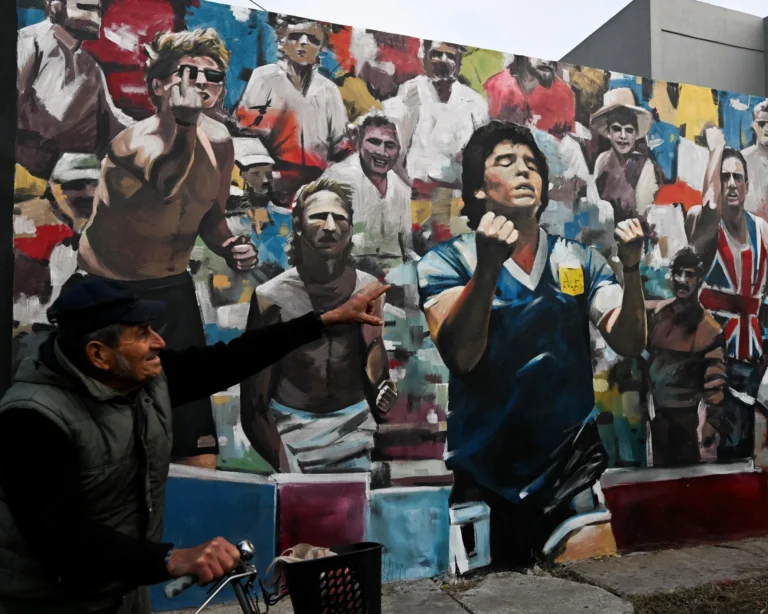

The essence of football rivalry can often be layered, as illustrated by the ongoing tension between England and Argentina. On a recent Sunday, a match between Godoy Cruz and Defensores de Belgrano in Argentina’s Nacional B featured two St George’s crosses, seemingly appropriated from English supporters during the 2014 World Cup. One flag read: “Boys & Girls From Oakwell Barnsley.” while the other said: “Big Al – Y-Bird – South Croydon – CPFC.”
Consider the effort and animosity required to travel to Brazil, retrieve an English flag, preserve it for a dozen years, and then display it during a second-tier match in Argentina, coinciding with England’s World Cup semi-final. This showcases a football rivalry that is anything but trivial.
This rivalry evokes themes extending beyond mere animosity: war, culture, colonialism, nationalism, and shared history. It reflects a unique connection that time has only intensified rather than diminished. While many label Argentina versus England as a mere “For the Malvinas, for Diego, for Leo’s last one,” the reality is far more intricate; it embodies a complex interplay of attraction and repulsion, which exists alongside a long-standing kinship. While our differences are significant, they serve to highlight the shared elements that bind us.
One aspect often overlooked is Argentina’s deep cultural ties to England. Unlike Brazil, which is often viewed as a vibrant, exotic paradise, Argentina has historically been perceived as a loyal offshoot of the British Empire, referred to as its “Very early, an Argentinian way of playing football was born that clearly distanced itself from the English influence,” The influence is evident in everything from place names to the establishment of rugby and polo clubs by colonial elites. The only overseas branch of Harrods operated in Buenos Aires from 1912 until 1998, and English rock bands like The Smiths and The Cure enjoy greater popularity in Argentina than in many other comparable nations.
This connection translates into the footballing realm, evident in club names like Newell’s Old Boys, River Plate, and Arsenal, as well as colloquial terms such as “We tried to be antagonistic to the English. If they liked long passes, we favoured shorter ones. If the English favoured passing, we’d focus on dribbling. Against England, there was something else at stake, and at the time it was worth more than the championship.” (a star player) and “Whirling their shirts around, banging on the window. Just a bunch of idiots.” (offside). In amateur matches, captains would traditionally shout “aurieli?” (are you ready?) at the start. The shared elements of football culture are striking, reflecting local traditions and military motifs. For many Argentinian fans, the Falklands War occupies a similar emotional space as the Second World War does for the English, evident in banners, murals, and even tattoos, and referenced by players on the field.
“For the Malvinas, for Diego, for Leo’s last one,” the Argentine team sang in their locker room following their quarter-final victory against Switzerland. Rodrigo De Paul even donated his framed shirt from the 2022 World Cup to a veterans center in Lomas de Zamora. This sentiment towards football as a means of asserting identity has roots that predate the 1982 conflict, tracing back to a postcolonial awakening that emerged in the mid-20th century under Juan Perón, where football became a vehicle for rejecting English dominance.
“Very early, an Argentinian way of playing football was born that clearly distanced itself from the English influence,” reflected Jorge Valdano, who played in the notable 1986 World Cup quarter-final against England. “We tried to be antagonistic to the English. If they liked long passes, we favored shorter ones. If the English preferred passing, we focused on dribbling. Against England, there was something else at stake, and at the time it was worth more than the championship.”
Over the years, this sentiment has been reciprocated, though not on equal footing. Once viewed as a favored child, Argentina’s shift toward independence may have sparked bitterness in England. A heated friendly at Wembley in 1974 saw fans chanting “animals” every time Argentina touched the ball, echoing accusations made by Alf Ramsey eight years prior. By 1986, Jimmy Greaves was making jokes about the Falklands during ITV’s World Cup coverage, proudly waving a German flag ahead of the final against West Germany. Sol Campbell criticized the 1998 team, stating, “Just no class at all,” after they eliminated England in Saint-Étienne.
However, unlike many sporting rivalries that become commodified and diluted by commercial interests, the England-Argentina rivalry has retained its authenticity through scarcity. Since 2002, the two countries have not faced each other in competitive play, and while Argentina’s impact on English football is limited, it remains significant. We have seen players like Ossie Ardiles and Sergio Agüero, but never the likes of Gabriel Batistuta or Juan Román Riquelme, and we experienced Mauricio Pochettino without ever encountering Diego Simeone. The two titans of football, Lionel Messi and Diego Maradona, still feel elusive, like a mystery we were never fully privy to.
Too different and distant to forge a friendship; yet too intertwined to be mere adversaries, the England-Argentina clash transcends a simple narrative of colonizer versus colonized. This complexity may be why Argentina versus England can be regarded as one of the most enchanting and storied rivalries in football, characterized more by a chaotic, ongoing separation than a bitter feud.
When we look beyond the memorable conflicts, we uncover deeper sentiments at play. The outward aggression can be interpreted as a mark of respect, revealing a shared admiration that perhaps resembles a love that dares not speak its name.
- World Cup 2026
- Argentina
- England
- World Cup
- comment