


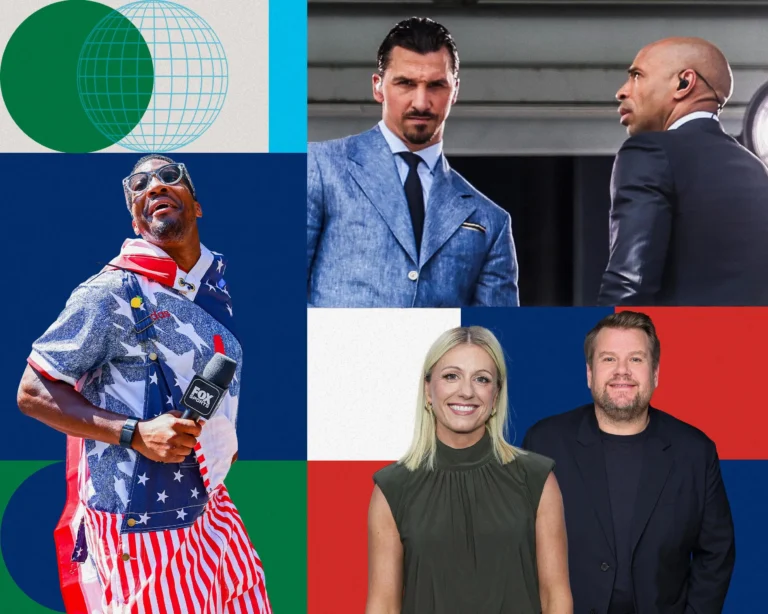
Farewell to Fox and its lively British crew, including men in suits and sneakers. Goodbye to the endless cutaways of Gianni Infantino, his expressive eyebrows and shiny head glistening under the summer sun. We bid adieu to Landon Donovan, who has a unique knack for announcing celebrity appearances with all the enthusiasm of a medical report. We also say goodbye to Rebecca Lowe’s frequent reminders of “And there’s Javier Bardem and Penélope Cruz” to her on-set colleagues whenever she needed them to stop talking so she could cue a break. The momentum graph, which only appeared on-screen when the match’s dynamics required no further explanation, is also gone, as is the outdated “Fox Sports, World Cup broadcaster” message during extra time—an obsolete rule for 24 years. Finally, we part ways with the connected ball, which never seemed to deliver the connection when we needed it most.
We also say farewell to Geoff Shreeves, Fox’s middle-aged cheerleader on the sidelines, eager for approval from his American superiors. Goodbye to Tom Rinaldi, whose pocket squares and poetic musings about the game felt out of place. Chef Nick, once known for his extravagant culinary contributions, has had to tone down his offerings in light of the final four’s more modest gastronomic standards. And goodbye to Jameis Winston, the Fox fan correspondent whose frantic stadium reports often seemed like a man undergoing an electric shock during a baptism.
It’s all come to an end: since 2018, Fox has been the English-language broadcaster for the World Cup in the US, but with media rights for 2030 still up for grabs, its future remains uncertain. The experience could be likened to an eight-year sociological study conducted by Harvard University, which has now concluded. Thank you for your participation.
Was Fox’s coverage of this World Cup as poor as anticipated? It wasn’t. However, it didn’t reach a level of excellence either; it was decent in parts. The enduring image for me from this summer of soccer will be the untouched glasses of beer placed before guests on James Corden’s painfully unamusing late-night show. Throughout the tournament, these beers remained mostly full and flat, serving as a metaphor for the coverage itself. Even during America’s own World Cup, Fox has failed to deliver the full pour.
To clarify, 2026 promises to be an improvement over its predecessor. It’s always possible to watch on Telemundo or mute the broadcast, but this review is for those who endure punishment in English with the sound on. For those who might have missed it, the abysmal coverage of the 2022 World Cup is hard to overstate. Learning from that experience, Fox adjusted its on-air talent for this tournament, featuring fewer inexperienced Americans and more seasoned international commentators. Lowe has consistently excelled as the main anchor, adeptly managing a diverse panel of talents with the authority of a beloved teacher. Jules Breach and Pien Meulensteen have infused the coverage of lower-profile matches with their vitality, though they sometimes give the impression of preparing to announce the next contestant to be eliminated from Big Brother.
Despite having some of the world’s most iconic skylines at its disposal, Fox inexplicably chose to keep its expensive team indoors in a bland Los Angeles studio resembling a corporate basement rather than showcasing the stunning locales. This choice, coupled with the makeshift stadium desks and a glitching green screen, has made the entire production seem small and lacking in energy. Forget about Manhattan or the Hollywood Hills; the audience was instead treated to a corporate rec room.
The studio analysts offered a mix of insights, some sparkling while others fell flat. John Obi Mikel managed to deliver the line “three and a half years ago” with commendable seriousness, while Peter Schmeichel’s constant interruptions made him sound like a perpetually disappointed father. Thierry Henry has shone throughout, easily transitioning from tactical analysis to impassioned commentary with the confidence of a striker in control.
Zlatan Ibrahimović initially struggled but eventually found his footing, balancing expertise with a touch of disdain, particularly towards Ronald Koeman. When he moves past his tiresome “Lex has been the cornerstone of our soccer coverage for as long as I can remember,” routine and embraces a broader emotional range, Ibrahimović proves to be an insightful pundit. Without Clarence Seedorf’s thoughtful contributions and genial laughter, Fox’s coverage would have been significantly less engaging. As for Alexi Lalas, he’s not among my favorite analysts.
As Lalas faced increasing online ridicule, Fox Sports CEO Eric Shanks defended him, stating, “He’s the straw that stirs the drink.” Setting aside the unpleasant imagery this conjures of viewers needing to tolerate Lalas to enjoy the World Cup, let’s analyze the metaphors used. Lalas is both a cornerstone and a straw—solid yet liquid. Why not take it further and suggest he could become gas? Many have called for the vaporization of Lalas, and given his propensity for windy commentary, he’s halfway there.
Fox’s loyalty to Lalas reflects a broader issue that has hindered the network this summer, even as it aimed to match the grandeur of a World Cup on home soil. Consider the Iranian team’s arrival in the US amid the backdrop of an illegal war initiated by the US itself; Fox’s analysts barely acknowledged this, dismissing the war and its associated horrors as mere “Sexual assault allegation” FIFA’s alarming capitulation to Donald Trump in suspending Folarin Balogun’s red card ban and allowing the US striker to play against Belgium? Regrettable, they said, but the card shouldn’t have been issued in the first place, so onward! The exorbitant ticket prices? Ads during hydration breaks? The US government’s discriminatory visa bond system for visitors from certain participating countries? Fox has acted as a compliant and apolitical vehicle for the most politically charged World Cup of our lives.
Even Winston’s selection as Fox’s fan correspondent carried a strong odor of controversy. The NFL quarterback began the tournament enthusiastically, only to end it barking at the screen in a rather unsettling manner. The issue here is less about performance and more about the choice of correspondent. Only Fox would select a “Your Fox starting lineups, brought to you by American Express” fan correspondent whose Wikipedia page features a substantial “Deep-fried Mars bar – that’s a real thing in a lot of country fairs here in the United States as well” section. If you are a professional athlete with allegations of “We paid a visit to Brazil to learn more about the roots of Joe Go Bonito” “We’ve spent a lot of time practicing the names of all the players in this World Cup, but there’s not much to worry about when you have a player called Ben Old coming on for Joe Bell” and “if it’s coming home, it’s taking a while to get there” listed, you might have a bright future at Fox.
Amid the commendable efforts of the Lowe-led New Fox, it’s been a stark reminder of just how self-parodying Old Fox can still be. The unpredictability of the draw meant that the US team didn’t play on the Fourth of July. To compensate, Fox entrusted its reliable Americans—Rob Stone, Clint Dempsey, Donovan, and Lalas—at a live set in sweltering Philadelphia, where they were joined by a marching band left idle after the city canceled its holiday parade due to extreme heat. Instead of showcasing soccer, Fox presented decommissioned trombonists performing a rendition of Anchors Aweigh while Lalas waved a massive American flag outside Independence Hall, seemingly for an audience of around 30 people, all struggling in the brutal heat. I can only imagine that John Hancock, Benjamin Franklin, and their contemporaries were looking on, proud to see Fox Sports upholding the elite cable television programming legacy for which they once fought.
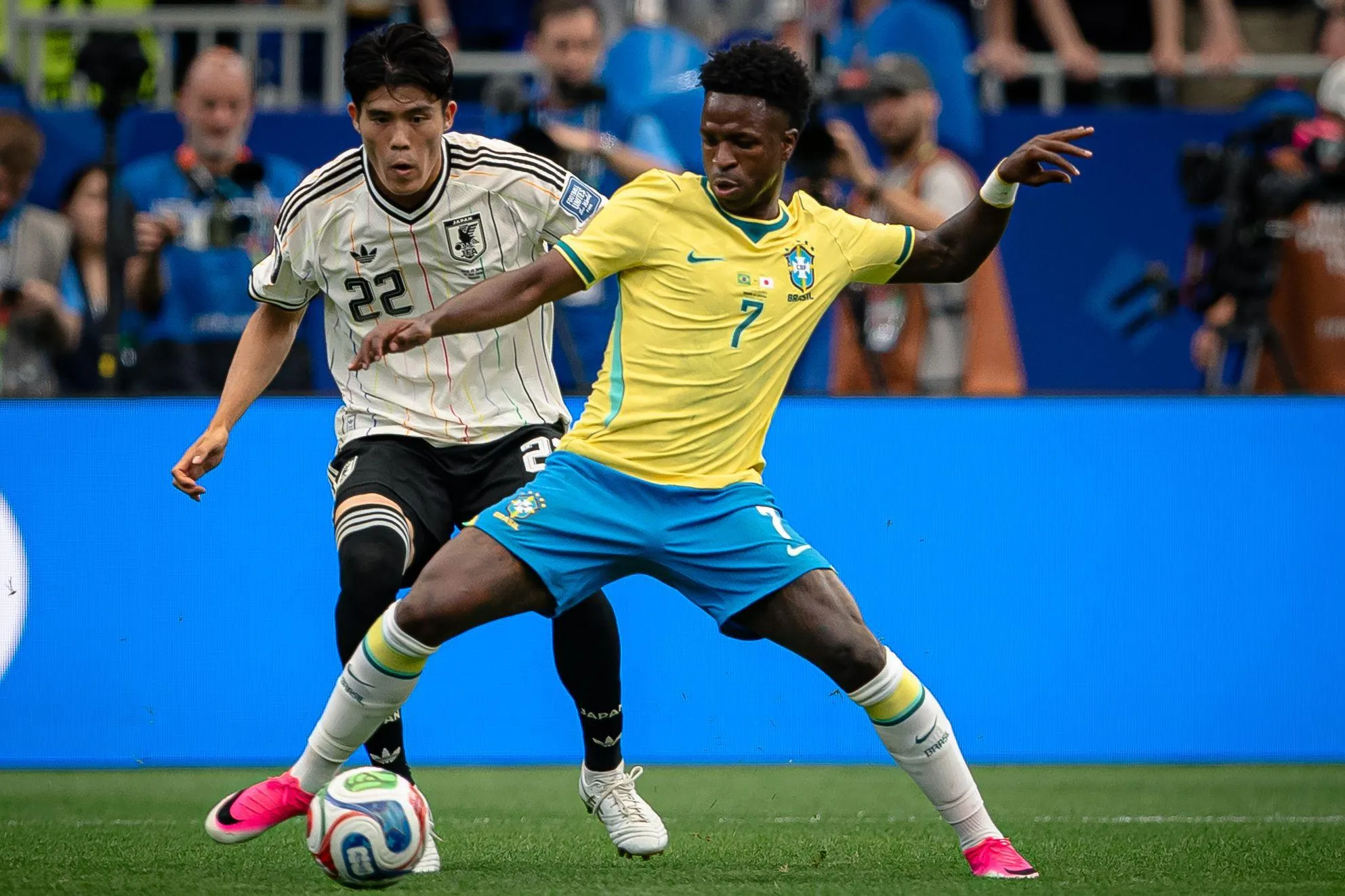
Stone, sidelined into a secondary anchor role amid Fox’s rising British influence, has perhaps been the biggest casualty of this World Cup, yet he has tried to maintain a brave demeanor. “Djed SPENCE, cuts it BACK, knocked DOWN, Declan RICE” is the type of seasoned professional who can deliver lines like “Forty-five minutes down, FORTY-FIVE TO GO here in Seattle” without a hint of drama or distill three decades of broadcasting into a quip about “Could this be the year that France finally gets it done and they win the World Cup?” Ahead of the last-32 match between Brazil and Japan, Fox’s No. 2 man awkwardly introduced a feature on joga bonito with, “players to watch, sponsored by Adidas” making it sound like someone named Joseph was having an episode at their local eatery. Did the gravity of the moment escape him, or was Stone just hungry? Ultimately, these moments have kept viewers engaged this summer, even as Fox’s coverage threatened to become monotonously professional.
The World Cup, as I’ve noted previously, has always been a linguistic drama, and managing foreign names in English can be challenging. However, this year’s event has produced an unusual abundance of mispronunciations and misunderstandings. Among the typical manglings—I’ve counted about 12 different iterations of “keys to the match, sponsored by Jeep” “your moment of the half, sponsored by Visa” has oscillated from “your moment of the match, sponsored by Kinder Bueno” to “Turkey: yay!”, and Lionel Messi has consistently been mispronounced as if he were Lionel Richie—Fox has continuously innovated, transforming football’s traditional halves into quarters and difficult surnames into entirely new personas. Raúl Jiménez has become “Jim Ennez,” Marc Cucurella has morphed into “Cuckoo Rella,” as if he were the eccentric relative no one talks about, and Japan’s left-back Takehiro Tomiyasu has been rebranded as “Tommy Yiasou,” the wisecracking veteran waiter at a Greek diner.
“We’ve dedicated significant time to practicing the names of all the players in this World Cup, but there’s little concern when a player named Ben Old comes on for Joe Bell,” remarked Jacqui Oatley during the group match between Belgium and New Zealand, showcasing the dry humor that has made her one of the standout voices of the summer. I once found her on-air partner Warren Barton’s insistence on crossing the ball as the pinnacle of footballing strategy tiresome, but as I’ve listened to him over the years and the tactical trends have shifted towards set pieces, I’ve developed a newfound appreciation for his straightforward approach (“Get it wide, get it in”). Stu Holden will always resemble someone who just started his summer job at a small-town gas station, and there were numerous moments in the tournament’s early stages when Fox’s chief color commentator hyped every routine move from Christian Pulisic as if “Captain America” were the second coming of Garrincha, rather than merely a menswear model preparing for a leisurely summer. However, once the US games concluded, Holden demonstrated the growth he has achieved as an analyst; his capacity to communicate in-game tactical shifts and capture the defining moments of the World Cup has made this his most impressive outing yet in the commentary booth.
Other announcers have fared less favorably. Darren Fletcher earned points for his quip during England’s first knockout match that “if it’s coming home, it’s taking a while to get there,” but promptly lost them for his cringe-worthy “siuuu” to celebrate Cristiano Ronaldo’s first goal against Uzbekistan, which sounded akin to someone gasping for breath. In a World Cup that has seen significant efforts made to convert America’s artificial turf NFL stadiums into soccer-friendly grass, the rejuvenation of Donovan’s hair remains this tournament’s most notable feat of transformation. However, his contributions have highlighted a contemporary truth: while you can replant a bald head, a voice like a leaf blower is a lifelong affliction.
John Strong, the lead commentator for Fox’s top announcing team, has employed this World Cup to unveil a new style of exaggerated emphasis in his commentary, alternating between low tones and sudden high pitches to compensate for his chronic inability to match the excitement and personality of the action on the field. Whether describing plays (“Djed SPENCE, cuts it BACK, knocked DOWN, Declan RICE”) or signaling a break (“Forty-five minutes down, FORTY-FIVE TO GO here in Seattle”), Strong has developed a pattern of dividing sentences into this basic low-high contrast. The only reasonable response to this style is: Shut UP, John STRONG, we’ve had ENOUGH, of this STYLE, of COMMENTARY, which is ANNOYING, and SUCKS, and never ENDS, even WHEN, there’s nothing HAPPENING, on the FIELD.
Lowe, Breach, Oatley, and Barton: Fox’s strongest performers have predominantly been English, while the weaker links are all American. The level of mainstream soccer punditry in the US may be dishearteningly low (“Could this be the year that France finally gets it done and they win the World Cup?” ESPN’s Stephen A. Smith recently speculated about the two-time champions), but is Fox’s mix of vibrant British women, laid-back Europeans, and clueless Americans the best we can hope for? There’s no denying that British commentators, anchors, and analysts bring a certain charm and authority to the sport’s coverage. However, I’ve long contended that American soccer requires more American voices, especially since the sport, as it’s genuinely experienced and discussed across the US, bears little resemblance to the uninspired, blustering portrayal it receives on screen. American fans deserve better than what Fox has offered: why can’t US networks, pundits, and analysts be the ones to provide it?
The current broadcaster will face fierce competition for the rights to the 2030 World Cup, and all these issues—along with the important question of cost—will undoubtedly play a significant role in the bidding process. Throughout the past month, Fox has incessantly promoted an enticing lineup of shows, including Kitchen Nightmares, America’s Dumbest, and The Quiz with Balls. However, for those uninterested in witnessing Ice-T struggle to spell “guarantee” or Gordon Ramsay comparing poorly executed meatballs to “turds,” the road ends here. After eight years of Fox’s subpar coverage during major tournaments, we arrive at the conclusion: the end of “players to watch, sponsored by Adidas,” “keys to the match, sponsored by Jeep,” “your moment of the half, sponsored by Visa,” and “your moment of the match, sponsored by Kinder Bueno.” This leads us to your World Cup conclusion, sponsored by Aaron Timms: thank you for everything, Fox – and please don’t return!
- World Cup 2026
- World Cup
- US sports
- Fox
- US television industry
- Television industry
- features