


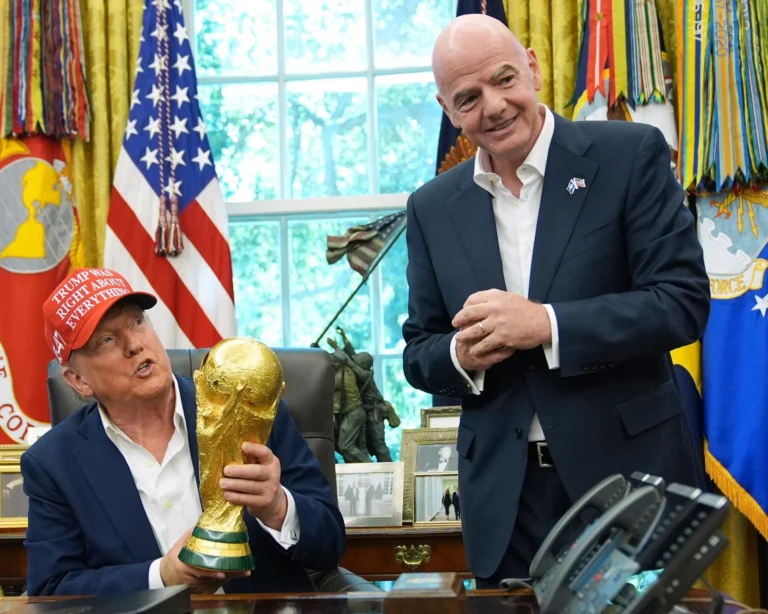
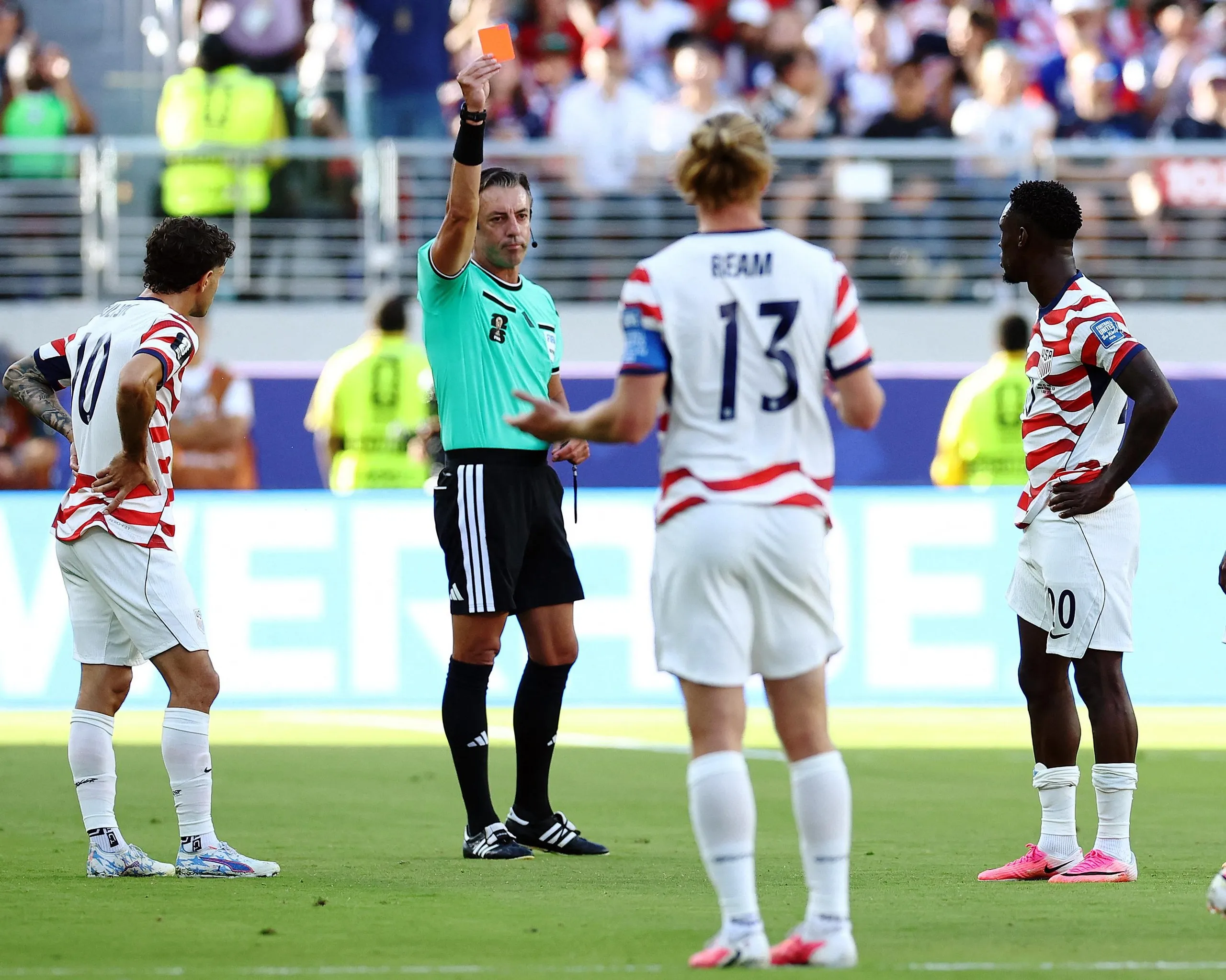
Gianni Infantino appears set to avoid sanctions despite allegations that he violated political neutrality rules in connection with the Folarin Balogun incident involving Donald Trump.
This week, the International Olympic Committee (IOC) received a formal complaint from the human rights group FairSquare concerning Infantino’s actions after Trump disclosed that he had contacted the FIFA president to request a review of Balogun’s suspension from the USA’s knockout match against Belgium. Following an unprecedented decision by FIFA’s disciplinary committee, the suspension was lifted for a year.
Having been an IOC member since 2020, Infantino is expected to adhere to the organization’s charter, which mandates that members operate independently from political and commercial influences. The charter also states that members cannot accept any instructions from governments or organizations that could compromise their autonomy.
FairSquare contends that Infantino’s discussions with Trump constitute a breach of these rules. Infantino has denied any wrongdoing, and sources indicate that a formal investigation is unlikely.
Insiders at the IOC have expressed a strong reluctance to interfere with the internal regulations of an international federation, particularly when the internal appeal processes have not been fully explored.
Additionally, perspectives have shifted in the power dynamics between the IOC and FIFA over the past two decades, with the IOC becoming increasingly dependent on FIFA for revenue and engagement with younger audiences.
With the upcoming Summer Olympics scheduled for Los Angeles in 2028, the IOC aims to leverage the burgeoning popularity of football in the U.S., which has seen record ticket sales and revenue from the World Cup, making any action regarding Balogun’s case less likely.
Notably, UEFA and the Royal Belgian Football Federation have yet to file complaints, despite both organizations condemning the decision to suspend Balogun’s ban.
The Belgian federation has stated that it is considering all legal avenues, including a possible appeal to the Court of Arbitration for Sport. However, it has remained silent since Belgium’s quarter-final elimination from the World Cup by Spain, suggesting it may be prepared to withdraw the issue.
Pascale Van Damme, president of the Belgian federation, is also a member of the FIFA Council, the main decision-making body of the organization.
Infantino seems to have maintained his influence amid the controversy, as more than 200 out of 211 FIFA members have sent letters of personal support ahead of next year’s presidential election.
Despite a strong statement last week in support of Belgium, UEFA appears to have opted against pursuing the matter any further, asserting that FIFA has undermined the integrity and credibility of football.
Infantino has acknowledged his conversation with Trump regarding the issue, but FIFA issued a statement asserting that the two frequently discuss various matters and that he also engages with other heads of state.
He added that the decision to lift Balogun’s suspension was made independently by FIFA’s disciplinary committee. “from governments, organisations, or other parties, any mandate or instructions liable to interfere with the freedom of their action and vote” Infantino stated. “They operate autonomously, apply the Fifa disciplinary code, and decide cases based on the applicable regulations and the specific facts before them,”
Reports suggest that the decision to revoke Balogun’s suspension was made solely by Mohammad al-Kamali, the chair of FIFA’s disciplinary committee from the UAE. However, other insiders have indicated that he may be positioned as a scapegoat.
A unilateral decision by al-Kamali would mark a significant deviation from the standard procedures of the disciplinary committee during a World Cup, which typically involves three-member panels overseeing disciplinary issues with decisions reached by majority vote.
Panel members are chosen from the 18 members of FIFA’s disciplinary committee, with Thomas Hollerer serving as the chair for the quarter-final stage.
The identity of the panel members for the last 32, where Balogun received a red card during the USA’s 2-1 victory over Bosnia and Herzegovina, remains unknown.
FIFA has yet to disclose the written rationale behind the disciplinary committee’s decision, although a recent statement noted that it “Their independence is essential to the credibility and integrity of football, and this must always be respected.” and emphasized that “was decided considering all of the specific circumstances surrounding the incident and evidence available”