


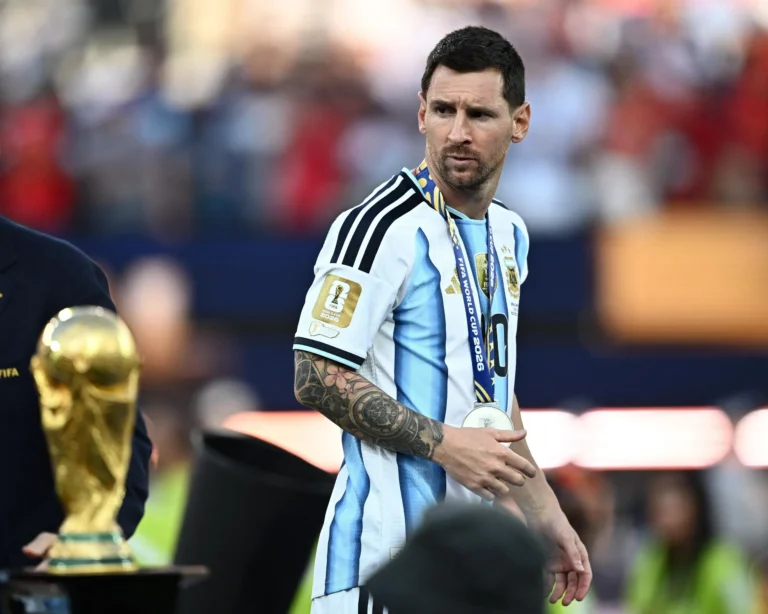
In what was expected to be a memorable farewell on the grandest stage of sports, Lionel Messi fell short as Argentina’s World Cup dreams were dashed. As the sun set behind the west stand of the New York New Jersey Stadium on Sunday, it became increasingly evident that Argentina had lost the enchanting form that had propelled them throughout the tournament. Spain, seizing control, ultimately led to a 1-0 defeat, marking the end of Messi’s World Cup saga.
This final match starkly contrasted with the performances Argentina and Messi had delivered in previous encounters. La Albiceleste dazzled throughout the tournament, not just for their goals but for their impeccable timing, frequently showcasing their ability to score at critical moments. They faced near elimination twice against lesser opponents, yet those challenges only seemed to strengthen their resolve.
World Cup finals often fall short of excitement, and this match was no exception. Spain’s defensive game was stifling, and after a lackluster first half, they found their rhythm in the second half, eventually breaking through in extra time. Argentina made history for the wrong reasons, becoming the first team in nearly a century of World Cup finals to fail to register a shot in regular time. Even after an additional half hour, they posed no threat.
Messi, until this final, had offered fans a rare glimpse of brilliance, performing under minimal pressure. At 39 years old, he has amassed an impressive collection of accolades as both an individual and a team player. This defeat does not tarnish his illustrious legacy; a victory might have further solidified his status as the greatest player in football history. Many Argentinians likely regard their semifinal win against England as nearly as significant as a final victory.
However, it must be noted that Messi was largely absent in this match, a stark contrast to his earlier contributions. Much of this can be attributed to Spain’s exceptional defensive strategy, which effectively neutralized Messi’s influence. By the end, Argentina had devolved into a team characterized by desperation and unsportsmanlike behavior, a perception that some had unfairly attributed to them from the outset.
For Messi, time on the field has often been irrelevant, as he skillfully evades defenders. His performances at this age have a nostalgic quality, prompting memories of his glory days at Barcelona. While he has occasionally lagged behind the passage of time, he has consistently managed to keep pace.
The undeniable truth now is that Messi’s World Cup journey is over. This mirrors sentiments expressed after he led Argentina to their first World Cup in nearly 40 years in 2022, and also recalls the doubts that arose in 2016 when he briefly stepped away from the national team post-Copa América defeat. Discussions at that time questioned whether he could replicate his Barcelona magic with Argentina, and claims about his national identity now seem absurd a decade later.
It remains uncertain how Argentina’s performance will be viewed domestically, where expectations were sky-high. Both head coach Lionel Scaloni and Messi had emphasized their accomplishments leading up to the final, suggesting that the outcome would not diminish their achievements.
This sentiment, however, was expressed before they stepped onto the field and delivered a lackluster performance. Scaloni’s legacy, like Messi’s, was already secure before this match, having led Argentina to a World Cup and two Copa América titles, yet this final presented a missed opportunity to further enhance it. It is possible for two truths to coexist: Scaloni is arguably Argentina’s greatest coach, while also delivering one of his worst performances.
What resonates more deeply is a prevailing sense of disappointment following this dismal final showing, which offered Messi and Argentina a chance to complete their fairytale. Instead, they transformed from heroes to villains in a performance that felt entirely unnecessary.