


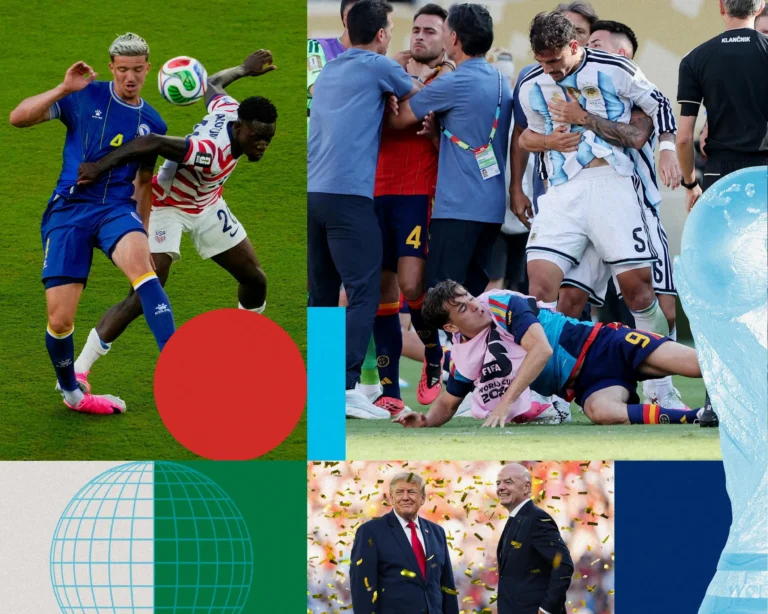
As the last remnants of the gold tape flutter down in New Jersey, it’s perhaps premature to evaluate the 2026 World Cup fully. A proper assessment will only emerge once the memories settle and the implications of key events become clearer. Nevertheless, an attempt to gauge where the tournament, which concluded with Leandro Paredes entangled with Gavi, stands in historical context is worthwhile.
The Balogun Affair may carry significant repercussions. Currently, it appears that the world has moved on, but such is the nature of tournaments; they possess a momentum that often eclipses surrounding issues. Undoubtedly, the capitulation to political pressures, which led to the departure from 64 years of tradition to allow a specific player to shine, mirrors past interventions by Gianni Infantino with Cristiano Ronaldo and the manipulation of Club World Cup qualification criteria to feature Lionel Messi. This represents a pivotal moment.
In the future, we might simply accept that celebrity players receive special treatment, prioritizing profit over fairness or the integrity of the sport. The emphasis on revenue generation has been a hallmark of this World Cup. Alternatively, this may galvanize resistance against Infantino, as evidenced by increasing criticism from British and some American politicians aimed at FIFA and its president. One immediate outcome could be the expansion of the World Cup to 64 teams as Infantino seeks to solidify his support, particularly in light of the damage caused by U.S. and Canadian immigration policies to his claims of championing the global south.
Emerging Issues and Player Treatment
Other concerns that have been overshadowed by the games are likely to resurface. The treatment of Iran during the tournament has drawn significant criticism, setting a troubling precedent. While ticket prices may be lower for the 2030 World Cup, the notion that a fair share should be allocated to regular fans who attend league matches seems a thing of the past. The World Cup now resembles more of an elitist event rather than a mass gathering.
The costs borne by host cities will only become evident in hindsight, encompassing both financial and social dimensions. In the U.S. and Canada, homeless populations have faced street sweeps, with individuals deprived of their possessions, identification, and medication. Meanwhile, in Mexico, there has been considerable outcry over water extraction and environmental degradation linked to World Cup-related projects.
An Italian publication, la Gazzetta dello Sport, recently published a two-page spread labeling the World Cup a “disaster,” citing various issues such as ticket pricing, the Balogun controversy, inclement weather, increased match frequency, and reduced rest periods for players. While such claims may be exaggerated, the aftermath was indeed challenging for the publication, which saw its allocation for final tickets cut from five to just two. It’s unclear if the two events were connected, but the notion that a media outlet could face restrictions for not adhering to the official narrative of this being the greatest World Cup ever is alarming.
Media Relations and Match Quality
This situation aligns with FIFA’s generally dismissive stance towards the media throughout this tournament. Despite some venues, particularly in Houston and Atlanta, striving to be accommodating, the overall organization and facilities ranked among the poorest in at least six World Cups. While the concerns of journalists regarding connectivity may seem trivial to many, they reflect a broader trend: fans are seen merely as revenue sources, while the media is regarded as a bothersome necessity.
As for the quality of football, it was decent but not extraordinary. Several thrilling matches occurred, including Brazil against Japan, Morocco facing the Netherlands, England versus Mexico, Argentina clashing with Cape Verde, and Norway taking on Côte d’Ivoire. However, most of these captivating encounters took place in the earlier knockout stages. The quarter-finals were less inspiring, with Argentina’s semi-final victory over England being exhilarating due to a collapse that will be remembered for years, while Spain’s triumph over France was rather uneventful as Spain swiftly established dominance.
Final Assessment
The final match was disappointing, characterized by an unsatisfactory performance. While Argentina emerged victorious in their typical subdued manner, the grim nature of the spectacle can be attributed to the leniency shown to the team earlier in the tournament. This conclusion inevitably taints the overall impression of the event, positioning it unfavorably compared to the 2022 and 2018 tournaments, and far behind the remarkable World Cups of the 1980s or 1998. Future assessments may determine its place among the ranks of 2014 and 2006, but while it may not have been exceptional, it was still commendable. Ultimately, aside from FIFA’s grandstanding, that sentiment is acceptable.
- This is an extract from Soccer Desk, a newsletter from the Guardian. Subscribe for free here.