


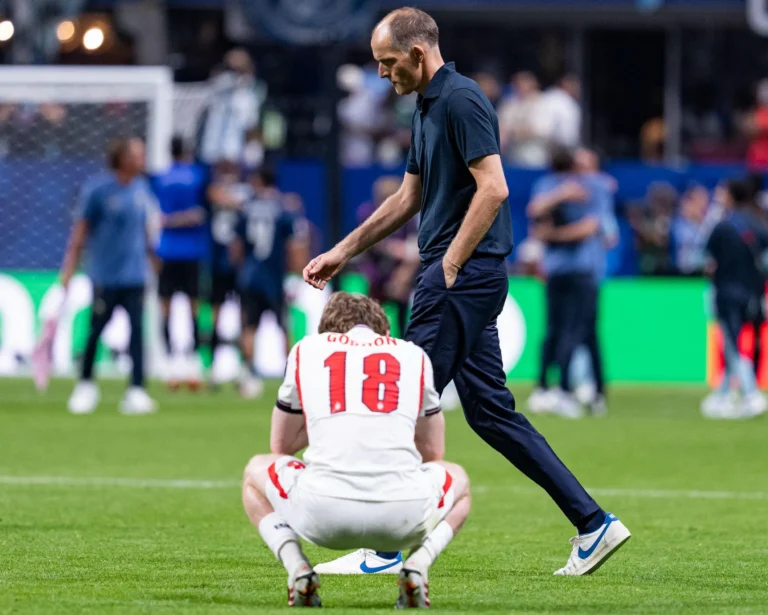
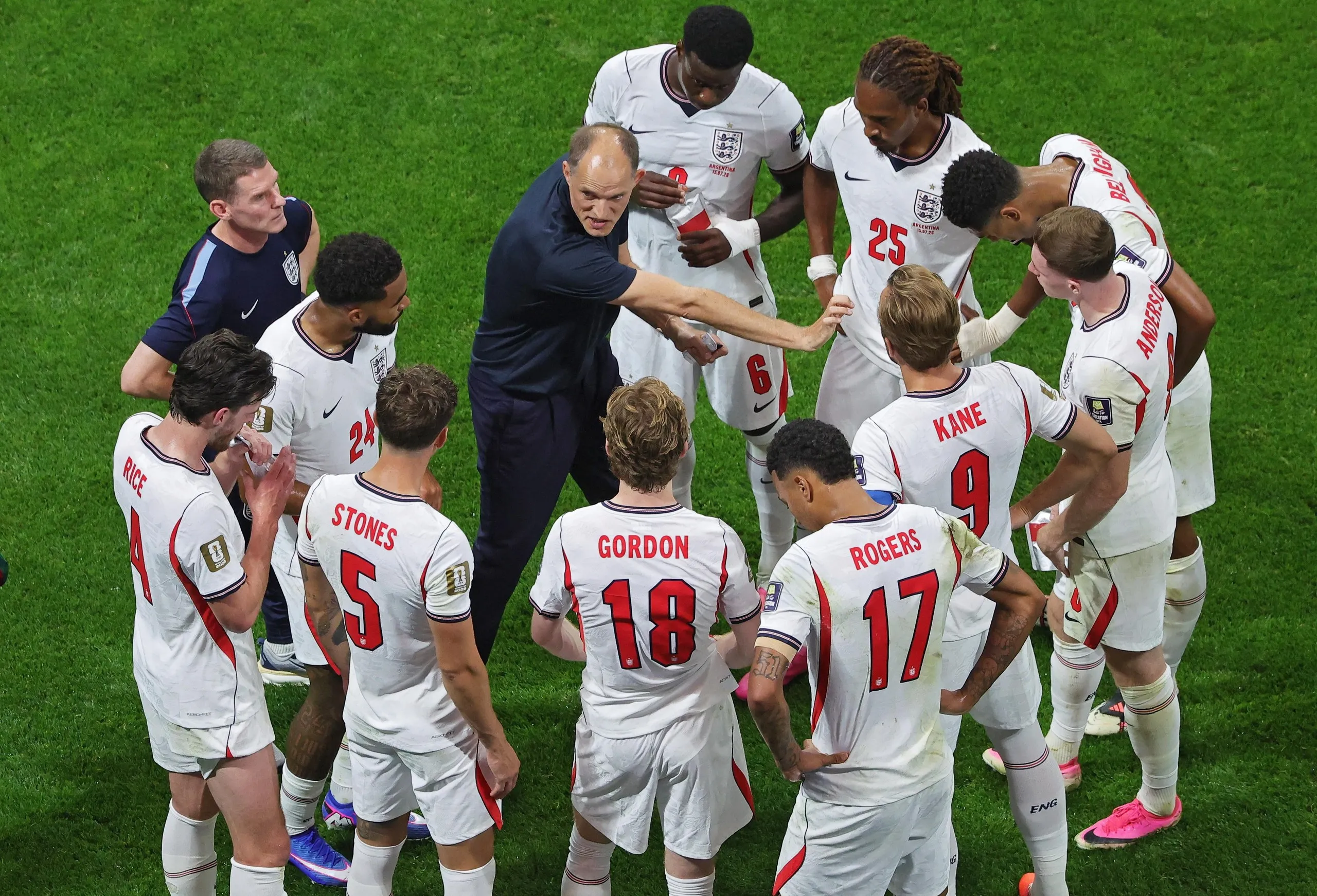
Lionel Messi has encountered defensive setups before, yet England offered nothing novel as they retreated with a chance to reach the World Cup final. Their conservative play was disappointing, leading to a swift and decisive response from Argentina in Atlanta.
This scenario feels all too familiar. After Anthony Gordon’s goal early in the second half, England had the opportunity to seize control but fell back into old habits. Their approach was timid, lacking the necessary aggression to secure victory. Harry Kane remained largely absent, while the midfield was thoroughly outmatched by Alexis Mac Allister and Enzo Fernández. Thomas Tuchel seemed outsmarted by Lionel Scaloni, whose substitutions had a significant impact, and he retreated too soon with plenty of time left to maintain England’s lead.
This was meant to be Tuchel’s time to shine. The highly regarded tactician, known for his success at Chelsea, was expected to guide England where Gareth Southgate had stumbled. Until now, Tuchel had managed the tournament well, with effective adjustments in previous knockout matches. Initially, his decision to start Morgan Rogers on the right appeared promising.
Rogers assisted in the opening goal in the 55th minute, delivering a cross that Gordon converted. However, from that point onward, England struggled. They failed to generate offensive pressure and had difficulty completing even basic passes. Astonishingly, they believed they could rely solely on a defensive strategy, resulting in frantic clearances and numerous close calls for over half an hour. Ultimately, this proved a misguided approach.
England’s tendency to play conservatively against superior teams is a long-standing issue. This was evident during Sven-Göran Eriksson’s era at Euro 2004, where leads against France and Portugal were squandered. Southgate faced similar criticism for his lack of proactivity in key knockout matches against Croatia and Italy after scoring early.
Fans hoped for a change under Tuchel’s leadership. He played a vital role in Chelsea’s unexpected triumph over Manchester City in the 2021 Champions League final. Known for his energetic presence on the sidelines and constant strategizing, Tuchel’s adept in-game management had partially fueled England’s journey to the semifinals. Nevertheless, England’s play lacked a distinct identity.
Following Gordon’s goal, the momentum shifted. A remarkable tackle by Djed Spence denied Giuliano Simeone, hinting at an unexpected turn of events. Cristian Romero forced an impressive save from Jordan Pickford, while Mac Allister struck the post. England’s intensity waned, resembling a lower-league team defending in an FA Cup match, holding just 12% possession between taking a 1-0 lead and falling behind 2-1. Kane was relegated to a defensive role, and Jude Bellingham saw little action. Rogers had a brief opportunity, but his shot was blocked.
For England, who recorded only one shot on target, advancing to face Spain would have seemed unjust. Argentina faced no real threat, with no fear of being caught off guard as they pressed forward. The only surprise was the delay in their equalizer from Fernández, who was unchallenged when he scored from a distance.
England’s defensive efforts were also subpar. Argentina exploited their aerial vulnerabilities, prompting Scaloni to sense the shift in momentum. He replaced Leandro Paredes with winger Nicolás González.
Argentina demonstrated their intent, while Tuchel appeared hesitant. His decision to switch to a back five, which had previously secured results against Mexico and Norway, felt premature. England placed themselves in a precarious position when Gordon, one of their few attacking options, was substituted for Ezri Konsa.
Fatigue was palpable across the pitch. Reece James and Declan Rice, recently returned from illness, struggled to keep pace. Tuchel continued to make defensive substitutions, introducing Nico O’Reilly to join Rogers and Elliot Anderson in midfield. Suddenly, Dan Burn found himself tasked with marking Messi. The outcome seemed inevitable.
These changes would have drawn criticism for Southgate or Eriksson. Tuchel’s approach only stifled England’s offensive capabilities. He could have injected fresh energy into the attack by substituting in Bukayo Saka, Marcus Rashford, Eberechi Eze, or Noni Madueke. At one point, both of Argentina’s center-backs were booked, yet England failed to capitalize on this opportunity.
Attention will turn to the decisions made in midfield. Kobbie Mainoo, a skilled playmaker, remained unused, while Jordan Henderson’s injury story loomed large. There were no replacements for Anderson and Rice as they fatigued. Tuchel made his selections, but the rationale behind choosing Mainoo over Adam Wharton and Alex Scott remained unclear.
Ultimately, England reaped what they sowed. Bellingham attempted to advance the ball at 1-1 but was overwhelmed by four opposing players. Extra time was never a possibility. Mac Allister struck the post again, and Lautaro Martínez, another substitution, headed in the decisive goal.
In added time, England sent aimless long balls toward Burn and Ivan Toney. Emi Martínez caught a cross and then went down seemingly injured, but it was hard to believe he was genuinely struggling; he had scarcely been tested since England’s goal.
- World Cup 2026
- Thomas Tuchel
- England
- Argentina
- World Cup
- analysis