


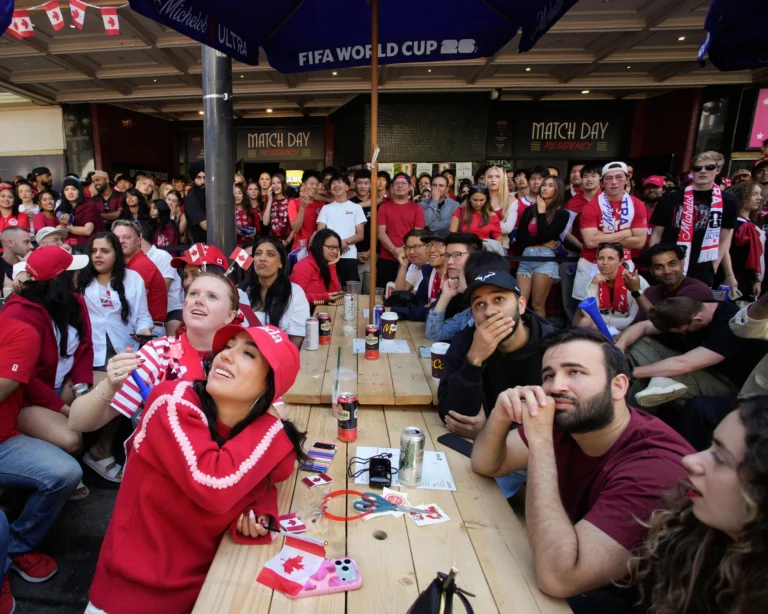
The scene was bustling at Toronto’s historic venue, The Wheatsheaf, during Saturday’s lunchtime as fans gathered to watch the World Cup match. Among them sat a group of despondent Irish GAA supporters, still reeling from Cork’s recent defeat to Galway in the All-Ireland Hurling semi-final. Clad in their red and white, they gazed into the distance, but at least they had another team to cheer for.
This was a peculiar situation. Canada, co-hosting the tournament, found itself playing Morocco far away in Houston, Texas, due to a second-place finish in the group stage. Yet, inside The Wheatsheaf, a sea of red and white erupted as Canadian fans congregated for the knockout clash. One supporter even sported a vintage Manchester United jersey featuring ‘Beckham’ on the back, showcasing their commitment to Canadian pride. The atmosphere intensified when Wayne Gretzky, once hailed as a legend but now criticized for his associations, appeared on screens, only to be met with raucous boos from the crowd.
However, that moment was a fleeting instance of unity for Canadian fans. Aside from the excitement that followed Tani Oluwaseyi’s first-half effort, which prompted a remarkable save from Morocco’s Montreal-born goalkeeper, Yassine Bounou, a sense of resignation enveloped the match. Following Azzedine Ounahi’s goal just five minutes into the second half, enthusiasm faded. As it became clear that Alphonso Davies would not be making an appearance to inject some much-needed energy, optimism dwindled. When the final whistle blew, the crowd’s reaction was muted, marked only by soft applause. No anger or blame surfaced, but neither did any analysis. The once vibrant bar quickly fell silent.
Throughout the week, the Canadian game—a highly anticipated World Cup knockout match—had not captured the city’s full attention. In fact, another nation was making headlines.
The arrival of the Portuguese squad ahead of their thrilling last-32 match against Croatia at Toronto Stadium caused chaos. Fans lined the highways, eager to catch a glimpse of the team bus as it arrived from the airport. Authorities were compelled to close part of the road, causing an hour-long traffic delay. This excitement paled in comparison to the throngs of supporters who gathered outside the team’s training sessions and downtown events. For three days, they congregated outside the hotel where the players stayed, eagerly awaiting sightings of Cristiano Ronaldo, who waved to fans much like a political figure addressing a crowd from a balcony. Media outlets fanned the flames of excitement, reporting on the dining habits of Ronaldo’s family during their stay. When Portugal departed on Saturday, their fans showed up in droves for a memorable send-off, with one woman expressing her joy at merely catching a glimpse of CR7.
“As they were leaving the bus, we caught the back of his head and the backpack,” she reflected. “It’s amazing, it’s a once-in-a-lifetime opportunity.”
The situation raises questions about Canadian soccer’s trajectory and its co-hosting status in this World Cup. While there were moments of celebration, such as Cyle Larin’s goal during the opener against Bosnia and Herzegovina and a stunning 6-0 victory over Qatar, these instances couldn’t compare to the fervor surrounding Portugal or Egypt, who celebrated with fans in Vancouver after their win over New Zealand. Why is it so challenging for Canada to generate similar excitement, even while co-hosting a World Cup?
This could be attributed to the Canadian ethos, which often balances between exuberance and restraint. Jesse Marsch faced scrutiny for his celebrations after the historic victory over Qatar, the first men’s World Cup win for the country. The typical Canadian approach tends toward being composed, measured, and overly cautious. However, in a moment where change is on the horizon, silence may not be the best option.
Canada has played a supportive role in this World Cup. Their name may be on the official banner, but they lack the most compelling narratives, despite significant investment. Nevertheless, they have made strides and created memorable experiences. Yet, uncertainty lingers: what does the future hold? Temporary seating at Toronto Stadium will soon be dismantled. In Vancouver, attention will shift to the fate of the local professional men’s club. Concerns persist about the future of CF Montreal and the sustainability of the domestic men’s league. Questions remain regarding long-term investments and infrastructure. Despite the excitement of the World Cup, answers seem elusive, leaving many in a state of cautious anticipation.
Canadian soccer history is riddled with near misses and lost opportunities. Let’s hope this World Cup does not add to that list.