


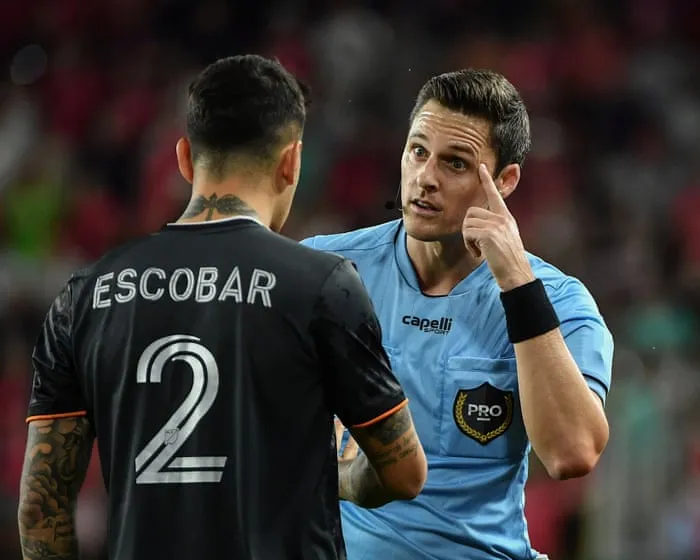
Joe Dickerson never envisioned a career as a referee. During his playing days, he learned that officiating could provide a side income, instill a sense of responsibility, and most importantly, deepen his understanding of the game.
What began as local assignments in the San Jose area has evolved into a distinguished career, culminating in his recognition as US Soccer’s male referee of the year in 2025. His keen attention to detail drives his work, a skill he will heavily rely on as a VAR official during this summer’s World Cup.
“There was a time when early in my career – and part of this goes through today: I hate going to the monitor,” Dickerson expressed. “I hate it because it means I’ve probably made a mistake and I want to be perfect on the field.”
As time has passed, Dickerson has learned to manage his apprehension toward the monitor, even if he hasn’t fully embraced it. This adjustment will serve him well as he navigates the VAR booth at stadiums across North America this summer.
Selected as one of many officials monitored by FIFA throughout the World Cup cycle, Dickerson was considered for both central officiating and video assistant roles for the tournament. He will serve as a critical voice in the referee’s ear, alerting them to plays under review and assisting with replay analysis.
“The vast majority of mistakes made at a World Cup by the best referees in the world are minor,” he noted. “Well, minor’s the wrong word; they’re really difficult. They’re subtle, specific, or they were really hard to see. These are the ones that nobody ever faults referees for missing.”
In addition to his officiating duties, Dickerson is pursuing a master’s degree at the University of Chicago. His thesis focuses on Machiavelli’s political philosophy, which he plans to link to the art of refereeing. While it may appear unconventional, he finds a clear connection.
“The short version is, I think Machiavelli makes a case for empathy and leadership through some hidden teachings in his otherwise very amoral pragmatism in his writing,” Dickerson explained. “I also really like Nietzsche and Confucius. The reason I bring that up is because I think that a lot of these things that we learn in refereeing are very philosophical, and they can apply to many aspects of life.”
VAR has sparked philosophical discussions within the soccer community since its inception. Criticism of the technology has surged recently, particularly after a series of controversial moments that have impacted title races and promotion/relegation battles. In February, UEFA’s refereeing director cautioned that the process was becoming “too microscopic.” By the end of the European club season, the Premier League opted against expanding VAR’s oversight to include potential corner kick reviews, a change that FIFA requested for this World Cup.
According to Dickerson, the differences between international and club football will benefit referees during this World Cup. In league play, the sheer number of matches can lead to outlier incidents becoming focal points.
“All FIFA events, and specifically the World Cups, are unique in that they are tournaments,” Dickerson remarked, “and they are highly visible, very short tournaments.”
As the VAR era reaches its tenth anniversary, the most debated calls often involve handballs—situations where one player gains possession before making contact with an opponent or moments when attackers instigate contact to draw a foul. These scenarios are meticulously reviewed by World Cup referees during seminars, the latest of which was held in Brazil.
“We do a 10-day seminar to make sure that we are as consistent as can possibly be on all the decisions,” Dickerson stated. “We know that 90-something percent of the decisions we will see at the World Cup, we will consider almost black and white, even if the footballing public doesn’t. We have spent so much time looking at all of these clips so we know ‘that’s a handball’, ‘that’s a penalty’, ‘that’s a red card’, ‘that’s a yellow card’.”
Currently, VAR booth procedures involve three officials: the video assistant referee, who communicates with the on-field referee throughout the match; a support VAR, who monitors the game while the primary VAR reviews potential contentious calls; and an assistant VAR, who records notes that the VAR cannot write down while overseeing the match. Each member has undergone the same training, enabling them to collaborate effectively during reviews.
While some may dislike the video review process, it is undeniable that VAR will play a significant role in this World Cup.
“You can’t eliminate the public’s bias from any analysis of VAR,” Dickerson acknowledged, “and that’s not a bad thing. I love going to stadiums that I would consider are hostile because it tells me that the fans are incredibly passionate about the game. I think that’s one of the beautiful things about the sport.
“The other beautiful thing about the sport is the subjectivity. When you combine subjectivity with inherent bias and high emotions, you get a lot of strong opinions about things like VAR decisions.”