


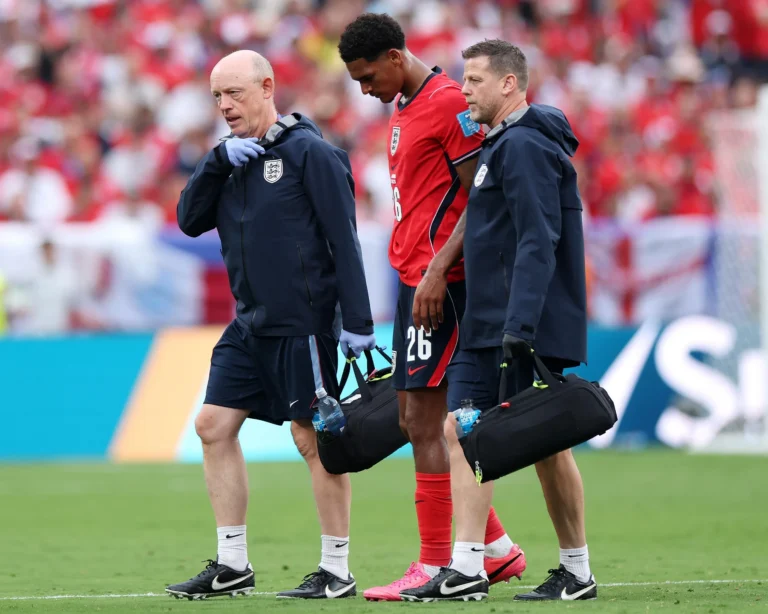
England’s hopes are boosted with Declan Rice returning for the round of 32 clash against the Democratic Republic of the Congo (DRC) on Wednesday. However, the situation at right-back has worsened for head coach Thomas Tuchel, as Jarell Quansah is expected to be sidelined due to an ankle injury.
The absence of Tino Livramento, who left the squad earlier this month with a calf issue, has already complicated Tuchel’s plans. Reece James also tweaked his hamstring last week, ruling him out of the match against the DRC and raising doubts about his availability for a potential last-16 encounter against Mexico or Ecuador the following Sunday.
Quansah was brought in to replace James during the match against Panama, but his World Cup debut was cut short when he twisted his ankle in the second half. The 23-year-old was substituted for Djed Spence and is now a significant doubt for the upcoming fixture. While Tuchel expressed optimism about Quansah’s recovery, sources suggest that the timing may not favor his return.
With both Quansah and James likely unavailable, Spence is expected to start. Tuchel has shown confidence in the versatile Tottenham defender, deploying him in all three group matches as England secured seven points. Alternatively, Tuchel could consider shifting Ezri Konsa to the right-back position while starting John Stones alongside Marc Guéhi in central defense.
Stones, who featured only five times for Manchester City during the latter part of last season, has not played for England since their 4-2 victory over Croatia in their opening match.
When asked about Stones’ readiness to start against the DRC, Tuchel stated, “Yeah, for sure. Why not? He was even in consideration to start [against Panama] but then it would have been the third change in the central defence in the third match, and I thought I’d stick with the pair because I saw them good against Ghana – and I saw them good against Panama.”
Tuchel also expressed confidence in Jude Bellingham’s dedication and impact on the team at the World Cup. Bellingham played a crucial role in England’s 2-0 triumph over Panama, scoring the opening goal—his second of the tournament—and assisting Harry Kane. The Real Madrid midfielder, who earned his 51st cap, did not feature in several of England’s qualifying matches, and Tuchel had warned that he would need to fight for his place.
In the match against Panama, Bellingham played in a deeper role while Morgan Rogers joined him in the lineup for the third time under Tuchel. The England head coach noted Bellingham’s standout performance and was not surprised by his ability to rise to the occasion. “I’m not sure if it’s a reaction but it is what we want from him,” Tuchel remarked.
“He was very positive from the first day in camp. He buys fully into all the things we demand as a team player, and then he brings his own individual quality to decide football games. That’s what you see in World Cups now, and what you see from other teams and other big players. We have it in him and he’s a key player … So well done until now. He needs to keep going.”
Returning to their base in Kansas City, England is gearing up for their clash with the DRC. Marcus Rashford is expected to keep his position in attack following a strong outing on the left. Tuchel refrained from disclosing whether he has identified his best team but emphasized the importance of adaptability for England.
“And from there I build and I see the energy on the training pitch and I see what the output is from match to match. Then we see what the opponent brings and how we need to react. But I see good performances and detail out there against very physical opponents, and I think we will find solutions when they are needed. “With a new stage of the tournament, it starts new again. It’s knockout football. It brings its very own tension, its very own dynamics. We’ll prepare for that and be ready for it.” he said. “And from there I build and I see the energy on the training pitch and I see what the output is from match to match. Then we see what the opponent brings and how we need to react. But I see good performances and detail out there against very physical opponents, and I think we will find solutions when they are needed.”
As the tournament progresses into knockout stages, Tuchel noted the unique challenges it presents. “With a new stage of the tournament, it starts new again. It’s knockout football. It brings its very own tension, its very own dynamics. We’ll prepare for that and be ready for it.”