


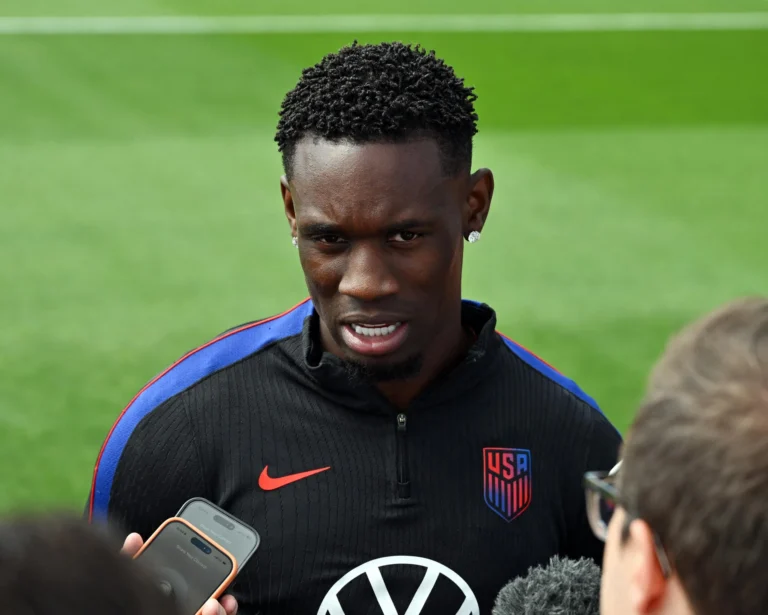
On the morning of his 25th birthday, Folarin Balogun faced a barrage of questions, but the cards in focus were not birthday greetings. Following the United States’ victory over Bosnia and Herzegovina in the World Cup round of 32, where he scored the opening goal in a 2-0 triumph, Balogun was issued a red card during the second half, preventing him from addressing the media.
As the skies cleared over Seattle on Friday, marking the start of the team’s next training phase in the Pacific Northwest, Balogun appeared to be reconciling with his exclusion from the upcoming last-16 match against Belgium. While he refrained from endorsing the red card decision, a spokesperson from US Soccer confirmed that his suspension applies only to this single match.
“I’ve been upset. I’ve been happy,” Balogun commented on the emotional rollercoaster of the past day and a half. “It’s been surreal, to be honest. But for me, I think it was just important to stay calm. I never want to react out of anger and out of emotion. There’s still lots of people we’re inspiring, little kids, boys and girls who are watching, and we have to show them the correct way to handle things, even when you think it’s unjust.”
Despite his disagreement with the call, Balogun made a point of shaking the hand of referee Raphael Claus after the match, emphasizing the importance of setting a positive example for fans, many of whom may be experiencing the World Cup for the first time.
“Even though you can feel like something unjust has happened to you, it’s not an excuse to be disrespectful,” he stated. “After every game, I try to shake the referee’s hand, and this game was no different.”
The incident has sparked significant conversation within American sports circles. While concepts like VAR and pressing tactics may still be new to casual fans, a perceived unjust ejection has become a rallying point for many. Balogun’s post-match Instagram was flooded with comments, including from brands and prominent figures. ESPN host Pat McAfee even used the hashtag “I love seeing how engaged the country is in our journey and in what we’re doing,” while NFL stars Mac Jones and Lamar Jackson expressed their support. This unexpected controversy seems to have united both dedicated fans and more casual observers ahead of the crucial matchup against Belgium.
“I think for me it’s important to be fair even when I’m giving my opinion on things,” Balogun affirmed.
When asked to recount the events leading to his dismissal—an innocuous clash with Bosnia and Herzegovina’s Tarik Muharemovic in which Balogun’s foot accidentally landed on his opponent’s ankle—he found it challenging to justify the harsh punishment imposed. “If you’ve played the game, you would understand there’s scenarios that you simply can’t avoid and it has to be taken into context when it’s being reviewed. I felt [that context] wasn’t [considered] on this occasion. “I think as you all saw, there’s nowhere else to put your leg. It’s going to be unavoidable. I’ve seen many different opinions and takes, but for me personally, I think a yellow card would have been fair. It’s something that’s happened, so we have to move forward and have to accept it. But the most important thing is just to focus on the bigger picture, which is Belgium.” he explained. “Obviously, things change a little bit, but we’ve been flexible,”
“Guys have shown that they’re ready to play. If it’s [Ricardo] Pepi, if it’s Haji [Wright], if they go a different direction, who knows? I’m not the coach. But yeah, it should be an exciting opportunity for whoever has to step up.”
Rudi Garcia’s squad will certainly breathe a sigh of relief at the prospect of not facing the US’s most lethal attacker. Belgium struggled significantly against Senegal during their last-32 game, particularly against strong target forwards in earlier group matches.
In the coming days, coach Mauricio Pochettino will strategize on how to keep Belgium on the defensive as much as possible. Given the nature of Garcia’s tactics, the Red Devils will aim to maintain more possession than at least three of the US’s first four opponents in this World Cup, making effective transitions crucial. Without their usual offensive leader, the US must adapt to ensure their attacking sequences remain effective.
“Obviously, things change a little bit, but we’ve been flexible,” said midfielder Tyler Adams, whose role will shift away from center-forward positions. “Guys have shown that they’re ready to play. If it’s [Ricardo] Pepi, if it’s Haji [Wright], if they go a different direction, who knows? I’m not the coach. But yeah, it should be an exciting opportunity for whoever has to step up.”