


The upcoming 2026 World Cup is poised to be unprecedented in its scale, duration, and financial outlay. Alongside its grandeur, a series of significant rule modifications will be introduced. These changes encompass expanded duties for video assistant referees (VAR), the introduction of new red card infractions, and various initiatives aimed at accelerating the pace of play. Below is a comprehensive overview of the new regulations for the tournament taking place in the United States, Canada, and Mexico, along with the rationale behind these updates.
VAR to Monitor Corners and Second Yellow Cards
Despite widespread criticism from fans regarding video refereeing, FIFA is intent on reinforcing its use by broadening the VAR framework. For the first time, video officials will be tasked with reviewing every incident that leads to a corner kick. As per guidance from the International Football Association Board (IFAB), VAR intervention will be permissible only if it can occur swiftly, although specific time constraints have not been established. Additionally, VAR will now evaluate actions that result in the issuance of a second yellow card, which leads to a player’s dismissal, a change from the current focus on direct red cards alone. While some IFAB members express reservations about extending VAR’s responsibilities—particularly regarding corner reviews, which have become optional and may be dismissed by the Premier League—FIFA remains concerned about the implications of incorrect calls on high-stakes matches. The initial VAR guidelines aimed to rectify glaring oversights by match officials.
VAR Will Assess Fouls Before Set Pieces
In a surprising twist, less than two weeks before the World Cup kicks off, IFAB unveiled another modification to the VAR protocol. Dubbed a “clarification,” this update will lengthen the assessment period for goals, penalties, or red cards that result from set pieces. Video referees are now encouraged to review any foul committed before the set piece is taken, provided that play was halted and the infraction is deemed to have a “direct impact” on the outcome. This adjustment is widely interpreted as a strategy to address grappling in the penalty area prior to corners and free kicks. For instance, a missed foul during England’s recent friendly against Uruguay illustrates the type of offenses that will be scrutinized.
New Red Card Offenses for Player Protests
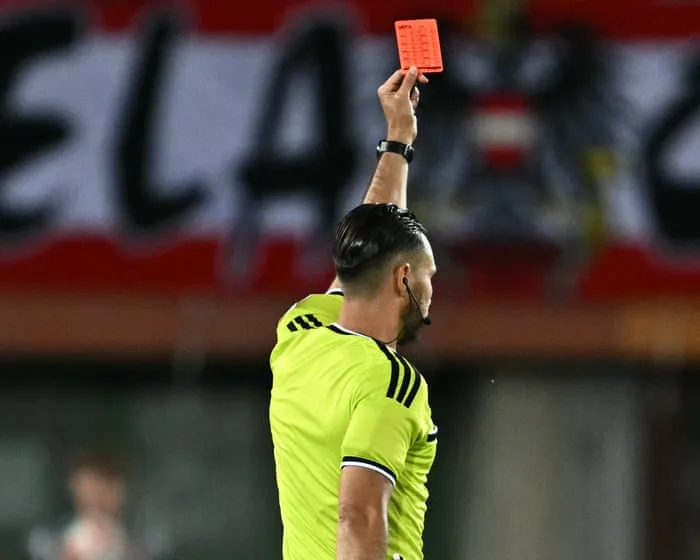
This year witnessed two high-profile incidents that prompted the introduction of new red card offenses. The first incident involved Senegal’s coach, Pape Thiaw, and several players who left the field in protest during the Africa Cup of Nations final following a penalty awarded against them. Consequently, any player or official who “leaves the field of play in protest at a referee’s decision” is now subject to a red card. Furthermore, players who cover their mouths in confrontational scenarios will face the same penalty. This rule has gained attention after Benfica midfielder Gianluca Prestianni concealed his mouth beneath his shirt while confronting Vinícius Júnior during a Champions League match. While Real Madrid alleged that the abuse was racist, the player confessed to making homophobic comments and subsequently faced a ban. Remarkably, FIFA president Gianni Infantino specifically advocated for disciplinary measures against such actions, and this rule, while optional, will be enforced during the World Cup.
Measures to Eliminate Tactical Timeouts
A growing frustration in football circles is the prevalence of tactical timeouts, where injuries are feigned to allow coaches to deliver instructions to players. These interruptions are viewed as an exploitation of existing rules and a disruption to the flow of the game, prompting lawmakers to take action. At the World Cup, officials will intensify scrutiny on this practice. Players will be required to exit the field for treatment as usual but must remain off for 60 seconds post-treatment before re-entering. Goalkeepers, often the main offenders of this tactic, will still receive treatment on the pitch; however, referees are expected to implement a rule from the National Women’s Soccer League (NWSL) that mandates all other players retreat to the center circle during treatment, prohibiting access to their coaches’ technical area.
Building on the successful introduction of referee countdowns to expedite goal-kicks, this measure will also extend to throw-ins at the World Cup. In both scenarios, officials may signal a five-second countdown to players who are delaying play. If the countdown reaches zero, the throw-in will be awarded to the opposing team, and similarly, a corner kick will be given if a goal-kick exceeds the time limit.
Finally, a new regulation stipulates that any player substituted must vacate the field within 10 seconds after their number is displayed. Should they exceed this time, the incoming player will be required to remain off the pitch for an additional minute.