


“It was scorching back in ’94,” declared Alexi Lalas, the former USA defender and current Fox Sports analyst, who made a mark during his country’s hosting of the World Cup that year. “And guess what? This time, it’s going to be just as hot.”
Lalas’s emphatic statement came during the December draw in Washington DC for the upcoming tournament, and it was hard not to be captivated by his powerful delivery. Known for his loud and assertive demeanor, Lalas took a moment to evaluate England’s prospects, recalling their failure to qualify three decades ago.
In essence, Lalas made it clear that England was arriving on his home turf with the intention of claiming the trophy and bringing it back home, and he certainly wasn’t pleased about that. His specific grievances with England were left vague. Regardless…
Lalas’s core message regarding the heat was that he had no patience for complaints, seemingly aimed at the European powerhouses, including England. Just adapt, he urged. It’s the same for everyone.
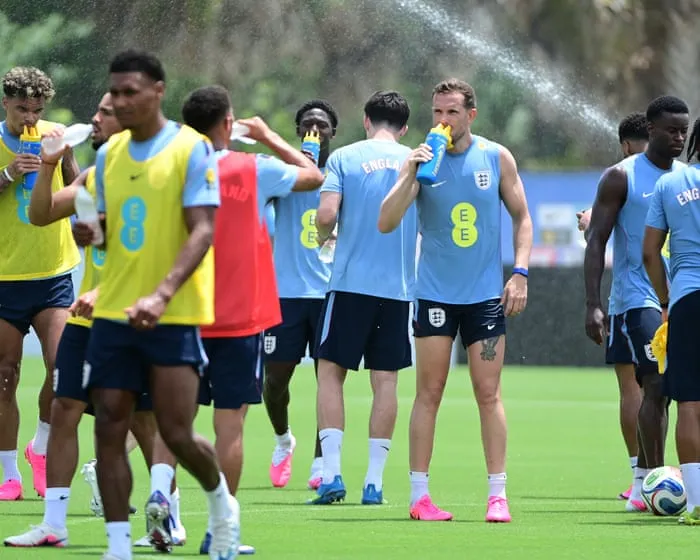
England is adjusting to these conditions. There’s a reason Thomas Tuchel opted to lead his first training session of the summer in West Palm Beach on Tuesday, just 15 days before England embarks on their quest for a second star against Croatia in Dallas. The manager is eager for his players to adapt to the climate as quickly as possible, and Florida offers a prime testing ground. Some members of Tuchel’s squad arrived in the Sunshine State during the last week of May, partly for leisure and partly to begin acclimatizing.
The temperature reached 32°C with 79% humidity during Tuesday’s session in West Palm Beach, while the Miami stadium ranks as the tournament’s most challenging venue in terms of heat. Kansas City, where England will be based throughout the finals, is a close second. If England tops their group and advances, they will face a quarter-final in Miami. Before that, they will contend with a last-16 match in Mexico City, where the high altitude could pose additional challenges.
England’s first friendly match is scheduled against New Zealand on Saturday at 4 PM local time (9 PM BST) in Tampa, roughly a four-hour drive from West Palm Beach. The kickoff temperature is expected to be 32°C, though with lower humidity than in West Palm Beach, aligning with the Football Association’s mantra to make the players “comfortable being uncomfortable.”
There’s no denying that extreme heat complicates the game. Higher temperatures lead to decreased movement from players, regardless of speed. Data from last summer’s Club World Cup in the U.S. supports this. Tuchel’s assistant, Anthony Barry, has noted, “The environments [in North America] do not promote world-class football. You won’t witness the best teams displaying their best performances. The World Cup winner will be determined by moments.”
Every England supporter is concerned that the weather may present one of the biggest hurdles, especially as most of Tuchel’s players have just endured a taxing Premier League season. Some are even nursing minor injuries. The FA has emphasized that this World Cup will be the most demanding one yet — the hottest since 1994; the largest due to the expansion to 48 teams; and the most logistically challenging, spanning the U.S. as well as Mexico and Canada, the other co-hosts. There are four time zones from coast to coast.
The team that adapts best to these variables will emerge victorious, and for England, the focus is on a “heat-proof game model” which encompasses player selection, rotations, substitutions, and recovery strategies.
The FA has dedicated significant resources and planning to ensure players are in peak physical condition throughout the tournament. Much of the acclimatization process occurs in Florida, where England will also face Costa Rica in a second friendly in Orlando on Wednesday. However, preparations began last June when Tuchel took the squad to Girona for a week of warm-weather training.
The training sessions were grueling. Players were required, for instance, to cycle for 45 minutes at a consistent pace inside a tent heated to no less than 35°C. Sports science played a pivotal role, with players ingesting biometric tablets beforehand to monitor their core body temperatures under stress. Some players have also invested in hyperbaric oxygen chambers, red-light saunas, and ice baths at home to aid recovery.
The importance of data cannot be overstated. The methods of collecting and analyzing it are complex. External loads, such as distances covered and the number of high-intensity runs, are tracked using GPS technology. Internal loads, including heart-rate variability, are assessed through wearable devices. The players have utilized health bands during training this week.
The FA has benefited from collaboration with the players’ clubs, which have shared training data. Tuchel has indicated that his choice to include John Stones, who had limited playing time for Manchester City in the season’s second half, was influenced by encouraging data from club training. The goal is for Tuchel and his team to understand every aspect of a player’s condition to optimally adjust their training and match loads.
This commitment to recovery extends to meal choices on flights back to Kansas City after matches and strategies for achieving quality sleep. The FA has aimed to acclimatize players to the Bermuda grass used in North America, which differs slightly from the surfaces in England — it is somewhat more compact — and has ensured high-quality training pitches.
Kansas City has been selected as the base camp due to its central location within the U.S.; there will be no flights longer than three-and-a-half hours, which may not be the case for teams that travel extensively during the knockout stages. The FA believes there are advantages to having a permanent base with associated comforts; it is satisfied with the four-star, 54-room Inn at Meadowbrook, which it will occupy starting next Saturday. Tuchel has characterized it as private and cozy.
And so, the first small step begins — the match against New Zealand at the Raymond James Stadium, home to the NFL’s Tampa Bay Buccaneers, owned by the Glazer family. Originally, these warm-up matches were intended for Miami or Orlando, but a mix-up led them to Tampa instead.
England will be the designated home team against New Zealand, and the tunnels in all four corners of the stadium have been adorned with FA branding. High above one of the main stands lies the Bucs’ ring of honor, showcasing the names of their most celebrated players, including the late Malcolm Glazer, the former owner.
This venue is noted for the replica pirate ship situated behind the seating area at one end. When the Bucs score a touchdown, the ship fires its cannons, filling the air with loud bangs and simulated smoke. It remains uncertain if similar festivities will occur should England score. The summer’s journey is about to commence.