


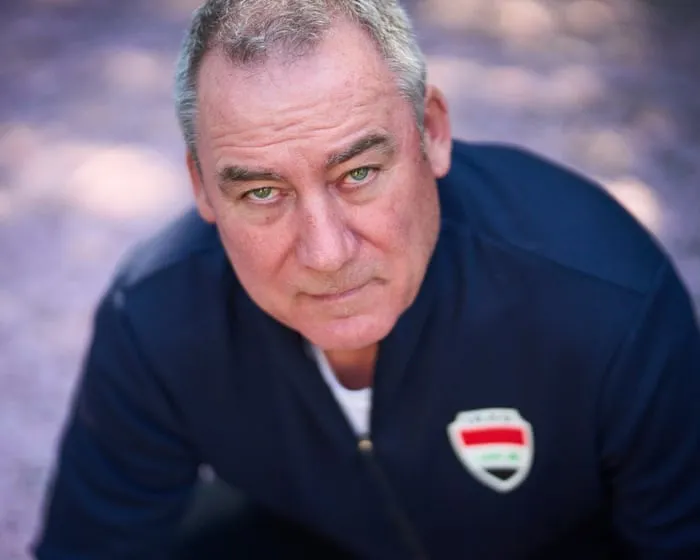
The path to Iraq’s first World Cup appearance in four decades was paved with unparalleled challenges. After enduring 20 qualifying matches, the team found themselves facing a crucial playoff in Monterrey, Mexico. However, the ongoing conflict in the Middle East and the closure of airspace made the journey exceptionally difficult for many players and staff.
“They had to make long journeys by car or bus from various cities to Baghdad,” explains René Meulensteen, who serves as the assistant coach under Graham Arnold. “Some traveled up to eight hours. Once in Baghdad, they embarked on a grueling 15-hour drive over rough roads to reach Amman, Jordan, where the few available flights were operating. The other players based in Asia made their way to Amman to ensure they could travel together.”
FIFA arranged a private charter for the team, but they encountered a nine-hour delay before their flight. A subsequent eight-hour journey to Lisbon was followed by a two-hour layover and then a lengthy 12-hour flight to Mexico.
This chaotic travel schedule was far from ideal for what Meulensteen refers to as “the most significant match of their lives.” Nevertheless, the team arrived in time to recover and managed to defeat Bolivia 2-1, clinching the last spot in the tournament in front of a supportive crowd.
“Most of the remaining tickets went to local Mexicans, who showed up in large numbers alongside a significant group of Iraqis living in the US,” Meulensteen adds.
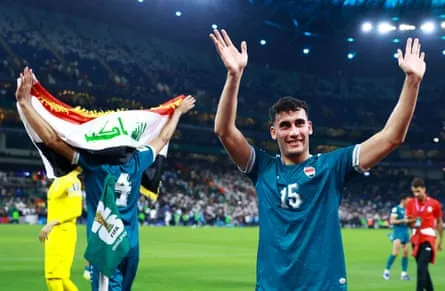
The historical significance of the venue was not lost on the squad. “We reminded the players that our journey to this point has been extraordinary, and perhaps it was fate that this match took place here, as Iraq last participated in a World Cup in Mexico,” he said.
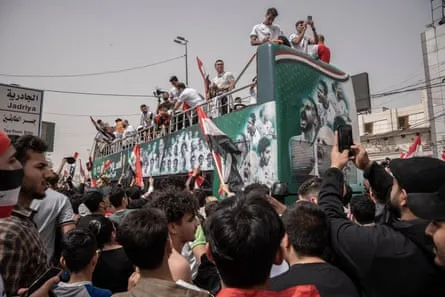
The atmosphere back home was electric. “It was absolute chaos in Baghdad, even though it was early morning,” Meulensteen recalls, having watched videos of the jubilant celebrations. “The entire nation has been longing for something to celebrate, and this brings a tremendous surge of energy and hope. You can genuinely sense the pride and optimism among the people.”
This qualification adds to Iraq’s previous accomplishments, including a fourth-place finish at the 2004 Olympics, where they triumphed over Cristiano Ronaldo’s Portugal, and winning the 2007 Asian Cup. That victory temporarily united a nation grappling with civil unrest, and both the 1986 World Cup and the 2004 milestones were achieved amidst similar turmoil.
“Iraq is still a country burdened by the aftermath of the second Gulf War,” Meulensteen shares. “The impacts are evident in the cities. They are on the mend, but you can’t compare the logistics and organization to Dubai or Saudi Arabia.”
At 62, Meulensteen appreciates the local culture and camaraderie among the players. “You should hear them on the bus to training and matches, singing and enjoying music. It’s absolutely delightful.”
Iraq finds itself placed in a formidable group alongside France, Senegal, and Norway. “It feels like Manchester United facing off against Grimsby Town,” Meulensteen notes, but he remains hopeful, recalling how the underdogs emerged victorious in that encounter last August. He is determined to replicate that success, just as he and Arnold did with Australia in the previous World Cup.
“In our group, we faced France, Denmark, and Tunisia, and the odds were stacked against us,” he says. “Yet, that’s where our greatest strength lies: the element of surprise.” Australia managed to defeat both Denmark and Tunisia, and even challenged Argentina, the eventual champions, in the knockout stage.
The Iraqi squad comprises players born in the country and those of Iraqi descent. While not all of them speak Arabic, Meulensteen has developed an intermediate proficiency during his coaching years in Qatar. He made the move to Qatar in 1993, which required marrying his girlfriend due to local laws prohibiting cohabitation before marriage.
Meulensteen joined Manchester United eight years later, thanks to a recommendation from Lee Kershaw, the academy director, and Dave Mackay, who met Meulensteen while coaching Qatar’s under-17 team. He began in the academy, later working closely with first-team players, a role that intensified in 2007 after a brief tenure as Brøndby’s head coach. He collaborated extensively with Ronaldo, focusing on key aspects of his finishing. “I had several sessions with him both on and off the field, utilizing videos to highlight specific points. We concentrated on critical facets of finishing, dividing the penalty area into zones to improve his awareness of positioning, the types of crosses, and the optimal finishing techniques for each scenario.”
Meulensteen encouraged Ronaldo to shift his focus from flair to efficiency. “I advised him to be as unpredictable as possible, varying his gameplay… over the years, he perfected that approach.”
“What stood out most about Cristiano was his relentless pursuit of perfection, and that drive remains evident. At Carrington, we had a fenced area with rebound boards. After training, he would often spend an additional 10 or 15 minutes in there by himself. I also introduced him to drills using those boards to handle the ball creatively. He genuinely enjoyed that.”
“All the work we did that season—both on the field and in our discussions—I compiled into a DVD for him. It was essentially a PowerPoint presentation filled with video clips, where I also emphasized the significance of setting goals, illustrating how individuals with clear objectives tend to be more successful than those without them.”
At the beginning of the 2007-08 season, Meulensteen inquired about Ronaldo’s goal for the year after he netted 23 the previous season. Ronaldo replied he aimed for 30. “What about 40?” Meulensteen suggested. Ronaldo agreed and ultimately scored 42 goals, aiding United in clinching both the Premier League and Champions League titles.
In the summer of 2008, Meulensteen was elevated to first-team coach, tasked with designing and leading training sessions. “Sir Alex outlined on three flipchart sheets his vision for how Manchester United should play, which became our guiding framework for all training sessions.”
“It encompassed principles for both defensive strategies and possession play. The final sheet was deemed the most crucial, as it encapsulated the essence of Manchester United. He stated, ‘When we attack, I want pace, power, penetration, and unpredictability. I expect you to incorporate those four elements into every training session in some capacity.’ Reflecting on our peak performance period, you could see those elements in action.”
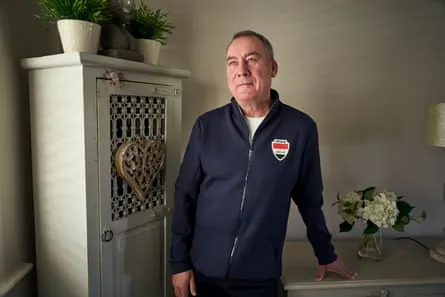
After departing from United in 2013, Meulensteen’s career took him to Fulham and various coaching roles in the US, Israel, and India, before contributing to Australia’s World Cup qualification. He gained invaluable insights that have proven beneficial in his coaching approach, particularly in helping players manage their insecurities.
“When they confront fear, I encourage them to personify it. What exactly does that fear entail? It could stem from worrying about the repercussions of losing a match. While we can’t control every thought that crosses our minds, I urge them to focus on their aspirations—such as performing well, scoring goals, or qualifying for the World Cup.”
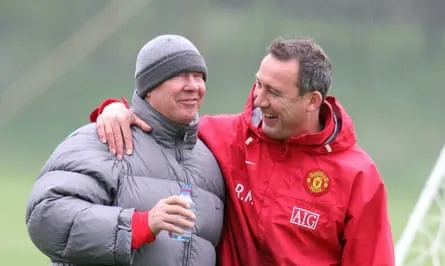
Meulensteen advises players to “add” elements to their game rather than change existing ones. Ferguson also emphasized the power of words in coaching. “He always asserted that the two most crucial coaching phrases are: well done,” Meulensteen notes. As training sessions approached their conclusion, Ferguson would often pass by, tap Meulensteen on the shoulder, and offer that simple compliment.
The duo formed a strong connection. “He is a fantastic storyteller with broad interests. He reads extensively and possesses a wealth of knowledge about politics and history. He’s deeply interested in the American Civil War and is incredibly knowledgeable on the subject, as well as in films, actors, and beyond.”
“During our time at United, we often played Who Wants to Be a Millionaire? on my iPad during bus or train rides to away games. The frequency with which we made it to the final question is astonishing. He knew things I could never have imagined.”
They occasionally meet for tea. “We can sit for an hour and a half, two hours, and the time just flies. It’s wonderful.” Meulensteen reflects fondly on his “beautiful period” at United and hopes to create another memorable chapter this summer.