


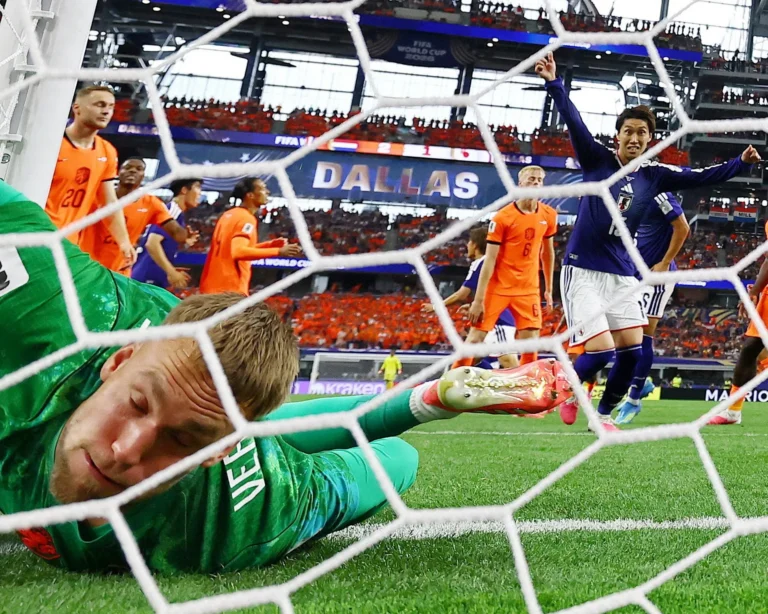
The World Cup delivered another unexpected turn in Arlington, Texas, as Japan faced the Netherlands in an intensely competitive Group F opener. In an atmosphere marked by soaring temperatures, Daichi Kamada netted an equalizer in the 88th minute, leveling the score at 2-2 just as the Dutch appeared to seize control of a challenging group.
Sport often surprises its audiences. As the jubilant Japanese bench rushed onto the field to celebrate Kamada’s deflected shot from a corner, one couldn’t help but ponder whether something extraordinary was unfolding.
The narrative surrounding fatigue, game formats, and empty seats has been prevalent, even though the stadium was filled to capacity. Yet, it seems that a different story is emerging from the early matches: perhaps this World Cup is actually showcasing quality football.
This match was captivating from the outset. The Dallas Stadium, resembling a colossal concrete spaceship, offers a unique ambiance. Inside, the structure mimics an expansive Victorian railway station, with a vast glass roof and panel inserts at either end, giving it the impression of an enormous agricultural shed.
The color schemes were striking, featuring a warm royal blue contrasted against a vibrant classic orange. The Netherlands, irrespective of their team’s form, evoke a sense of nostalgia, with their distinctive sounds and colors transporting fans back through tournament history. Ronald Koeman had suggested that Memphis Depay might be fit to play, but ultimately Donyell Malen led the attack.
Japan has demonstrated their capabilities on the World Cup stage in recent tournaments. Their head coach, Hajime Moriyasu, is also intent on making a significant impression, as the team’s ambition is to clinch the title this year. They opted for a formation featuring attacking midfielders in wing-back positions and employed a back three, reflecting an evolution in strategy since the last World Cup.
Early in the match, the Netherlands seized possession and came close to scoring within three minutes. Malen executed a brilliant run, turning sharply before unleashing a powerful shot that was deftly saved by Zion Suzuki. Following this, the game shifted into a cautious exchange, characterized by the Netherlands’ measured possession and probing attacks.
Japan displayed moments of high pressing, while Frenkie de Jong orchestrated play with poise, appearing to command his own calm space on the field.
The hydration break momentarily stalled the game’s momentum, but it was enlivened by the unexpected appearance of the Dallas Cowboys cheerleaders on the stadium’s massive HD screen, showcasing a surreal sight that captivated the crowd.
Group F appears daunting, especially with Tunisia and Sweden on the horizon, perhaps explaining the initial caution exhibited by both teams. There was a noticeable absence of aggressive forward runs from midfielders.
As the match progressed to the 34th minute, Malen found himself with another opportunity, heading the ball from a corner that Suzuki expertly kept out. At that moment, the Dutch dominated possession with 67%, executing double the number of passes and controlling the game’s tempo, but without creating clear-cut chances.
Japan’s best opportunity came just before the halftime whistle, with a well-constructed play down the right flank leading to a shot from Keito Nakamura that narrowly missed the target. Moments later, a perfectly timed pass sliced through the Dutch defense to set up Ayase Ueda, whose attempt hit the side netting, eliciting gasps from the blue-clad spectators.
However, it was the Netherlands who broke the deadlock five minutes into the second half. Virgil van Dijk directed a header that trickled in off the far post, despite Tsuyoshi Watanabe’s protests that he had been unfairly shoved aside. Van Dijk celebrated in front of the Dutch supporters, proudly pointing to his name on the back of his jersey.
At that point, Japan appeared deflated, struggling to maintain possession and find their rhythm. Yet, urgency surged through their play on the left flank, leading to an equalizer just seven minutes later. A deft sequence of passes culminated in Nakamura finding space to fire a right-footed shot into the corner, aided by a deflection off Jan Paul van Hecke.
With the score now level, the match ignited with renewed vigor, opening up spaces for both teams. Crysencio Summerville restored the Dutch advantage in the 64th minute, crafting a beautiful left-footed shot into the far corner after receiving the ball from Ryan Gravenberch. Japan, responding swiftly as they did to the first goal, regrouped even as the Dutch players celebrated and pressed forward again.
The final moments were rife with tension and excitement. Group F now stands as a competitive battleground, promising late drama ahead. Dallas has successfully passed its inaugural test as a soccer venue, and for those seeking a more subdued World Cup experience, England is set to arrive next.