


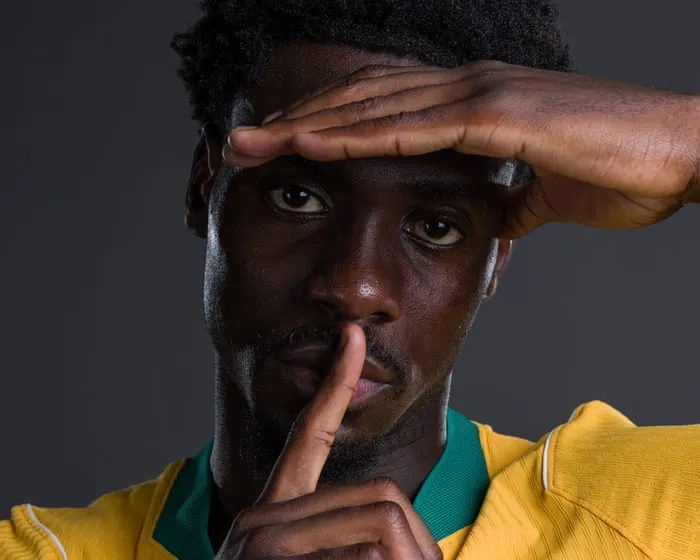
The 22-year-old forward was taken aback but pleased when he stumbled upon a playful image circulating online. The graphic, labeled “Mohamed Touré is… The Ter-Mo-Nator,” featured a digitally enhanced image of Touré with a red-glowing eye and the caption “Target acquired.”
Touré, affectionately known as Mo, has ignited excitement among Australian football fans reminiscent of the buzz surrounding legendary striker Mark Viduka from nearly 40 years ago. As one of the prominent figures leading the Socceroos’ current World Cup journey, he is gradually acclimatizing to the mounting expectations.
The comparison to the iconic character from the Terminator franchise is novel for him. “Perhaps some have likened me to being serious or playing with intensity, but no one has ever dubbed me a Terminator,” Touré remarked from his training camp in California, just days ahead of their opening match against Turkey on Sunday.
When asked if he identifies more with the original film’s cold-hearted machine or the one that becomes a hero, he replied, “I’m the friendly one. I can’t be evil.”
This notion of positivity is a recurring theme during the conversation. When prompted about how he wishes to be perceived by Australians tuning back into football after a hiatus, his response is immediate. “Some people aspire to be superstars; I simply want to be seen as a good person.”
Strikers often carry the stereotype of being self-centered, relishing the limelight, and prioritizing personal goal tallies over team success. Touré embodies the traditional attributes of a forward with his speed, finishing ability, and skill, yet he is far from a show-off. Instead, he plays a vital role within Tony Popovic’s well-coordinated team, aimed at outsmarting their Group D challengers.
Having been born in a refugee camp in Guinea after his parents fled Liberia, Touré arrived in Australia at just seven months old. His parents spent 14 years in that camp. “I have a narrative that existed before football and one that will persist after,” Touré reflects.
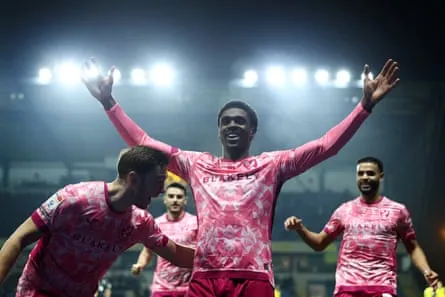
His current journey began in Adelaide, where the promising striker made his A-League Men debut at the age of 15 in 2020, becoming the youngest player to score in league history. He later made his mark in France with a debut for Ligue 1’s Reims at 19. In 2024, he netted a brace against Danish giants Brøndby while playing for Randers FC, followed by two goals for the Socceroos against New Zealand in late 2025. After transferring in January, he scored nine goals in 11 league appearances for Norwich in the Championship last season.
However, Touré’s football journey has not been a straightforward ascent. He has faced numerous injuries and undergone several transfers, having played for five different clubs in just four years. The injury woes have shadowed him since his stint at Adelaide United, where balancing his explosive speed, a sudden growth spurt, and the rigors of professional football proved challenging.
Now, Touré follows a training routine focused on building resilience. “To strengthen areas where I typically sustain minor injuries during the season,” he noted, emphasizing big muscle groups like the hamstrings, groin, and quads.
His recovery serves as a significant advantage for the Socceroos. He played 81 minutes in the warm-up match against Mexico, and although he started on the bench for their game against Switzerland on Sunday, he was brought in for the final 20 minutes.
Touré stands among six African Australians in the 26-player squad, alongside Awer Mabil, Lucas Herrington, Tete Yengi, and Jason Geria. His closest companion is Nestory Irankunda; their bond blossomed through football during their school years in Adelaide. Like Touré, Irankunda is a refugee, with his family hailing from Burundi via a Tanzanian camp on the continent’s opposite side.
“We come from different backgrounds, but especially in Adelaide, I can’t speak for other cities, we don’t focus on those differences; we see ourselves as part of a larger African community. Within that community, we have our sub-groups, but Nestor is just another African kid, and Mabil is another African guy. We all grew up sharing the same passion, which is how we connect,” he explained.
Though Liberia is absent from this World Cup, the nation is represented through its diaspora. Haji Wright, a striker for the USA, scored twice against the Socceroos in a friendly last year, while Marseille forward Timothy Weah, son of George Weah—the only African Ballon d’Or winner and former Liberian president—also plays for the World Cup hosts.
Touré stays connected to his roots, receiving updates from his father, Amara. “Liberia will always feel like home when I hear its name,” he expressed. “It’s where I belong, and regardless of challenges, I will never abandon it or stop caring for it.” He also has a fondness for Guinea and, of course, Australia.
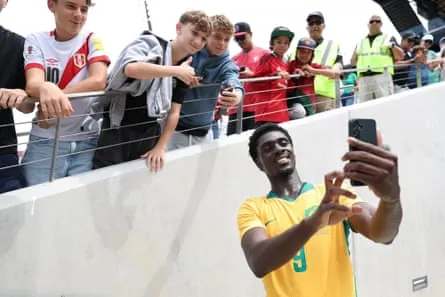
Touré holds a deep respect for the Socceroos who came before him. For many years, Australia’s male footballers faced misfortunes, unable to secure a World Cup spot. However, Touré’s generation knows only success.
When John Aloisi scored the decisive penalty that sent the team to Germany in 2006, Touré was merely one year old. He was just starting to walk when Viduka led the Socceroos onto the pitch for their historic victory over Japan in Kaiserslautern twenty years ago.
“We were just discussing this at the dinner table, where we have photos of past teams and line-ups, trying to recall how many players we recognized,” he shared. “It was thrilling to see where they played… very nice.”
The conversation about Harry Kewell’s time at Liverpool, Tim Cahill’s stint at Everton, and Vince Grella and Mark Bresciano’s experiences in Serie A sparked ambition within the younger cohort. Historically, Australia’s top footballers have rarely made it to the elite level of the world’s largest clubs.
“We mentioned it because at our table, there are many young players, and we said that’s our goal too: one day, people will look at our squad and say, ‘Oh, that’s Mo from Real Madrid, that’s Nestor from Bayern, that’s Lucas from Liverpool.’ “
Since Aloisi and Viduka’s era, Australia has yet to produce a complete striker flourishing in a top European league. While Mitch Duke impressed in Qatar and hybrid winger Mathew Leckie had his moments, strikers like Jamie Maclaren, Tomi Juric, Nikita Rukavytsya, and Josh Kennedy have often been more specialized players—either finishers, speedy forwards, or target men. Touré possesses all the qualities of an elite, leading forward: strength, speed, and finesse. However, he is quick to dismiss any comparison to Viduka, stating, “That’s insane; that’s too much.”
The overarching motif in the Terminator series is the desire to reshape the past to secure the future. Much discussion has arisen regarding the youthful nature of this Socceroos squad, featuring Touré, Irankunda, full-back Jordy Bos, and central defenders Herrington and Alessandro Circati. Many speculate they may reach greater heights in 2030 or 2034.
Touré, however, is not taking anything for granted. Despite his youth, he understands that football’s history cannot be rewritten. “Playing for the Socceroos has always been a dream of mine,” he said. “Now that I’m here, I don’t have forever. The guys say that playing for the national team comes around quickly, so I just want to make a lasting impact.”