


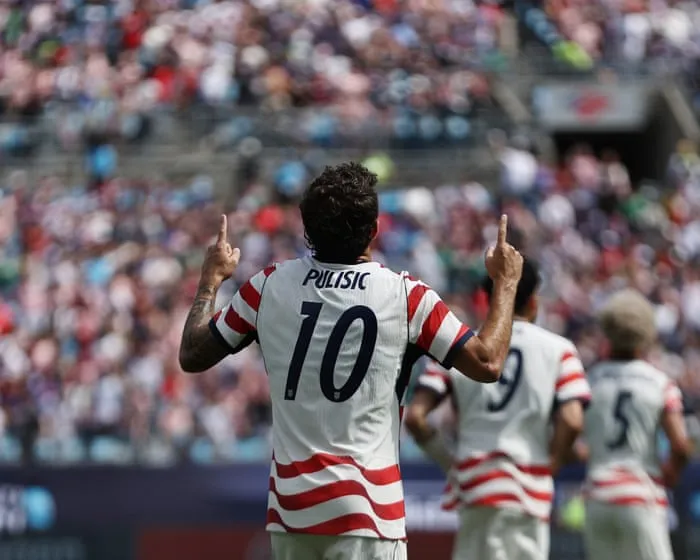
In the latest episode of the extensive nine-part documentary series featuring Christian Pulisic, the star player is seen at a dining table, with vibrant pink orchids in the background.
A friend, holding a camera, queries, “What time is it?” as Pulisic responds, “Bible time,” casually flipping through the pages of his Bible with a pencil in hand, a notepad ready for notes beside him. A cross dangles prominently from his necklace.
Pulisic’s expression of faith is not new; he has previously shared images of highlighted Bible verses on his Instagram account.
Fellow US Men’s National Team (USMNT) player Weston McKennie’s Instagram bio succinctly states, “All glory to God.” His profile picture captures him pointing both index fingers skyward, with cross-shaped diamond earrings adorning his ears.
Defender Chris Richards has also been vocal about his spiritual beliefs, revealing that he and several of his Crystal Palace teammates engage in pre-game prayers and Bible study sessions.
Goalkeeper Matt Freese mentioned in a casual remark that he had met Pulisic during a Bible study gathering after joining the USMNT.
Head coach Mauricio Pochettino, a devout Catholic, is often seen wearing a bracelet featuring a patron saint. When he began his managerial career at Espanyol in 2009, he made a pilgrimage of 7.5 miles to the Montserrat religious shrine near Barcelona, seeking divine intervention to prevent the club’s relegation, which ultimately proved successful.
The USMNT’s roster at the last World Cup included players like Walker Zimmerman, whose father is a pastor and who uses his platform to share his faith; Yunus Musah, a practicing Muslim who observed fasting during Ramadan even on match days; and DeAndre Yedlin, a Buddhist who led teammates in meditative practices on the pitch following games in Qatar.
This shift marks a significant evolution in the team’s openness regarding religion and personal beliefs.
While many past national team stars likely held religious beliefs, few felt comfortable expressing them publicly. Clint Dempsey, for instance, shared his faith in a single interview with a religious media outlet around the time of the 2014 World Cup. Tim Howard was part of the Fellowship of Christian Athletes but rarely discussed his faith in public. Jozy Altidore mentioned being raised as a Jehovah’s Witness but provided little detail. Landon Donovan, on the other hand, appears to identify as an atheist.
Despite these past reticences, the current atmosphere surrounding the team is markedly different.
It is essential to recognize that while these expressions of faith are personal and sincere, they occur against a backdrop of a political landscape that often emphasizes religious fervor. The Trump administration has emboldened Christian nationalists and aims to reshape a constitutionally secular nation into one with overt Christian values.
The team’s leading players are expressing their beliefs genuinely, reflecting a broader cultural shift among American athletes who feel more liberated to share their views compared to previous generations.
While displaying religious beliefs is not a new phenomenon among professional athletes, the national team’s context creates unique challenges. US Soccer had previously prohibited kneeling during the national anthem, only to retract the ban three years later as public sentiment shifted, arguing that such actions in national colors differ from those under a franchise’s banner. Similarly, using the World Cup platform for evangelism complicates notions of national sporting neutrality.
Past instances have shown that such expressions can backfire, as evidenced by Team USA’s controversial militaristic display at the World Baseball Classic, which positioned them unfavorably among fans.
However, there is a positive aspect to the confidence displayed by the team’s stars in showcasing their true selves during significant moments. This new generation of US players has largely shied away from media opportunities that could reveal their articulate and intriguing personalities, leading some to label them as unlikable due to their relative obscurity.
As the nation prepares to engage with its men’s national team in the upcoming weeks, fans will discover a deeper understanding of their beliefs and values than ever before.
- Leander Schaerlaeckens is the author of ‘The Long Game: U.S. Men’s Soccer and Its Savage, Four-Decade Journey to the Top, or Thereabouts,’ available now. He is also an educator at Marist University.