


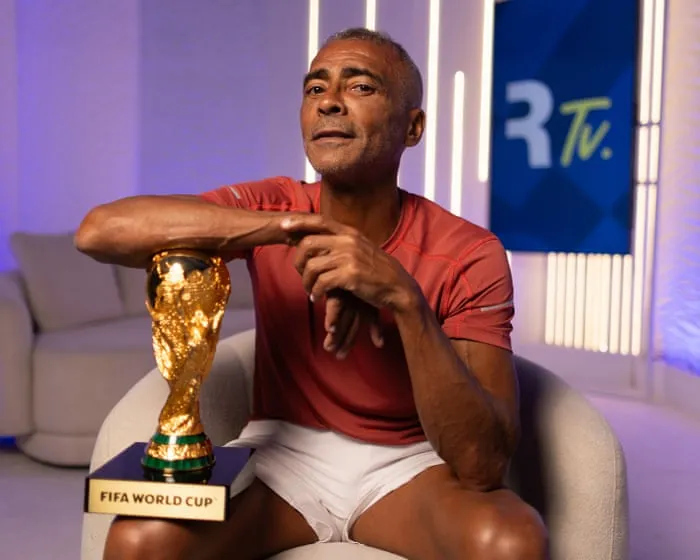
Few interviewers can boast a guest list that includes Neymar, Robert Lewandowski, Xavi Hernández, and Iker Casillas, but Romário is no ordinary figure. After 32 years since he led Brazil to victory as the World Cup champion and was named the tournament’s best player in 1994, he is now connecting with football legends for his YouTube series.
Romário launched his initiative, titled “face to face with the man,” a year ago. He explains, “This whole Romário TV endeavor is a fresh chapter in my life. I’m truly enjoying it, and it’s quite exciting.
“It’s a fantastic way to revisit my past. Since I retired in 2006, stepping into the role of an interviewer allows me to relive experiences, especially when I speak with fellow players from my era. It’s one of the key reasons I’m having such a great time now.”
Recognized as one of the finest talents in both Brazilian and global football, Romário does not hesitate to express his beliefs. “I see myself among the top five players in history,” he asserts confidently.
When prompted to reveal his list, he names six individuals: “Pelé, Maradona, Messi, Cristiano Ronaldo, myself, and Ronaldo. That’s my lineup. I would rate myself an 11 out of 10 as a player.”
This self-assessment also relates to the iconic number he wore during his career, including most of his 71 appearances for Brazil, notably during the 1994 World Cup. While he faced criticism for his laid-back approach to training, he passionately defends his style.
“Romário was considered lazy,” he acknowledges, addressing a common critique. “I didn’t train the way many thought I should, but my goal-scoring record speaks for itself.
“On the pitch, I was a formidable presence, and that was that. If anyone had a problem with it, they had to deal with it.”
Romário’s playing days took place in a vastly different era, one devoid of social media, which allowed him a more private life outside football without the constant scrutiny faced by today’s players. He openly embraced nightlife, acknowledging that had he played in the current age, he might have had to adjust his lifestyle, although he might have garnered greater recognition for his on-field accomplishments.
“I would have loved to have social media during my time. I’m sure I would have embraced it. The internet reveals your true self. Back then, perhaps 50% of Brazil didn’t have the opportunity to watch my matches or understand my contributions to football. Now, everyone is informed about everything.
“However, there’s a downside. People were unaware of my more foolish escapades. That could have been problematic, but that’s life. If social media had been around when I played, I probably wouldn’t have engaged in as many antics. But whatever I did would have been well-documented.”
Romário’s grin is unmistakable. His bold character has propelled him into a successful political career alongside his YouTube endeavors. He began his political journey 16 years ago with Brazil’s socialist party, PSB, and was elected as a federal deputy in 2010, later becoming a senator in 2014.
In 2017, he transitioned to the centrist Podemos party, and four years later, amid a wave of populism under President Jair Bolsonaro, he accepted an invitation to join the ruling far-right PL party. In contrast to Bolsonaro, who currently faces house arrest for an attempted coup, Romário advocates against liberalizing gun ownership and emphasizes increased investment in education.
“My focus is on education, health, social matters, and sports,” he elaborates. “I stand up for those with disabilities and inclusion. I don’t pressure anyone to support my initiatives in exchange for favors, like legalizing drugs. Legalizing abortion? That’s not something I’ll support. Arming the nation? I’m against that. I only endorse projects I genuinely believe in.”
So, how does he evaluate himself as a politician? Another 11, he claims.
Romário’s independent stance in politics, marked by party shifts and a refusal to conform, has attracted criticism from both sides. With presidential elections approaching in October, Luiz Inácio Lula da Silva is seeking re-election against Flávio Bolsonaro, Jair Bolsonaro’s son, who is the PL candidate following his father’s disqualification.
Romário hopes the Brazilian national team can secure a sixth World Cup title, ushering in a return to tranquility for the country. “We find ourselves in a situation reminiscent of 1994,” he reflects. “From a political perspective, the country is chaotic. The divide between left and right is stark, and violence is rampant.
“There’s a flood of negative news nationwide. Speaking from personal experience, I believe a victory for Brazil would bring relief and happiness to our struggling population. I’m certain it would help ease the country’s tensions. A World Cup win symbolizes hope for a brighter future. I sincerely hope Brazil claims the title, but it will be challenging.”
Romário’s skepticism regarding Brazil’s potential stems more from the players’ performances while representing the national team rather than from the squad’s overall talent. He feels that the country lacks standout players comparable to those from his era, such as Ronaldo and Ronaldinho, or even the legendary Zico.
“Brazil has athletes who excel in their clubs, performing exceptionally in leagues like the Premier League and La Liga. They are stars in their teams. However, once they don the Brazil jersey, they often falter. I hope those issues are behind them, and they can perform at least 80% of their club level. If they achieve that, Brazil stands a chance of winning the title.”
Romário believes that the absence of “spectacular” players today has heightened his own significance. “I think I’ve gained even more importance than before. Years ago, you had Romário, you had Ronaldo, but now there’s a void.
“That’s why we remain relevant. We hold substantial significance in Brazilian football because we achieved great things and represented our country. Unfortunately, today, no one else embodies that spirit.”
Romário acknowledges there are five teams superior to Brazil, but he does not include England among them. “Brazil possesses a stature, and the national jersey carries immense respect. England is a solid team, but I view others as stronger.
“I admire Harry Kane, [Jude] Bellingham, and [Bukayo] Saka. They’re sharp players with fantastic technique who can make a difference. They might stir the pot, but I wouldn’t place them among the frontrunners. My favorites are France, Spain, Portugal, Argentina, Germany, and Brazil.”
This “short man,” as Romário is often called, owes everything to football, yet he does not enjoy watching the game. He typically prefers spending time at the beach over viewing matches, although he makes exceptions for Brazil and the Premier League, especially due to Pep Guardiola, a former Barcelona teammate.
“Pep always displayed a unique intelligence as a player. Despite being the youngest amongst stars like [Hristo] Stoichkov, [José Mari] Bakero, [Ronald] Koeman, and [Miguel Ángel] Nadal, he truly distinguished himself. He had a knack for controlling the game.
“[Johan] Cruyff had immense faith in him. Pep was always attentive during Cruyff’s discussions. He focused intently during training, which he carried into his coaching career, making him one of the best. He ranks among the top two or three of all time.”
“He used to say that if I was quiet and my head was down in the dressing room, it would spell trouble. But if I was lively and dancing, no one could stop me. Everyone has off days. I certainly did, but they were rare.”
Before concluding his interview, Romário takes charge of the conversation, posing questions to himself in what he deems the “greatest interview of all time.”
“Romário, how did you manage to excel while exerting so little effort?” he queries. “While others were asleep, you were out on the streets. While they were dining, you were enjoying ice lollies on the beach. How did you accomplish that?
“Now Romário will respond… I’ve always had immense faith in myself. I knew that if I had pursued a conventional athlete’s path, I wouldn’t have reached my current heights.
“I was born in [the favela] Jacarezinho and later moved to Vila da Penha [a suburb]. I played barefoot and often injured my toes. I had to play football in a way that felt comfortable and joyful for me. That’s why I approached it the way I did.”