


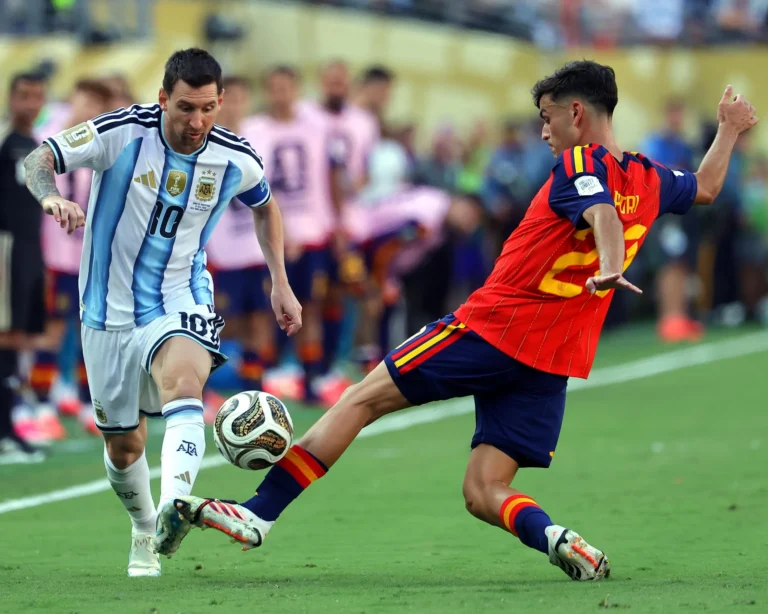
As the first half of the World Cup final neared its conclusion, a troubling question arose: would the halftime entertainment surpass the lackluster football on display? Argentina struggled to match Spain’s possession game, yet they found ways to disrupt the flow. Under the guidance of Lionel Scaloni, Argentina aimed to stifle the match’s excitement before seizing control in the latter half. The Slovenian referee, Slavko Vincic, allowed Argentina to push the limits, as evidenced by Alexis Mac Allister’s early foul on Dani Olmo that could have drawn a booking. The leniency, coupled with a pitch that hindered fluid play, enabled Argentina to disrupt Spain’s rhythm, contributing to one of the dullest World Cup finals in recent memory.
Spain, however, demonstrated admirable composure, resisting the temptations of Argentina’s tactics. The European champions clinched their second World Cup title, exhibiting patience despite the niggling interruptions by their opponents. Argentina’s attempts to advance were hampered; they struggled to build from the back, especially on the left flank, as Spain expertly pressed and suffocated their attacks. Midfielders Enzo Fernández and Mac Allister were outmaneuvered, prompting Scaloni to make a halftime substitution, replacing the ineffective Nico González with Leandro Paredes to add stability. Nevertheless, the change failed to uplift Argentina’s performance, which remained lackluster. Paredes was cautioned for an unnecessary foul on Rodri and was fortunate to escape a red card by the end of regulation. The situation deteriorated when Fernández received a second yellow card in stoppage time, jeopardizing his prospects of a transfer to Real Madrid.
Argentina appeared slow and aging, having already endured two rounds of extra time. Their physical condition worsened with the loss of both starting center-backs to injury. Lisandro Martínez and Cristian Romero, both adept with the ball, left the pitch early, diminishing Argentina’s tactical options and exacerbating their dependence on Lionel Messi. Spain effectively cut off the supply to the 39-year-old, who was smothered by their intensity. Unable to find space or evade more than one defender, Messi’s impact was minimal, contrasting sharply with the dangerous crosses that had troubled England in the semi-finals. Some argued that Scaloni should have substituted Messi following Fernández’s dismissal, but he instead removed Julián Álvarez, a player whose speed could have posed a greater threat.
Álvarez’s exit prompted Scaloni to introduce Marcos Senesi, shifting to a back five. The statistics were telling: Argentina’s expected goals (xG) stood at 0.00 until the final minutes forced a frantic attempt at response, ultimately rising only to 0.22. It wasn’t until the 117th minute that the defending champions managed their first shot, a long-range effort from Messi that deflected wide. Throughout the match, Spain’s organized defense remained resolute, while Argentina managed just 34.9% possession and a mere six touches in the Spanish penalty area. Spain dominated the second half, amassing 20 shots compared to Argentina’s two, but poor finishing and exceptional goalkeeping nearly led to a penalty shootout. Emi Martínez made an impressive 12 saves, the highest by a goalkeeper in a World Cup final, including a remarkable dive to fend off a free-kick from Lamine Yamal. Yet, even his heroics were insufficient.
From both a moral and tactical standpoint, Spain emerged as deserving winners. They executed their game plan flawlessly, displaying resilience against Argentina’s disruptive tactics. Rodri excelled in the No. 6 role before being substituted for Martín Zubimendi in extra time, successfully neutralizing Fernández. Coach Luis de la Fuente made astute substitutions, with Pedri proving to be a game-changer after coming on for Fabián Ruiz. While Argentina focused on halting Lamine Yamal’s progress by deploying Nicolás Tagliafico to contain the young winger, De la Fuente’s strategic adjustments paid off as he introduced Nico Williams for Álex Baena on the opposite side. This maneuver injected pace into Spain’s attack, and the pressure ultimately culminated in a goal. Pedro Porro delivered a precise cross from the right, allowing Williams to outpace Nahuel Molina and set up fellow substitute Ferran Torres for the decisive score.
- World Cup 2026
- Spain
- Argentina
- World Cup
- features