


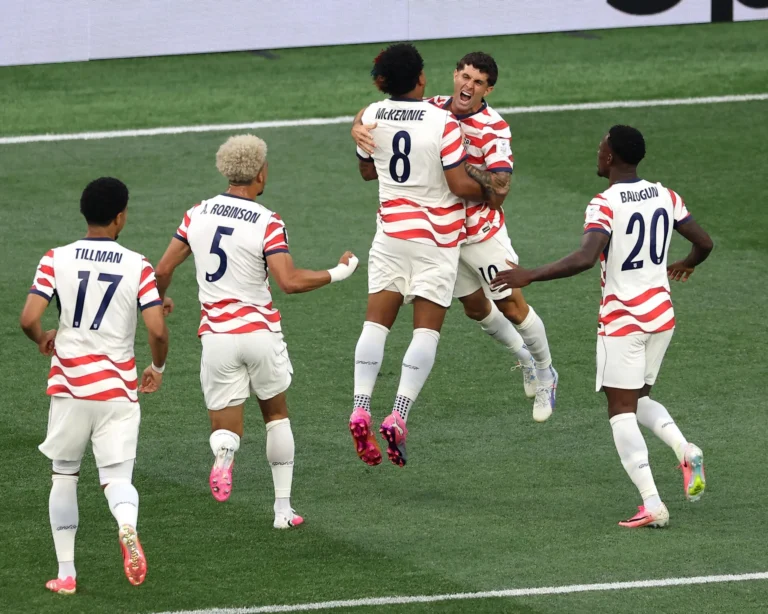
Significant uncertainties surround the US men’s national soccer team as they navigate the upcoming years. Mauricio Pochettino’s contract is nearing its end, and while US Soccer has proposed an extension, both sides are currently deliberating. Additionally, the recent departure of Matt Crocker as sporting director, who took a similar position in Saudi Arabia just before the World Cup, raises further questions about the sport’s trajectory in the United States. Despite the core of the 2026 squad still being poised for the 2030 World Cup, there is much to consider over the next four years.
Each year presents a major tournament, and it is crucial for the US to clarify their objectives and strategies at every juncture.
2027: Nations League and Gold Cup
The United States will soon return to regional competition, aiming to maintain their momentum. The Nations League is set to kick off in September, with the US likely entering in November, as the top four teams in the region receive byes directly to the quarter-finals. The semi-finals and final are scheduled for March 2027.
Having previously won the first three editions of the Nations League, the US fell short in 2025, losing to Panama and subsequently to Canada in the third-place match. The upcoming tournament offers a vital opportunity for this team to demonstrate that their strong performance over the summer was not a fluke but rather a sign of a new standard: entertaining and efficient soccer.
The Gold Cup will take place in the summer, traditionally serving as a testing ground for players on the fringe of the national team. In 2019, the US rebounded from their World Cup absence by giving tournament debuts to stars like Christian Pulisic and Weston McKennie. Pochettino’s only Gold Cup experience allowed for the integration of Malik Tillman, Sebastian Berhalter, Alex Freeman, and Matt Freese into the squad.
Players who narrowly missed selection from Pochettino’s squad, such as Aidan Morris, Diego Luna, Tanner Tessmann, and the injured Patrick Agyemang, could use this tournament as a springboard to become more integral to the squad in the earlier stages of the cycle. Additionally, those who were deemed too inexperienced for this summer’s competition, including Zavier Gozo, Niko Tsakiris, Adri Mehmeti, and Julian Hall, will be eager to make their mark.
The goalkeeper position is one to monitor closely. Despite having a Gold Cup experience, Freese appeared inexperienced this summer and struggled against Belgium. With Matt Turner recently turning 32, the search for alternatives is crucial. Establishing a reliable goalkeeper by next summer would provide them with multiple tournaments to build synergy with the rest of the team.
The United States will also commence World Cup qualifying in November 2027, joining round two alongside the other top-ranked teams in the region. They will be the top seed in their group of four, where securing a first or second-place finish (with matches scheduled for November and March 2028) will propel them to the final qualifying round. There is simply no justification for failing to advance from this stage.
2028: Copa América and the Los Angeles Olympics
The Copa América is tentatively scheduled, as official confirmation of Conmebol hosting its flagship tournament in the United States for a second consecutive time is still pending. However, Brazilian publication O Globo reported that the 2024 and 2028 tournaments have been awarded together, suggesting that the USA and other Concacaf nations will have entry pathways even if the event takes place in South America.
More prestigious than the Gold Cup, the Copa América will serve as a critical mid-cycle evaluation for this group. It will be an essential moment for starters to reaffirm their reliability ahead of 2030, as the final stages of World Cup qualifying approach. Players approaching their 30s will need to perform exceptionally well, as younger contenders will be eager to secure their spots.
Another prominent event on home soil in 2028 is the Los Angeles Olympics, with Olympic soccer set to be held at various MLS stadiums. This tournament will primarily feature under-23 players, with teams permitted to select three over-age players.
Underestimating Olympic soccer would be a mistake. While the Paris 2024 games didn’t yield any World Cup starters, they significantly boosted Tessmann’s profile as he captained the team to the quarter-finals. The Olympics could prove even more insightful as the program prepares for a likely generational shift after the 2030 World Cup. Providing a platform for emerging talent to shine on the international stage will be a valuable opportunity to expand and enrich the player pool.
2029: Qualifying and Regional Competitions
The approach for both the Nations League and Gold Cup remains consistent: showcase a style similar to the main team while evaluating additional rotational or fringe players.
Qualifying brings an intriguing element, provided the United States avoids a historic setback in the second round. After 2028, the US coach will have recent tournament performances to analyze across a pool of 46 players: 26 from the Copa América and 20 younger hopefuls from the Olympics. This extensive group will be critical as players cycle in and out of qualifying windows due to injuries and form.
As the US learned in 2018, qualifying is not guaranteed. However, since their last entry in 2022, the expanded field has made Concacaf qualifying slightly more lenient. Instead of the previous round-robin formats, Concacaf now organizes the final twelve teams into three groups of four, with the top two teams from each group advancing to the World Cup. Additionally, the two best third-place teams will compete in a play-in game for a chance at the inter-confederation playoff.
Qualifying is a tense affair worldwide, but thoughtful planning throughout the entire cycle can cultivate confidence. By the end of 2027, a clear team style and a solidified goalkeeper will be essential. Assessing the A-team during the Copa and nurturing the next generation at the Olympics in 2028 will be critical to refining team dynamics leading into a successful qualifying run in 2029.
After a cycle devoid of crucial evaluations, the US has a chance to generate momentum and build steam well in advance of the 2030 World Cup. The responsibility lies with the program to make astute decisions regarding their coaching staff and potentially in the backroom to ensure a strong start.