


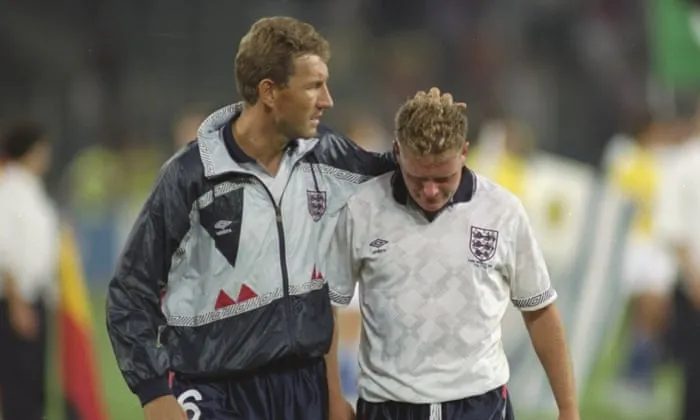
In a defining instant for a generation, Paul Gascoigne’s tears during the 1990 World Cup semi-final encapsulated both the peaks and valleys of England’s football saga. As the tournament progressed, the nation experienced an unexpected wave of optimism that paralleled Gascoigne’s emerging brilliance, ultimately culminating in a gut-wrenching defeat that left an indelible mark.
Gascoigne’s ascent to international fame came swiftly after just one previous cap, following a remarkable showing against Czechoslovakia in April 1990, which solidified his position on the squad. His performance against West Germany was nothing short of extraordinary, igniting hopes that England could achieve footballing glory.
“I received the ball in the center circle and pushed my way forward. As Matthaus attempted to take it from me, I nudged the ball away just out of reach, but I overran it. I had to stretch as Thomas Berthold came in. I was giving it my all; it was the World Cup semi-final, and I wanted to ensure they earned nothing easily. To this day, I genuinely believe I didn’t touch him, but he fell to the ground, rolling as if in agony. I crouched down to check if he was alright, not realizing I was in trouble. I thought there was nothing wrong with the challenge. Then, everything slowed down.”
As the tension heightened, Gascoigne’s emotions surged when he confronted the referee, who brandished a yellow card. The realization struck him like a hammer blow, as it meant he would miss the final should England progress.
“I straightened up and faced the ref,” Gascoigne recounted in his memoir, *Glorious: My World, Football and Me*. “He reached for his pocket. Suddenly, everything went silent. The world froze, leaving only the man in black. My eyes followed his hand, to the pocket, then out with the card. There it was, raised high above my head. I gazed at the crowd, looked at Lineker, and couldn’t contain my emotions. At that moment, all I wanted was to be alone.”
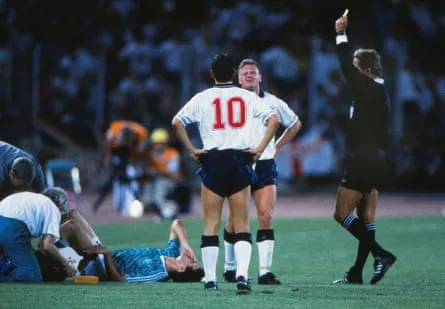
Manager Bobby Robson felt the gravity of the situation acutely, expressing his sorrow over losing such a gifted player at a critical juncture. The atmosphere was electric, and Gascoigne’s reaction illustrated the emotional burden the match placed on him.
Robson shared, “My heart sank the moment the referee produced the yellow card. It felt like my heart hit the ground. I realized instantly, that was it for Paul Gascoigne; he was out. It was a tragedy—for him, for me, for the team, for the country, for all of football.”
As Gascoigne struggled to manage his feelings, Gary Lineker, recognizing the weight of the moment, tried to console him amidst the turmoil. The pressure on Gascoigne became starkly apparent as he contended with the ramifications of his booking.
The consequences of the match were profound. As England geared up for a penalty shootout, Gascoigne, overwhelmed by emotion, chose not to take a penalty, which led to Chris Waddle stepping up instead. Gascoigne’s choice not only highlighted his mental state but also influenced the match’s outcome.
Referee José Roberto Wright later justified his decision to issue the yellow card, stressing that it was a clear infringement of the rules. His viewpoint added another layer to the intricate narrative surrounding that fateful confrontation.
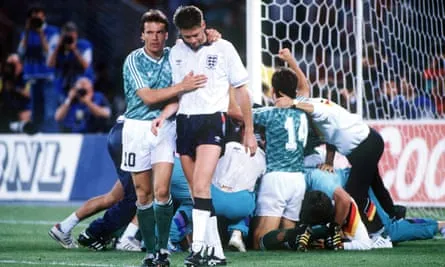
“Listen, there was no controversy,” Wright asserted in a retrospective interview. “The boy tackled an opponent from behind, and in today’s game, he could have even been sent off. It wasn’t my concern if Gascoigne had already been booked; my duty was to enforce the game’s laws.”
The aftermath of Gascoigne’s emotional upheaval became a defining moment in English football history. His tears resonated powerfully with supporters, symbolizing vulnerability and passion in a sport often characterized by grit.
Despite enjoying notable success at the club level, including a Golden Boot at the 1986 World Cup, Gascoigne’s legacy remains intertwined with that moment of profound sorrow. He is cherished not just for his extraordinary skills on the pitch but for the innate qualities that endeared him to fans.
As England reminisces about its footballing heritage, the recollection of the Italia ’90 semi-final continues to resonate. Many believe the team delivered one of its greatest performances, yet the result left supporters longing for what might have been. The loss served as a stark reminder of the thin line between victory and defeat in the realm of sports.
“It’s the one thing I look back on and regret,” Lineker reflected. “It still stings. We were so close to a World Cup final. We would have won it, too. Argentina were vulnerable.”
In the end, the story of Gascoigne’s tears and England’s near-miss stands as a poignant chapter in football lore, capturing the emotional rollercoaster of the sport and reinforcing the deep connections fans cultivate with their heroes.