


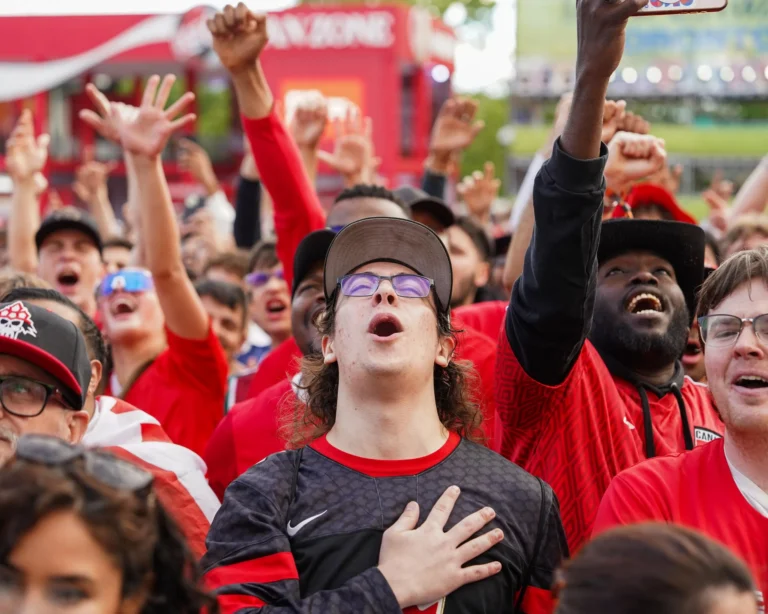

Toronto’s Front Street buzzed with excitement throughout the week, connecting the central station with the waterfront area that features a fan fest and the Toronto Stadium to the west.
In anticipation of the Croatia-Panama match on Tuesday, fans donned jerseys not just for those teams but also for Brazil, Scotland, and others. A fan from Croatia confronted a street vendor near the Rogers Center, where the Blue Jays were set to play, for not offering Croatia merchandise: “Canada’s first professional women’s soccer league,” he exclaimed. “This World Cup is our coming out party,”
Across the street, the Canadian Broadcasting Corporation showcased images of six women’s soccer players in Northern Super League uniforms. The caption read, “Over the years, we’ve gone through our fair bit of controversy, a little bit of lack of transparency, and changes within the organizational structure of Canada Soccer. But that is all behind us and now we’re steady on the path of growth, the path of creating a foundation.” This serves as a reminder that domestic soccer continues to thrive amidst the World Cup festivities.
The juxtaposition highlights the significance of this extraordinary event for Canada.
While the United States and, to a lesser extent, Mexico, have captured much of the media attention, Canada stands out as the only first-time host in 2026. Mexico will be hosting for the third time and the USA for its second. For Canada, the potential benefits are substantial, as this World Cup is anticipated to provide the same boost that U.S. soccer experienced in 1994, a lift that Mexico no longer requires.
“I think the biggest opportunity is not just the five weeks hosting and participating in the tournament,” said Tosaint Ricketts, a long-time forward for Canada who is currently with the Vancouver Whitecaps and was involved in the committee that appointed Jesse Marsch as the national team manager. “It’s really in the legacy that the tournament leaves behind, which can be transformation for soccer in this country.”
The Canadian Soccer Association is shaking off years of dysfunction. After the men’s team returned to the World Cup in 2022, ending a 36-year absence since their sole appearance in 1986, momentum is building. It’s important to note, however, that the women’s team has won three consecutive Olympic medals from 2012 to 2020, including a gold in the most recent Games. “Of course, people know soccer is not number one in Canada, but I’m not sure people know that it’s the most participated-in sport,” Ricketts stated. “There’s over a million participants across Canada. The next step is to get the corporations investing in the game, improve the infrastructure so these million participants have the facilities and resources to grow and get better. What the World Cup does is allow all of this progress to be sustainable.”
With the sport gaining stability, the World Cup presents a crucial turning point that could finally elevate soccer within a nation that traditionally favors hockey, while also sharing a rich sports culture that is far from homogenous.
“We want to bring investment in,” remarked James Johnson, commissioner of the Canadian Premier League, which currently includes eight teams in its eighth season (with three additional Canadian clubs in MLS). “We want to scale and we want to take advantage of the momentum the World Cup creates. We want to increase our marketing spend for the Canadian Premier League, to increase the playing time on the pitch and our clubs’ infrastructures to develop better players. It requires investment. For us, it is really commercializing the sport and bringing in revenue and partners. It’s positioning the sport in the mainstream and making sure when the World Cup comes and goes, people can still see soccer in Canada on billboards and on linear TV.”
Just as there was in the U.S., a significant gap exists between the widespread popularity of soccer and the elite level of the domestic game. “The legacy for a sport is very heavily influenced by the performance of the national team,” Ricketts explained. “The longer the host nation stays in the tournament, the deeper the connection new fans have with the sport.”
There is hope that sponsors drawn in by the World Cup will continue their involvement long after the tournament concludes. “All this history is going to create a legacy and inspire the next generation,” Johnson stated. “Kids are going to talk about this for the next four years and beyond.”
For these aspirations to materialize, the support of the men’s national team is crucial. After achieving their first World Cup point, win, and advance to the knockout stage, Les Rouges’ victory over South Africa in the round of 32 ensures they will remain a topic of national interest for another six days, as they prepare to face the winner of the Netherlands vs. Morocco match. “How can we position the CPL as really the legacy story of the 2026 World Cup, just as Major League Soccer was the legacy story coming out of the 1994 World Cup?” Johnson noted. “It really feels like we have the foundation now … to really grow and take this game even further in Canada. We’ve been in it for a while, but it really feels like it’s just the beginning.”
“All this history is going to create a legacy and inspire the next generation,” Ricketts echoed. “Kids are going to talk about this for the next four years and beyond.”
Ultimately, this World Cup presents an opportunity for growth. It allows the Canadian Premier League and Northern Super League to capitalize on the tournament’s long-lasting effects. The challenge lies in forming connections between the excitement of Croatia and Panama’s visit and the experience at local professional teams.
“How can we position the CPL as the legacy story of the 2026 World Cup, similar to how Major League Soccer emerged as the legacy story following the 1994 World Cup?” Johnson inquired.
“It’s looking positive,” Ricketts added when discussing the future of Canadian soccer. “It really feels like we have laid the foundation … to grow and advance this game in Canada. We have been in this for a while, but it genuinely feels like it’s just the beginning.”
- Leander Schaerlaeckens is the author of The Long Game: U.S. Men’s Soccer and Its Savage, Four-Decade Journey to the Top, or Thereabouts, which is out now.
- He teaches at Marist University.
- Canada
- World Cup 2026
- World Cup
- features