


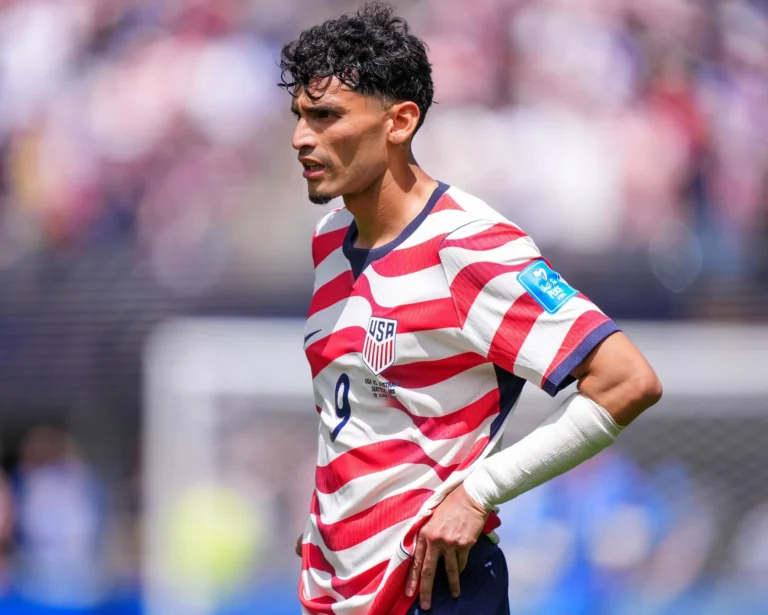
With the news that Christian Pulisic would miss Friday’s match against Australia due to a calf injury, Mauricio Pochettino faced several strategic choices. Pulisic remains a key figure for the United States, and finding a suitable replacement posed a challenge.
Australia approached this fixture eager to make a statement following their opening win over Turkey. Like their previous friendly encounter with the United States in October, the Socceroos employed a low defensive block, featuring five defenders and a focused zonal marking scheme. This strategy often proves effective against teams that play with a single striker, a formation the US has favored throughout much of the 21st century.
When the teams were announced, the US made only one alteration from the squad that convincingly beat Paraguay 4-1. Instead of Pulisic, Ricardo Pepi stepped in to partner with fellow center-forward Folarin Balogun. While this shift seemed risky, it ultimately proved to be a tactical success, as the US established a commanding 2-0 lead by halftime, a margin they maintained through to the end of the match.
“I feel like it opens up some spaces, of course, but you know it’s always good to be able to have two strikers,” Pepi said after making his first World Cup start. “If the defenders are marking me, then the other [striker] is always free. So it’s a good thing that we were able to play like this, and it just shows what the team has.”
This team possesses strong chemistry, honed through years of playing together at both youth and senior levels. With several weeks of training prior to the match, the US displayed improved coordination in their movements, effectively challenging even the most formidable low defenses.
The first time the US truly put pressure on the Socceroos, they capitalized on it by scoring. This marked the second consecutive match where they forced an opponent into an own goal.
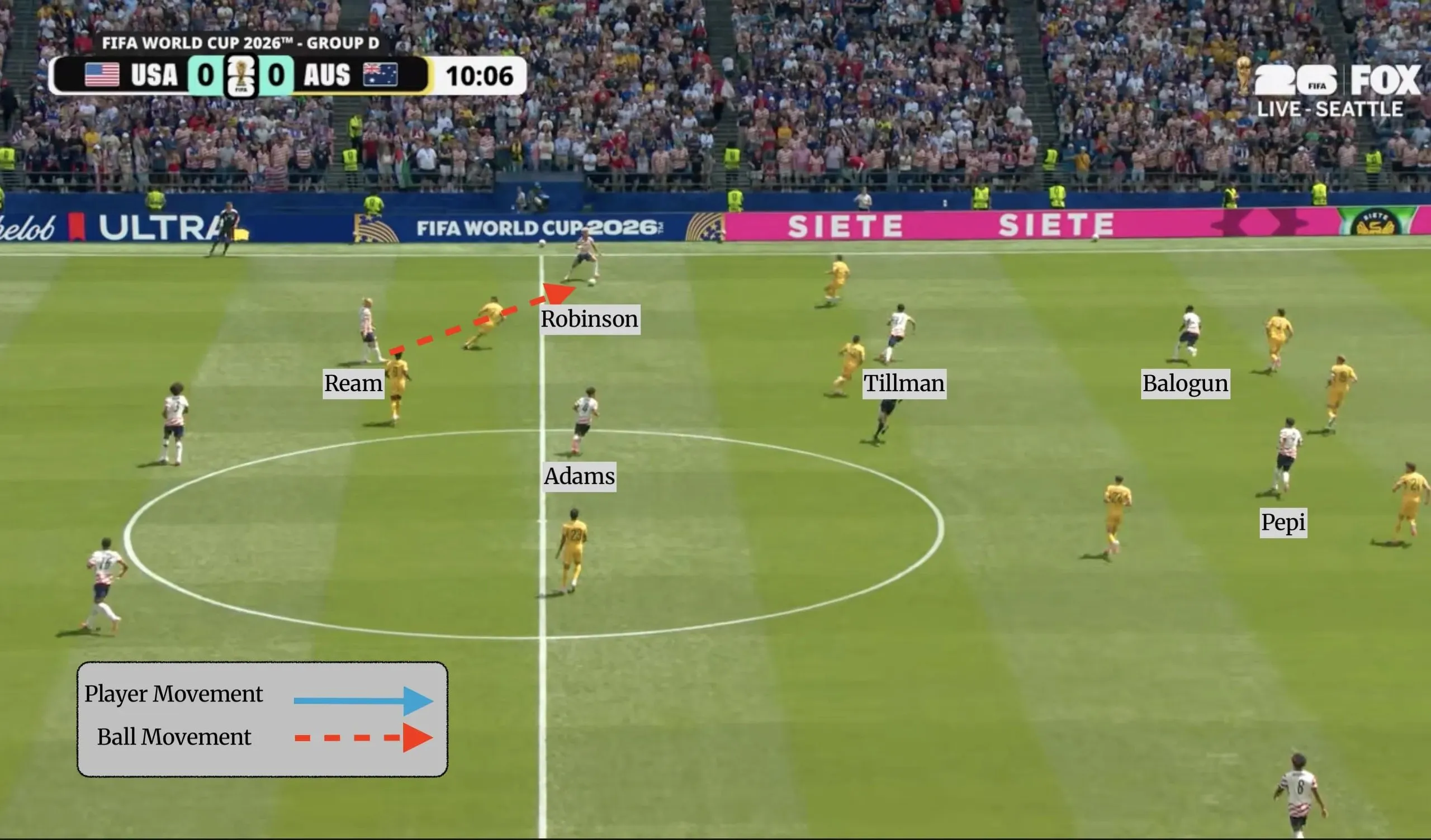
In the 11th minute, following multiple attempts to test the Australian defense, Antonee Robinson received a pass from Tim Ream, a familiar partnership throughout their careers. When the US employs two attacking midfielders, as they typically do with Pulisic, Robinson instinctively seeks to connect with either the holding or attacking midfielder to advance the play.
Against Paraguay, sequences like these kept their South American rivals on high alert, enabling the US to create intricate patterns of play. The addition of a second striker made a more direct approach even more feasible, with support readily available during aggressive runs.
Robinson challenged Australia with a ball directed up the line, successfully drawing wing-back Jacob Italiano out of position. Balogun recognized the opportunity and made a decisive run to exploit the space.
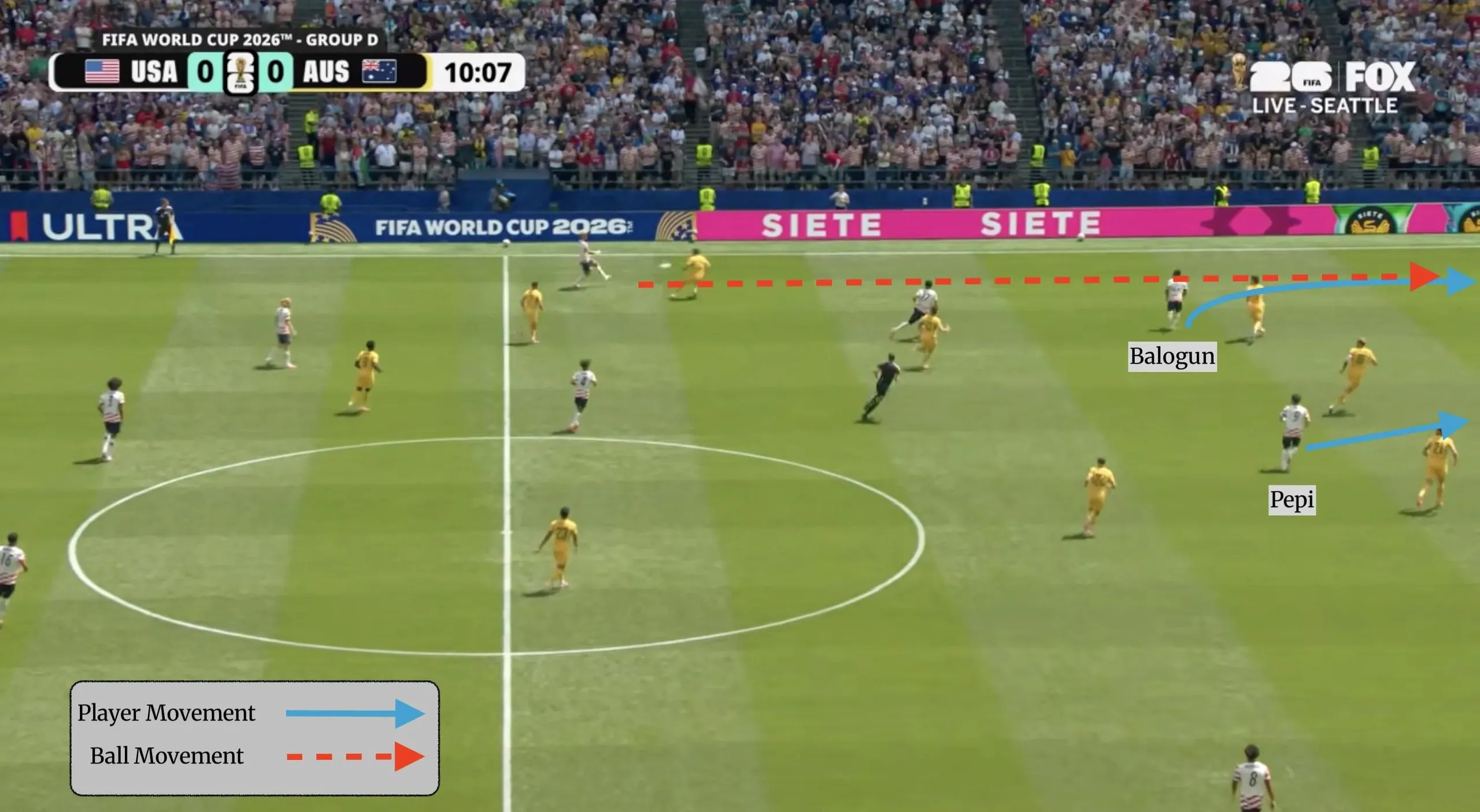
A similar opportunity arose for the US in a recent friendly against Senegal, where Sergiño Dest created a crossing option for Pulisic after Pepi had dropped back to assist in the buildup. On this occasion, with all three Australian center-backs positioned at the edge of their defensive third, the US gained a speed advantage as midfielders and wing-backs rushed to provide support.
“I mean, credit to [Balogun],” Robinson remarked post-match. “I could see that he was looking to run the space in behind, so I just kind of played it down the channel for him, and then he’s done a lot of work to get towards the goal and create a chance.”
Despite not traditionally playing as a winger, Balogun seized the space available to him, confident in his ability to stay ahead of Alessandro Circati.
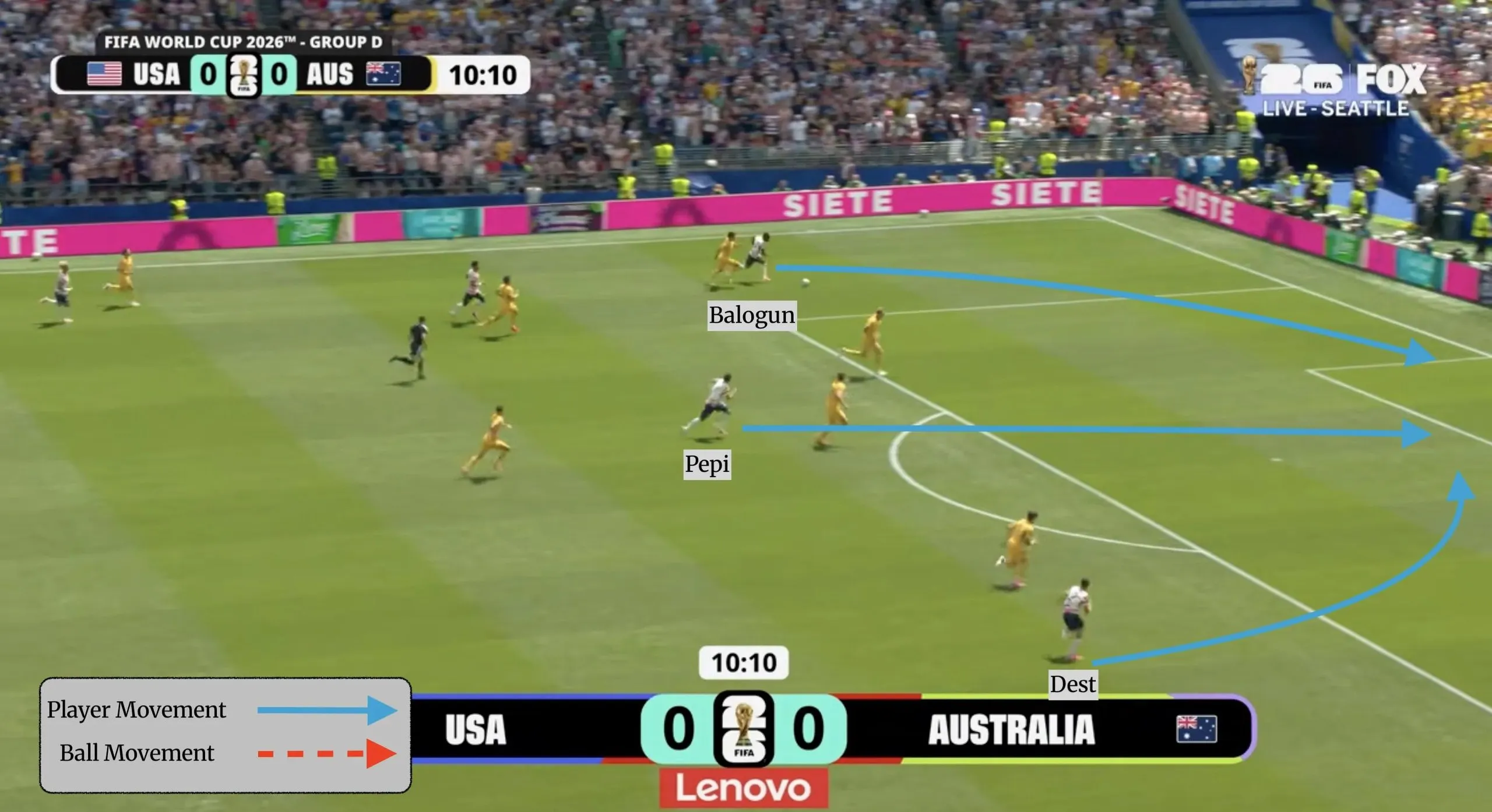
Pepi continued to perform his duties as a center-forward during the buildup, making a run through the middle of the pitch. While Balogun had previously scored twice against Paraguay, ignoring Pepi would have been a serious oversight for Australia, as he had netted 16 goals in 26 league games for PSV last season. Although Balogun was running out of space, he had excellent options in the center of the box.
Cameron Burgess managed to position himself between Balogun and his teammates, desperately attempting to nudge the ball out for a corner kick. However, under pressure, Burgess accidentally directed the ball into his own net, rewarding Balogun’s effort.
The tactical decision quickly paid off, as Australia’s defense struggled to maintain focus from the outset, with their center-backs unable to adequately cover Balogun.
“I want to create opportunities, and it might not always be myself that scores, but if I can force an error that gives us the lead, then for me it’s like a goal as well.” Balogun stated following the victory. “Whether it’s coming to feet, running off the ball, we’re all trying to create options for each other,”
Pepi’s positioning in the box was crucial for the second goal. As Robinson prepared to take a free kick at the end of the first half, Australia faced the challenge posed by three US center-backs and two strikers, including Pepi, who were all potential targets for such deliveries. Dest lingered at the edge of the area, attracting the attention of Australia’s defenders as he received Robinson’s free kick. This frantic marking left the Socceroos’ defensive block unsettled, allowing Alex Freeman to be in a prime position when Dest’s shot took a deflection toward him.
From that moment on, the second half proved significantly easier for the US to manage. Australia had committed to a defensive strategy in hopes of sneaking in a goal or two, similar to their approach against Turkey. Despite making three substitutions at halftime, the changes did little to enhance their offensive threat. Pepi continued to fulfill his role effectively, drawing defenders and finding space. His pressing and movement made him a valuable alternative to Pulisic, despite their differing roles.
For Pepi, who was controversially omitted from the last World Cup roster, this match marked a memorable debut that should secure him more playing opportunities in the future. Regardless of who is selected, this team is confident in their ability to adapt and maintain the momentum.
“It feels fluid. Everyone feels like they’re linking up really well, and hopefully we keep going with it.” Robinson noted. “It feels fluid. Everyone feels like they’re linking up really well, and hopefully we keep going with it.”