


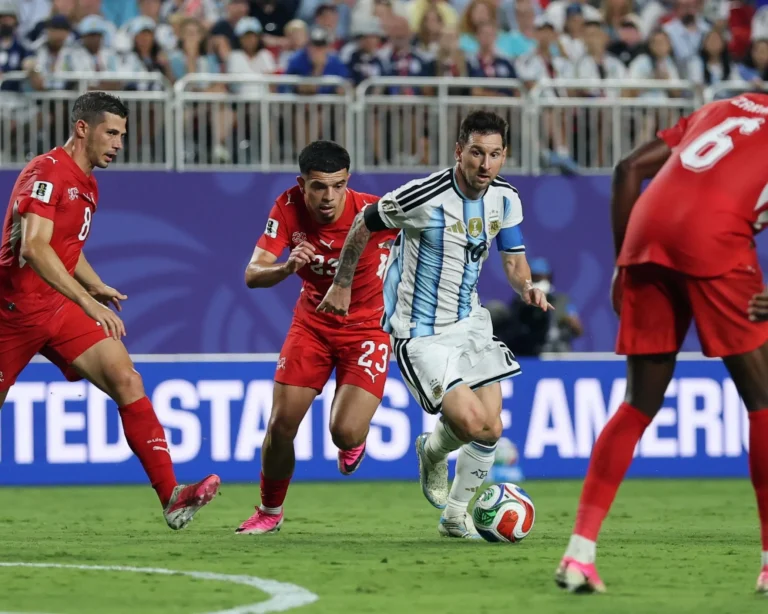
As England prepares to face Lionel Messi in their World Cup semi-final, the team’s defenders are bracing for a formidable challenge. The Argentine superstar is not only celebrated as one of the greatest players in history, but his distinctive style of play makes him particularly difficult to contain.
At 39 years old, Messi is known for his ability to conserve energy throughout a match, only to unleash his full potential when the moment demands it. This strategic approach complicates defensive efforts, as he adeptly identifies and exploits spaces that seem inconsequential when the ball is not near him.
This unique skill set explains why Messi has stood out at the tournament; he leads with 22 moments of significant impact, defined as ball carries of at least five meters that culminate in either shots or key passes. His timing and awareness allow him to elevate his game precisely when needed.
In the quarter-finals against Switzerland, Messi did not score or provide an assist during open play, yet the running statistics from that match highlight his distinct approach compared to other elite forwards. According to FIFA, Messi covered 6,655 meters at the slowest movement speed of 0-7 kilometers per hour (km/h), surpassing all players on both teams.
This slow-paced movement constituted 64.8% of his total distance traveled, significantly higher than the figures recorded by Harry Kane (40.5%), Lamine Yamal (45.4%), Kylian Mbappé (52.6%), and Erling Haaland (55.7%) in their respective matches.
However, the majority of Messi’s peers displayed greater activity in the mid-range speed categories of 7 to 20 km/h. Interestingly, there was little variation between Messi and other forwards when it came to the percentage of sprints, defined by FIFA as movements at 20 km/h or higher.
Despite matching younger forwards in sprinting percentage, Messi’s overall sprint count remains lower. However, the difference is not vast. In the quarter-final, he recorded about 85 sprints per 90 minutes, edging out Haaland (74) and coming close to Mbappé (97).
When it comes to top speed, Messi still competes effectively. Data from Sofascore indicates that his fastest sprint during this World Cup reached 30.9 km/h, eclipsing the high-speed runs of Lautaro Martínez (30.5 km/h) and Alexis Mac Allister (30.2 km/h), both of whom are over a decade younger. His top speed is also closely matched by Kane (31.4 km/h) and Jude Bellingham (31.1 km/h).
While England can take some comfort in the fact that their fastest recorded player, Nico O’Reilly, reached 35.6 km/h, which may aid in trying to neutralize Messi, the challenge remains daunting. Tracking Messi’s movements and making split-second decisions on when to react is a far more complex task.
- World Cup 2026
- Lionel Messi
- Argentina
- England
- World Cup
- features