


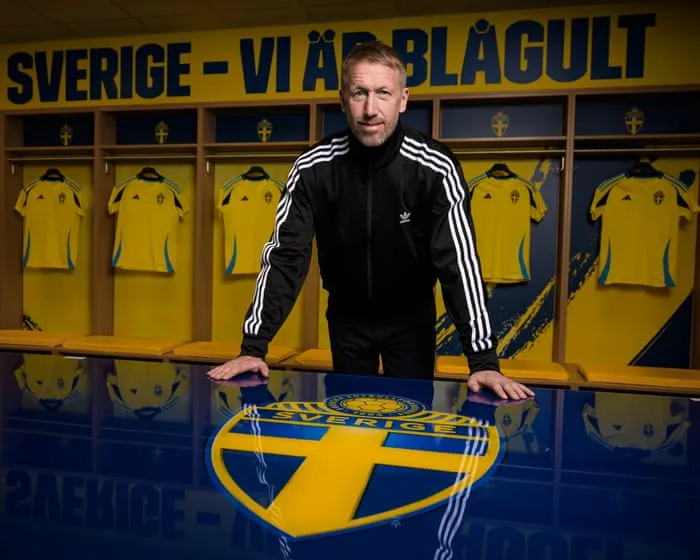
Graham Potter has learned through his management career that avoiding failure is futile. Reflecting on his challenging tenures at Chelsea and West Ham, the 51-year-old emphasizes the importance of confronting setbacks. “You have to face the bad stuff,” he asserts. “The more you confront it, the better your life becomes. Then you experience those beautiful moments.”
During a candid discussion about the tumultuous journey of recent years and the harsh realities of being a football manager, Potter acknowledges his share of successes. He has notably revitalized Sweden’s football scene, guiding the team into the World Cup, yet is aware that critics often highlight the failures. After just seven months at Chelsea, following a stable period at Brighton that began in September 2022, he found himself back in the coaching scene when West Ham approached him at the start of last year.
However, his stint at West Ham proved to be a misstep, as he struggled within the club’s chaotic environment. Potter managed to secure only six wins out of 25 matches, starting poorly in his first full season, which led to a pivotal moment in his career after he was dismissed last September. Faced with uncertainty, he contemplated the future of a career that once seemed promising.
“I’ve gained enough life experience to put all these challenges into perspective,” he reflects. “I appreciate every experience, both good and bad. Ultimately, you must deal with whatever life presents you. Following my time at West Ham, I had two choices: either sit idle and engage in media work or return to coaching.”
Then, an opportunity arose from Sweden. The national team was struggling in their World Cup qualification group and needed a new leader to replace Jon Dahl Tomasson. Before making any decisions, Potter took the time to introspect, consulting with those close to him on how to move past his West Ham experience.
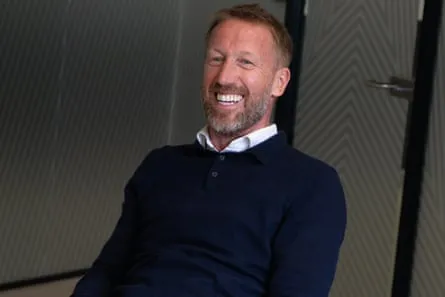
“You must confront failure,” he explains. “Yet, I believe it shapes you into a better person. Sometimes in football, you simply cannot rationalize the situations. You just think, ‘Perhaps it wasn’t meant to be.’ Then, you strive to move forward with your life.”
Potter chooses to ignore external opinions. “Worrying about others’ perceptions is a path to a miserable existence,” he remarks. He recognized the stakes involved when he agreed to take on the role of Sweden’s manager on a temporary basis last October. Despite not advancing from their qualification group, Sweden earned a second chance through their Nations League performances, which secured a playoff spot. Another failure could have further tarnished his reputation.
In March, a transformation occurred. Sweden displayed resilience in the playoffs, with Viktor Gyökeres netting a hat-trick in the 3-1 semi-final triumph over Ukraine, followed by an 88th-minute winning goal in the 3-2 victory against Poland in the final.
“If you watch the Swedish commentary on YouTube from that game, the emotion in the commentator’s voice is palpable,” Potter recalls. “When Viktor scored, it felt surreal. All our substitutes rushed onto the pitch. With 15 players celebrating, I thought about the yellow cards and potential complications. But this is the World Cup, so all bets are off.”
Potter has extended his contract with the Swedish national team until 2030. He has developed a profound connection with his adopted nation. His previous success with Östersund, where he led the club from the fourth tier to the Europa League, has made him feel at home in his new role.
“I feel very Swedish when I’m working,” he states. “I resemble a bit Swedish. Two of my children were born in Sweden.” He finds a deeper significance in international football. “With the national team, you’re part of something larger than yourself. The intensity is palpable, and that’s what makes it beautiful.”
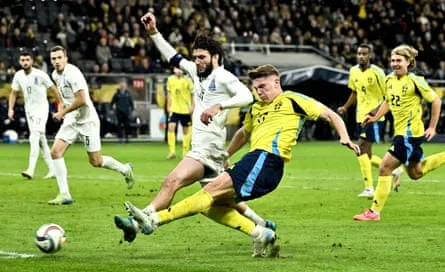
Transitioning to international management has posed challenges for Potter, particularly as he is known for his systematic approach. “You lack the time to cultivate ideas,” he notes. “The risk lies in overthinking and creating tactical schemes for matches months in advance, while the reality is that you only have two days to prepare. Simplicity is key.”
Following the playoffs, Potter faced tough discussions with players who did not make the World Cup roster. Keeping morale high within the team is essential. “Even in a training match with 11 versus 11, four players are left out,” he explains. “That can be challenging. It’s crucial for the group to remain unified.”
Sweden is currently in a training camp in Stockholm before traveling to their base in Texas. Potter is mindful of the expectations, especially considering Sweden’s historic third-place finish in the 1994 World Cup. With Japan, the Netherlands, and Tunisia in Group F, progressing to the knockout stage will be a significant challenge.
As Sweden prepares for their opening match against Tunisia in Monterrey on June 14, managing the heat will be critical. Potter anticipates that games will be slower and that set pieces will play a crucial role.
“The evolution of the game is evident,” he observes regarding dead balls. “In tournament football, the stakes are higher, making it harder to maintain an expansive style. Matches tend to tighten up, so creating chances through set pieces will be a focus for many teams.”
Sweden boasts other attacking threats. Although Dejan Kulusevski will miss out due to injury, a forward pairing of Alexander Isak and Gyökeres could be potent. Gyökeres faced criticism during his initial season at Arsenal, but Potter highlights the positives. “He exemplifies the modern football landscape,” he points out. “From our perspective, he has been instrumental in getting us to the World Cup. For Arsenal, he has fulfilled his role, scoring goals and helping the team win the Premier League and reach the Champions League final. His contributions have been outstanding.”
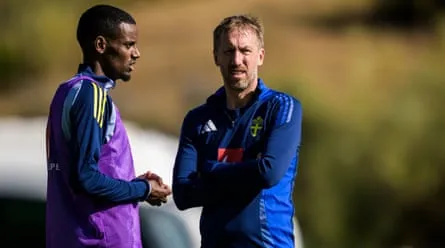
Isak, on the other hand, has encountered difficulties since transferring from Newcastle to Liverpool last summer. A disrupted pre-season and struggles with form and fitness, following a broken leg, have hampered his performance.
“His first season at Anfield hasn’t unfolded as he hoped,” Potter reflects on Isak’s situation. “We often assume that signing a player will solve all issues. I’ve experienced this firsthand – it doesn’t always work out as expected. While Isak thrived at Newcastle, the question remains: how does he adapt to Liverpool’s style? His ability hasn’t diminished; he’s still a top player. It’s all about team dynamics, which can take time to align. He’s a fantastic individual.”
Potter recalls Isak’s debut for AIK against Östersund. “We were somewhat pleased before the match because their center-forward was absent, and instead, a 16-year-old was starting,” he shares. “Then he scored, and we lost 2-0, which taught me a valuable lesson.”
Encouragement came when Isak netted a spectacular goal in Sweden’s 3-1 loss to Norway recently. Potter is eager to deploy both Gyökeres and Isak in his lineup. “Their contrasting styles are beneficial to us. We haven’t yet played with both together, which presents an exciting opportunity for development.”
As the excitement builds, Potter has been in touch with former Swedish striker Zlatan Ibrahimović. He reflects on the trend of club managers transitioning to international roles. “I’ve talked to those who’ve experienced both sides, and they often describe tournaments as the pinnacle of football,” he shares. “In the national team setting, you feel a connection to something with greater depth and meaning.”
Potter is thriving in his current role. Although West Ham dismissed him, they could not escape relegation. Now, he is set to lead Sweden into the World Cup. “My earliest football memories date back to ’86 when I was 11, watching Diego Maradona dominate the game. That’s when my passion began. To have the chance to work in that environment is truly a dream come true.”