


This piece is part of the 2026 World Cup Experts’ Network, a collaboration among leading media outlets from the 48 qualified nations. Coverage leading up to the tournament, set to commence on June 11, includes daily previews from three different countries.
Strategic Overview
Iran was among the earliest teams to secure a spot in the 2026 World Cup, enjoying a smoother qualification journey compared to past tournaments. However, the preparation process for this competition has encountered numerous obstacles. Tensions with the US and Israel have raised significant concerns regarding Iran’s participation, especially since all three of their group matches are scheduled to be held in the US. Consequently, head coach Amir Ghalenoei and his staff have been diligently working to minimize disruptions.
Despite these challenges, Iran showcased their determination during two friendly matches in March against Nigeria and Costa Rica. In their opening encounter against Nigeria, they utilized a 3-6-1 formation, which Ghalenoei labeled as the team’s “defensive plan B,” likely aimed at countering Belgium in the group stage. For the match against Costa Rica, Ghalenoei opted for a 4-4-2 setup, indicating a flexible tactical approach depending on the opposing team. The primary formation remains 4-2-3-1, which Iran predominantly employed during their qualification campaign.
Iran: Group G Matches
15 June vs New Zealand, Los Angeles (6 PM local, 16 June 2 AM BST, 16 June 11 AM AEST)
21 June vs Belgium, Los Angeles (noon local, 8 PM BST, 22 June 5 AM AEST)
26 June vs Egypt, Seattle (8 PM local, 27 June 4 AM BST, 27 June 1 PM AEST)
Certain players can be assured of their positions in the starting lineup, irrespective of the chosen formation. Alireza Beiranvand is set to be Iran’s primary goalkeeper for a third consecutive World Cup. Shojae Khalilzadeh is the sole center-back guaranteed a starting role, while Saeid Ezatolahi, if in good health, is the undisputed No. 6 in the midfield. Up front, regardless of whether Iran plays with one or two strikers, Mehdi Taremi—wearing the captain’s armband—will lead the attack. Notably, fellow forward Sardar Azmoun has been excluded from the squad due to his controversial status in Iran after photos surfaced showing him with the ruler of the United Arab Emirates, a nation that has supported the US and Israel during conflicts.
Amidst the controversies and challenges facing the national team, which relocated their World Cup training camp from the US to Mexico just weeks prior to the tournament, Ghalenoei still believes his squad can achieve remarkable success.
“We’ve encountered numerous issues recently, but the players have dedicated themselves and made sacrifices. They have worked incredibly hard through qualification and given up a lot, so I must express my gratitude to them. They are capable of creating something extraordinary at the World Cup. They possess the technical skills to make it a memorable tournament,”
he stated.
The Head Coach
Amir Ghalenoei, a former midfielder known for his time at Esteghlal—one of Tehran’s leading clubs—has had a noteworthy coaching career. His most infamous moment as a player involved a physical clash during the Tehran derby, which led to a six-month suspension. As a coach, Ghalenoei has earned numerous accolades in Iran, although his intense personality has hindered his universal appeal. This marks his second tenure as the national team’s head coach; he initially took the role after the 2006 World Cup but was dismissed post-Iran’s elimination from the 2007 AFC Asian Cup, an experience he remembers with bitterness. Achieving success this summer would allow Ghalenoei to confront long-standing critics.
Key Player
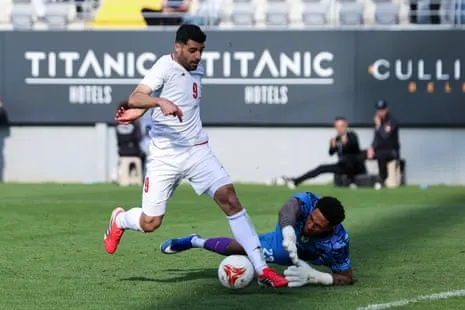
Mehdi Taremi may not have always been a fan favorite, yet his performance will be crucial if Iran aspires to make a significant impact at the World Cup. He has consistently excelled with clubs like Porto, Inter, and Olympiakos. With years of experience competing at the highest levels in Europe, Taremi has developed a commanding presence, even influencing decisions within the team. He is a diligent striker who also contributes defensively, excelling at making runs behind opposing defenses and creating one-on-one opportunities with goalkeepers. In such instances, he is always poised to either score or draw a foul for a penalty.
Player to Watch
Many anticipated that Mehdi Ghayedi would emerge as a major talent, but he has been plagued by controversies and distractions off the field. To date, he has struggled to deliver the consistency expected of him, but at just 27, he is entering his prime years. The speedy winger from Al-Nasr (UAE) could become Ghalenoei’s unexpected asset in North America. With his exceptional dribbling and accurate finishing, Ghayedi has the potential to create thrilling moments. After recovering from an injury, he marked his return to the national team with an impressive goal against Costa Rica in March.
Unsung Contributor
Saman Ghoddos has been a steady presence in the Iran squad since his debut nearly ten years ago. However, his lack of experience with an Iranian club has limited his recognition and support from traditional fan bases, resulting in less media attention. Nonetheless, his commendable character and professionalism have made him a respected figure within the team. Originally from Malmö, Sweden, he transitioned from the Premier League to Kalba in the UAE in 2024.
Expected Starting XI
Fan Dynamics at Matches
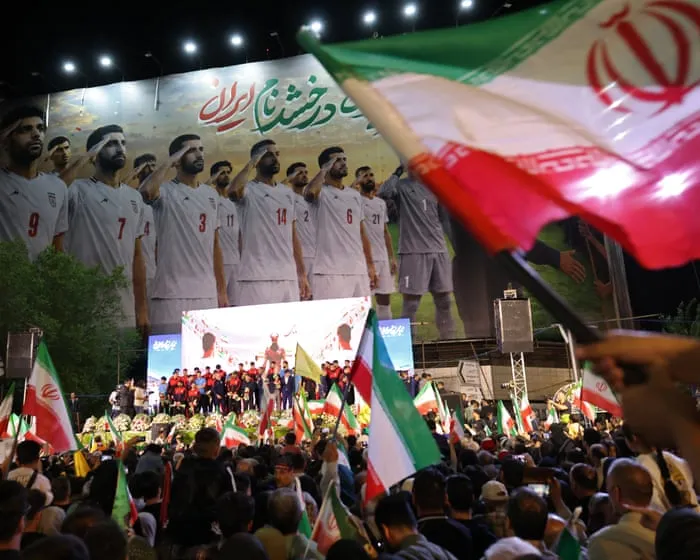
As the World Cup approaches, Iranian fans remain deeply divided regarding the national team. Some supporters back Team Melli unconditionally, while others oppose the Iranian government and prefer to see the national side lose, viewing it as a representation of the state. Given the visa challenges for Iranians traveling to the US, a significant portion of the crowd at the tournament is likely to be made up of members of the diaspora residing in America, many of whom oppose the Tehran regime. Similar to the situation in Qatar in 2022, FIFA is expected to prohibit the Shir-o-Khorshid (lion and sun) flag—Iran’s pre-revolutionary flag—from stadiums. However, it’s probable that chants in support of Reza Pahlavi, the former crown prince of Iran, will be heard. Moreover, if Iran concedes goals or faces defeats, segments of the audience may openly celebrate those occurrences.
US Relations and Team Presence
In the wake of the recent war, significant uncertainty emerged about whether Iran’s national team would be able to travel to the US for the World Cup. Ahmad Donyamali, the sports minister of Iran, remarked,
“Given that this corrupt regime has assassinated our leader, under no circumstances can we participate in the World Cup.”
Following Donald Trump’s comments suggesting that Iran’s team might not be safe in the US, Ghalenoei responded defiantly in an Instagram post:
“No one can prevent the Iranian national team from participating in the World Cup.”
Ultimately, the decision was made for Iran to compete, partly due to the belief that Trump would prefer a World Cup without Iran’s presence. Iranian officials were determined not to withdraw from the tournament, as that would be perceived as yielding to the president’s wishes. Despite security apprehensions, the Iranian government sees the national team’s participation as a symbolic triumph against Trump and the United States.