


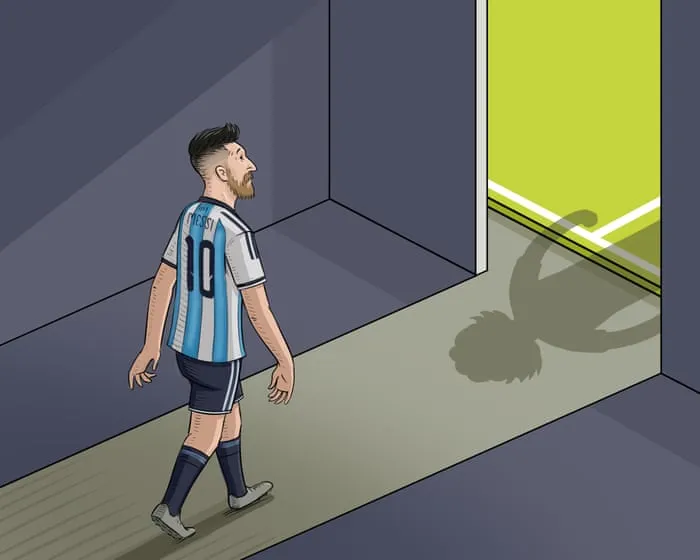
For Lionel Messi, the World Cup in Qatar was hailed as the ultimate conclusion to his storied career. The ongoing comparisons to Diego Maradona continued to loom large, casting a shadow over Messi’s impressive journey filled with both triumphs and challenges. While Maradona’s life was marked by dramatic highs and lows, Messi’s narrative has been more consistent, showcasing his talent for two decades with a steady stream of victories. There have been emotional moments and doubts, but they pale in comparison to Maradona’s tumultuous battles with addiction and scandal.
Qatar provided a fresh layer of suspense. Achieving club success alone was insufficient for Messi; his ambition was evident. He evolved from a reserved player into the team’s true captain, leading Argentina to victory in the Copa América the year before. A notable moment came during a post-quarter-final interview when he confronted Wout Weghorst, snapping, “Que mira, bobo?”—a glimpse of the fierce competitor emerging from his usual composure. As speculation mounted about this potentially being his last World Cup, each match felt like it could be his final appearance, highlighting the fragility of his brilliance.
The tournament in Qatar symbolically completed a circle. It was in Qatar back in 1995 that Argentina secured their first Under-20 World Cup title, a feat they would replicate four more times in 12 years under the guidance of coaches José Pékerman and Hugo Tocalli. Lionel Scaloni, the current coach, was part of that inaugural squad, alongside assistants Walter Samuel and Pablo Aimar. Messi himself participated in the last of those championships in 2007, alongside teammates like Papu Gómez and Ángel Di María. The legacy of Pékerman and Tocalli resonated throughout the current squad, amplified by the desire to transform their youth success into senior triumphs.
Had Messi been solely motivated by the narrative arc of his career, he might have dismissed the bisht placed on his shoulders during the trophy presentation and announced his retirement then and there. He could have taken a victory lap, reminiscent of Maradona’s iconic celebration in 1986. It would have been a fitting finale, a perfect closing scene.
Yet here we are, four years later, with Argentina gearing up for another World Cup featuring Messi. He has defied expectations, extending his career with more ‘last hurrahs’ than many could have imagined. Approaching 39 during the tournament, he will become the oldest Argentine player to participate in a World Cup, though he will rank only as the tenth-oldest player in the joint-host nations of the US, Mexico, and Canada. The looming risk is that he could exit the stage on a disappointing note, reminiscent of Argentina’s previous World Cup disappointments.
However, the possibility of glory remains. Could Messi achieve this remarkable feat again? To an outsider, it might seem he has nothing left to prove, having already solidified his legacy. Yet the mentality of elite athletes often hinges on an unshakeable self-belief. Perhaps he still envisions leading Argentina to another championship.
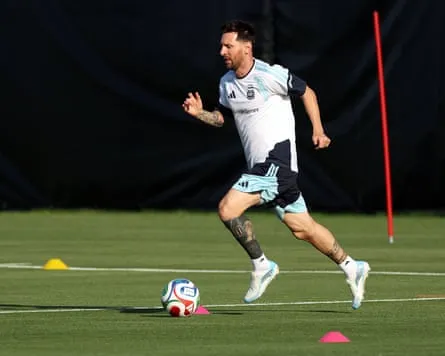
After years spent in the shadow of Maradona, constantly facing critiques about not matching his predecessor’s World Cup triumph, could Messi find a way to surpass him and secure a second title? Is there a future where Argentinians gather around the grill, acknowledging that despite Diego’s greatness, he only won the World Cup once?
But how feasible is this? In Qatar, Messi appeared to show signs of age. He often lingered on the outskirts of matches, occasionally dazzling with a moment of brilliance before fading into the background. Rodrigo De Paul played a crucial role in supporting him, prompting Inter Miami to sign him to assist Messi in MLS. Julián Alvarez and Enzo Fernández also contributed significantly to the team’s efforts. Yet, once it is accepted that a player may not possess the same speed, a gradual decline in physical abilities might not be as detrimental. By operating in the shadows, Messi could still pose a threat without obstructing team dynamics.
Before the last World Cup, Messi was still performing at a commendable level. In the half-season leading up to the tournament, he participated in 13 matches in Ligue 1 and five in the Champions League. This year, he has played 14 matches in MLS and two in the Concacaf Champions League, suggesting a similar workload. However, the intensity of competition is undeniably lower than that found in France’s top division. Despite this, Messi has maintained his effectiveness for Argentina, contributing in the most recent Copa América, which they won, and in subsequent qualifiers and friendlies.
Is he prepared for this challenge? The uncertainty lingers. There’s a fear that Messi might become a shadow of his former self, a poignant reminder of his past achievements. He faces the daunting prospect familiar to many athletes contemplating retirement—the anxiety of holding on past his prime, fearing the loss of purpose.
What lies ahead for Messi? His enigmatic nature makes it difficult to gauge his potential in coaching or punditry, or even if he harbors aspirations in those directions. If his life devolves into mere brand endorsements and endless gaming sessions, it’s understandable that he might resist accepting the end of his playing career.
Yet, perhaps it’s misguided to impose ordinary expectations on him, as Messi has transcended normal boundaries. While Qatar felt like the climax of his journey, it could very well be the beginning of an even more extraordinary chapter. There remains the tantalizing possibility that he could triumph once more.