


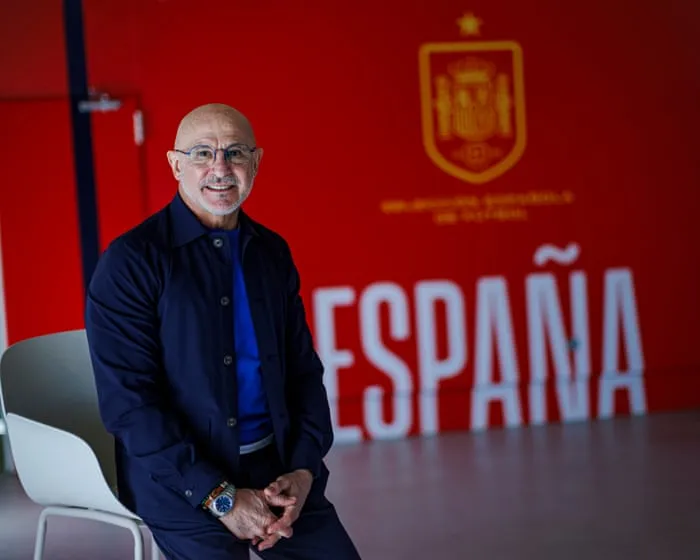
Within the Spanish Football Federation’s headquarters in Las Rozas, two classrooms on the ground floor proudly display photographs of every player who has ever worn the national team’s colors. Over 800 male athletes grace these walls, their images extending into the hallways, yet the coach responsible for leading them to World Cup glory is noticeably absent. Luis de la Fuente, whose international experience capped at the under-21 level, finds himself missing from this gallery — a fact he acknowledges with a humorous gesture, playfully reminiscing, “I once had hair like this” while mimicking flowing locks. Despite this absence, he is intimately familiar with the space, having both taught and learned here, guiding many to remarkable achievements.
The coach, who steered Spain to victory in the 2024 European Championship, relaxes on a couch in a small upstairs room. With his squad now finalized, he finds himself in the countdown phase ahead of their departure for Chattanooga. This moment is brimming with excitement as players arrive to evaluate their physical readiness: 20 on the first day, followed by Pedro Porro, Yéremy Pino, Mikel Merino, and those who participated in the Champions League final. Expressing his enthusiasm, he remarks, “I’m so happy to be going to a World Cup,” coupled with a sense of pride.
Among those present in Budapest were not only players like Fabián Ruiz, David Raya, and Martín Zubimendi, but also notable coaches: Luis Enrique, de la Fuente’s predecessor, and Mikel Arteta. Just days prior, Iñigo Pérez had led Rayo Vallecano to the Conference League final, while Unai Emery celebrated his Europa League success. Pep Guardiola bid farewell after solidifying his legacy as one of the most influential managers in Premier League history. Meanwhile, Xabi Alonso took over Chelsea, and Andoni Iraola assumed control at Liverpool. De la Fuente insists that these developments are not mere coincidence.
“This is a long-standing journey; finally, it seems that people are starting to acknowledge it,” he states. “That recognition should have arrived much earlier. While trophies can make recognition more apparent, the cultivation, structure, and efforts of coaching programs within regional and national federations have always set a standard for others to follow.”
He reflects on the legacy he has helped forge and witnessed, taking pride in the deeper rewards that extend beyond simple victories. Not all successful coaches hail from this environment, yet the culture of football in Spain has undeniably shaped them; a principle that the national team coach fully embraces. Both Iraola and Alonso began their paths surrounded by these photographs, just like Lionel Scaloni, the head coach of this summer’s defending champions, Argentina, along with many others. De la Fuente has played a vital role in nurturing these individuals, embracing the role of a mentor.
Having dedicated three years to leading training sessions since 2017, he is now greeted by familiar faces. During his time with Spain’s youth teams, he taught two subjects in the federation’s UEFA Pro License coaching course: the evolution of football and team dynamics. Notably, seated in the front row alongside Montse Tomé, who served as assistant coach during Spain’s victorious 2023 World Cup campaign, was Scaloni, while Joan Capdevila, known for his humor, occupied the back.
“It felt like school: the eager students at the front and the relaxed ones at the back,” de la Fuente reminisces. He fondly recalls Capdevila’s wit and Scaloni’s determination. Each name he mentions brings a spark of excitement to his expression, and the list is impressive: “Laura del Río with Leo and Montse, Xavi Hernández, Raúl, Victor Valdés, Albert Riera, Xabi, Xabi’s brother Mikel, Alessio Lisci, Mauro Silva, Walter Pandiani, Javier Saviola, Pablo Amo, my later assistant, Andoni, Gica Craioveanu, and Manuel Pablo…”
“While it’s easy to say Scaloni stood out, many had distinct traits. Their restlessness and the way they challenged you, saying, ‘I don’t see it.’ Scaloni was always eager for a discussion. We share similar journeys; he began with the under-20s and progressed to the senior team, achieving remarkable success. We both had to consistently win because anything less was simply unacceptable. His responsibilities with Argentina were vast, and I connect with him based on our shared experiences, how he views life and handles situations: with composure and without exaggeration.”
In a span of just six years, both teacher and pupil would emerge as champions on their respective continents. A potential reunion at the Finalissima in Qatar was anticipated, but conflict led to its postponement. Alternative arrangements were considered, yet an agreement was never reached. “Two parties cannot compete if one is unwilling; we were eager to play,” de la Fuente laments. “It’s unfortunate. I don’t foresee politics being an obstacle this summer: football has the power to unite people from diverse backgrounds, beliefs, and cultures. It would be wonderful to see Leo at the World Cup and share a moment together.”
The reigning champions will face formidable opponents, and it all began here. “Who could have imagined it?” de la Fuente ponders. His first significant senior position came in his sixties, following a decade devoted to Spain’s youth development, while Scaloni, at only 40, had no club coaching experience. “Life presents such opportunities. Nothing was given to us; it’s all the product of hard work…”
De la Fuente credits his current role to the contributions of his former students, stating, “They provided me with a fresh outlook and energy. For me, it’s an ongoing learning experience. Teaching has always intrigued me; I completed courses in Bilbao and Sevilla and was involved with the federation. Engaging in football discussions with Xabi, Xavi, Raúl, and Scaloni was enlightening. It was a reciprocal exchange of ideas among 30 individuals. The feedback they offered required me to enter class with nerves and leave better prepared. This isn’t merely about football; it’s about life: you’re always learning. I learned to simplify and become more practical.”
“Ultimately, sporting achievements are temporary. Yet, I remember my mentors… So when I had the chance to work at the RFEF [federation], I realized it was my responsibility to shape individuals.”
De la Fuente pauses, reaching for his glasses on the table. “Could you pass my glasses, please? … Thank you,” he requests. “Players notice when a manager expresses politeness. It’s about instilling education, values, and principles. It’s not about anything goes, for heaven’s sake. I’ve had relationships with many of our players long before they joined the senior squad: Álvaro [Morata], Dani [Carvajal], Unai Simón, Fabián, Rodrigo, [Marc] Cucurella, Mikel Merino, [Mikel] Oyarzabal… In that sense, I perceive myself as more than just a coach.”
“In a team environment, selfishness cannot coexist; that human connection is what empowers you. We consistently referred to the team as a ‘family,’ and players began to adopt that terminology themselves. We never instructed them to; it just evolved naturally. The closest resemblance I see to the [Spain] team that triumphed in 2010, which reflects our current challenge, lies in that unity. I spoke with Vicente del Bosque [the coach back then], and he shares insights that lead me to think: that’s us now.”
Few examples underscore his nurturing role more than that of Lamine Yamal, who at just 16 was called up to la selección while still finishing school exams. Now, at 18, he arrives at the World Cup as one of the globe’s brightest talents, bearing immense expectations. This is particularly notable given he hasn’t played since April due to a torn hamstring; he admitted he had “prayed” it wasn’t serious, feeling “scared” about the prospect of missing out.
“He’s recovering rapidly, achieving all the targets ahead of schedule,” de la Fuente observes. “I believe he’ll be ready for the first match, but that doesn’t guarantee his participation. We will assess whether he needs to play a bit, hold off, or wait for the second game.” He gestures toward Javier López Vallejo, la selección’s psychologist, who is seated nearby. “This gentleman is incredibly important,” he concludes.
De la Fuente underscores the importance of the group surrounding him, emphasizing respect as a cornerstone. “You want individuals who don’t cultivate ego or conflict. If given a choice between a talented player who possesses good character and one who does not, I’d choose the former without hesitation. The younger players gain wisdom from the veterans, while the latter draw energy from the youth. Veterans carry the responsibility for their behavior: ‘That’s not how we operate.’ Trust is essential for this dynamic; without it, the response might be, ‘Who are you to tell me that?'”>
“Lamine was destined for this. He possesses a bold character. Perhaps that pressure would have overwhelmed others. Yet, these players are extraordinary. We often ponder the fate of players who had potential but didn’t succeed: ‘What happened to them?’ To thrive, you need not only football skills but numerous other qualities. At 16 during the Euros, and now at 18, Lamine endures intense media scrutiny while making few mistakes. Just one error can lead to relentless attention, which is unjust. There are countless hours spent with physios, nutritionists, psychologists, and coaches; it’s about the work and the values.”
“Footballers are incredibly capable individuals, highly intelligent. They are geniuses, and some possess unique gifts, like Lamine and Messi…”
Whether blessed with divine talent or, in Lamine’s case, initiated by him, a famous baby photo exists showing him being bathed by Messi. De la Fuente laughs, “Perhaps Messi has held many babies. It could be mere coincidence. But for those of us with faith, we believe that ‘chance’ is merely God’s pseudonym when he opts not to reveal his identity. I believe everything occurs for a reason in life.”
Is Lamine Yamal the next Messi? “Messi: those are monumental words. Messi has been, is, and always will be… he embodies football.”
Who is the finest player he has ever witnessed? “I’ve always held Johan Cruyff in high regard. Experiencing [Diego] Maradona on the pitch felt like: ‘What is this?’ It was pure chaos. Those were different times, and people can’t comprehend the intensity: it was utterly ruthless, players were relentlessly pursued. However, I acknowledge that Messi, alongside Cristiano [Ronaldo], is… extraordinary. I’m not suggesting it’s easier now, but circumstances have shifted: pitches, habits, equipment. Cruyff today would still be Cruyff, still breathtaking. Could we compete now? Absolutely. Could these players have thrived in our era? Unlikely. We would run uphill for an hour and then down for the same duration.”
De la Fuente chuckles, reflecting on the evolution of football. “Fridays consisted of beans or T-bones. After training, the entire [Athletic Bilbao] team would gather at the bar near Lezama: beer, wine, tortilla, peppers, the works. We’d take a siesta and play the next day. There’s a lot of ‘literature’ now, and I admit that may not be popular since I’m not literary at all, but I’m a coach with a rather traditional approach to football. Yet, everything evolves, and so do you. I didn’t always possess the means to implement my ideas, but with experience, I have gained clarity. Learning is a continuous journey; if you don’t embrace that, you’re making a mistake.”