


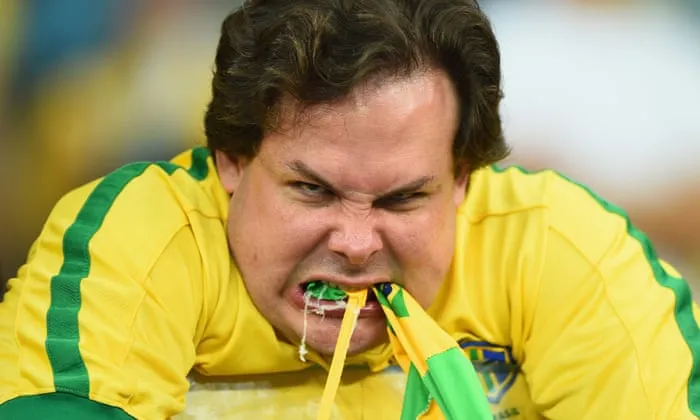
When it comes to the World Cup, the advantage of hosting is often significant. Just look at Uruguay in 1930, Italy in 1934, England in 1966, West Germany in 1974, Argentina in 1978, and France in 1998, as well as Sweden in 1958, Chile in 1962, and South Korea in 2002, who all finished in the top four. The expectation is that home teams will thrive, buoyed by passionate supporters.
However, this was not the case for Brazil in 2014. Zico, a legendary midfielder from the 70s and 80s, remarked, “The Brazilian players looked like they were stepping into the Hunger Games when they walked onto the pitch. They seemed unable to enjoy the occasion, which only added to their struggles. They were exposed when they faced a team of equal caliber.”
Brazil and Spain are the only two nations to have won the World Cup yet failed to claim victory on home soil, a fact that stands out given Brazil’s consistent success elsewhere and their hosting of the tournament twice. In 1950, they suffered a shocking defeat to Uruguay in the final at the Maracanã, an event that left a lasting scar on the nation’s football culture, known as the Maracanazo. Fast forward to 2014, and they experienced another disastrous moment, dubbed the Mineirazo. Yet this match transcended mere disappointment; it was an absolute embarrassment.
In a breathtaking display during the first half, Germany unleashed a level of football rarely seen in World Cup history against formidable rivals. For an astonishing seven minutes, they showcased a brutal and relentless assault that left spectators in shock. Between the 23rd and 29th minutes, they scored four additional goals, unraveling Brazil’s defense with astonishing speed and ferocity. The visuals were so harrowing that they might as well be watched through a foggy curtain, complete with a haunting Bernard Herrmann score. It was akin to a nation’s hopes swirling down the drain. “I just wanted to bring some happiness to my people who have already endured so much,” David Luiz expressed after the match. “All I wanted was to see them smile again.”
In the 23rd minute, Miroslav Klose made history as the first player to score 16 World Cup goals, pushing Germany into a 2-0 lead. Television cameras captured the heart-wrenching moment of a female Brazilian supporter, her face painted in national colors, as a single tear streamed down her cheek. Moments later, Toni Kroos unleashed a stunning shot from the edge of the box, leaving another Brazilian fan in complete disbelief. The situation was too much for one couple in São Paulo. “I was watching at home with my wife, and when the third goal hit, she burst into tears,” said Tite, the current coach of Brazil. “That set me off too. The 7-1 loss haunts us. It’s a ghost that lingers, and the more we discuss it, the less likely it is to fade away.”
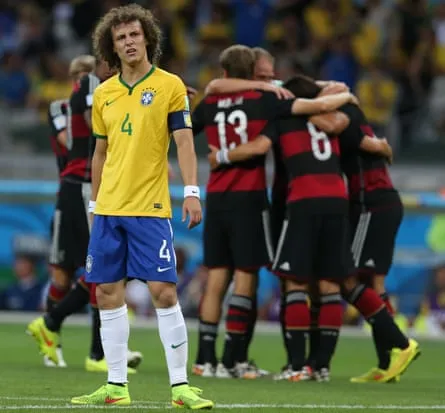
The nightmare continued. Immediately following the kick-off, Kroos intercepted the ball from Fernandinho, executed a swift one-two with Sami Khedira, and slotted in a third goal. Just three minutes later, Khedira added a fifth, prompting the broadcast director to focus solely on the fans’ reactions.
Meanwhile, Germany’s coach, Joachim Löw, turned to his assistant, Hansi Flick, questioning, “Hansi, tell me, is this actually happening?” Löw later described his emotions at that moment as a cocktail of sheer joy and disbelief. “It was 5-0 in a semi-final against the host nation. It was surreal,” he recalled.
As the first half concluded, Löw delivered a halftime address unlike any other, cautioning his players against excessive dominance. “I didn’t want us to embarrass the Brazilians in front of millions of viewers,” he stated. “The respect they showed us nationwide was immense. It was unfathomable to me to humiliate them or display arrogance.”
Eight years prior, Löw had served as an assistant coach to Jürgen Klinsmann when Germany suffered a semi-final defeat on home turf against Italy. He reflected, “In 2006, we felt the agony of missing a World Cup final in front of our fans. In 2014, we mixed our ruthlessness with compassion.”
Germany added two more goals in the second half, both courtesy of substitute Andre Schürrle, though they could have netted more. Brazil’s Oscar managed a late consolation goal just after Mesut Özil squandered a one-on-one opportunity against Júlio César.
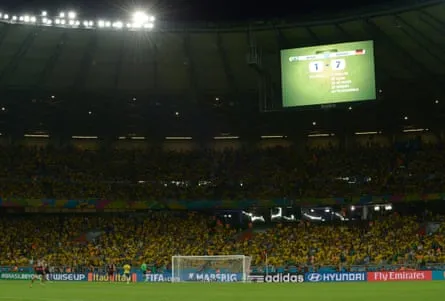
This marked Brazil’s first semi-final defeat at the World Cup in 76 years and their first competitive loss on home soil in 39 years. It was the most significant defeat they had experienced in nearly a century, dating back to a 6-0 loss to Uruguay in 1920. Throughout World Cup history, only Zaire and Haiti have found themselves five goals down at halftime, a statistic Brazil is not accustomed to.
Two players, Luiz Gustavo and Dante, subsequently returned to Germany to continue their club careers. Reflecting on the aftermath, Dante said months later, “If I had been in another country, it would have been easier. People tend to forget about respect; they forget everything you’ve accomplished. You’re left alone, facing those who try to remind you of this event at every opportunity. It was a painful experience, but I learned much from it. In football, what’s done is done. Today, I’m content. In life, one must move forward.”
Neymar, Brazil’s star forward, was sidelined due to an injury sustained in the quarter-final against Colombia and watched the semi-final from home. Midway through the second half, as his mother wept, Neymar turned off his television. His aspiration of leading his team to glory—whether from the pitch or the sidelines—had vanished.
Yet, hope was not lost for Brazil. Two years later, Rio hosted the Olympics, featuring a younger squad led by Neymar, who had a chance to redeem themselves. After failing to score in their initial two matches against South Africa and Iraq, the team faced heavy scrutiny from disappointed home fans. But they eventually found their rhythm, decisively beating Denmark, Colombia, and Honduras with an aggregate score of 12-0, setting up a rematch against… Germany.
Ultimately, the final was decided by penalties; all five Brazilian players scored, with Neymar netting the last shot, while Nils Petersen’s attempt was saved. It was a moment of catharsis, and as the players reveled in victory at a packed Maracanã, the crowd began to sing a familiar song, one that echoed when Brazil returned to the Estadio Mineirão for a World Cup qualifier three months later, triumphing over Argentina 3-0: O Campeao Voltou. The champions have returned.