


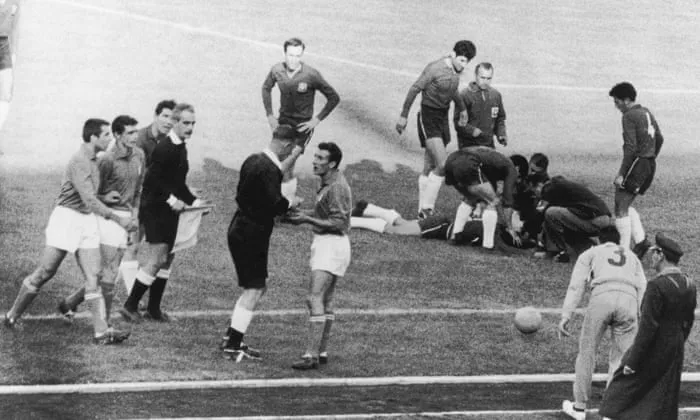
It took an astonishing 48 hours for the shocking events of what was dubbed the Battle of Santiago to reach British television screens from South America. In that time, this match developed a notorious reputation, capturing the attention of fans drawn to its brutal nature, blending soccer with sheer chaos. Frank McGhee from the Mirror characterized it as “the most disgraceful, vicious, and ugly match in soccer’s history.” He cautioned viewers, saying: “If you think that is exaggerating, watch the film on TV. But send the kids to bed first – it deserves a horror certificate!”
David Coleman’s opening remarks during the BBC broadcast have become legendary. He boldly asserted, “Good evening. The game you are about to witness is the most appalling, disgusting, and disgraceful exhibition of football ever. This marks the first encounter between these two nations; let’s hope it’s also the last. The national motto of Chile reads, By Reason or By Force. Today, the Chileans opted for force, while the Italians relied solely on aggression, resulting in a catastrophe for the World Cup. If the tournament is to survive in its current format, immediate action is necessary against teams that play in this manner. After viewing tonight’s footage, you may conclude that teams like this should be expelled from the competition.”
The Battle of Santiago is often remembered as an extraordinary and lawless event, but it was just one of many incidents in a particularly violent World Cup. Prior to the match, the Chilean newspaper Clarin ominously suggested that the event resembled less a World Cup and more a World War. On the day of the match, the Express reiterated these concerns, warning that “the tournament shows every sign of becoming a violent bloodbath.” Such reports painted a picture of chaos, indicating that players were more interested in inflicting harm than playing the beautiful game.
The opening matches of the tournament set a grim precedent, with eight games resulting in four red cards, three broken legs, a fractured ankle, and cracked ribs. In England’s first group match, Argentina faced Bulgaria, winning in what was described as a display of “hacking, tripping, pushing, and various dirty tricks.” Spanish referee Juan Gardeazabal, who issued an astonishing 69 free-kicks—averaging one every 78 seconds—was at the heart of the turmoil. Bulgarian player Todor Diev, showcasing his injuries after the match, remarked that Argentina played “like boxers.”
In another opening match, Russia clashed with Yugoslavia, where Eduard Dubinski suffered a broken leg due to a challenge from Muhamed Mujic, who was not penalized. The Yugoslav Football Association was so outraged by the foul that they suspended Mujic for an entire year. The Express criticized FIFA for their lack of action, stating, “It is regrettable that FIFA are not equally honest.” They highlighted the governing body’s failure to enforce its own rules to punish offenders immediately.
Donald Saunders, a football correspondent for the Telegraph, noted, “It became evident after just two days that many teams were so desperate to avoid an early exit that they had forgotten football was merely a game and the World Cup its greatest showcase. Reports from all four centers indicated violence, ill temper, serious injury, and precious little of the artistic soccer expected from the world’s top professionals.”
Italy, having already exhibited poor sportsmanship in their first match, now faced the host nation and their passionate supporters in a crucial game they could not afford to lose. The Observer emphasized the intense national pride in Chile, stating, “The patriotism here for the national team is astonishing.” This fervor intensified when articles emerged in Italian newspapers before the World Cup, depicting Santiago in negative terms, referring to it as a backwater plagued by social issues. Consequently, journalists from Italy faced significant backlash, with one Argentinian mistakenly identified as an Italian reporter being assaulted and hospitalized.
In light of the potential for violence, FIFA intervened, appointing experienced English referee Ken Aston, despite objections from the Italian FA regarding the initial selection of a Spanish official for a match involving Spanish-speaking nations. The Italians were not overly pleased with Aston, who had already officiated Chile’s opening match.
From the very beginning, Chilean players resorted to spitting and other provocative actions against the Italians. When the Italians retaliated, they found themselves penalized. The first foul was called a mere 12 seconds into the match, and just four minutes later, Giorgio Ferrini from Italy received a red card. He resisted leaving the field, which led to a delay as armed officers had to escort him off. The Mirror reported, “The pitch quickly transformed into a battlefield as players forgot about the ball and focused on kicking the nearest opponent.” Notable moments included Leonel Sánchez, a son of a boxer, breaking Italian captain Humberto Maschio’s nose with a punch without facing any repercussions.
Sánchez then took the free-kick that led to Jaime Ramírez scoring for Chile, who were now playing against just nine Italian players, with Jorge Toro later adding a second goal. Aston defended his decisions, stating, “I had my back to the incident at the time.” He added, “If the referee or linesman sees nothing, nothing can be done. I’m confident the linesman did see it, but he refused to inform me.”
The match saw its officiating scrutinized by the players; David, in particular, felt wronged. He later recounted, “We weren’t throwing punches; we were receiving them. We Italians were the victims, not the aggressors.” He lamented, “Sánchez broke Maschio’s nose, and the referee ignored it, instead sending off Ferrini, who was merely attempting to retaliate against Sánchez but didn’t even make contact.” Despite being reduced to nine men, David insisted, “I assure you, even with nine players we fought to the bitter end.”
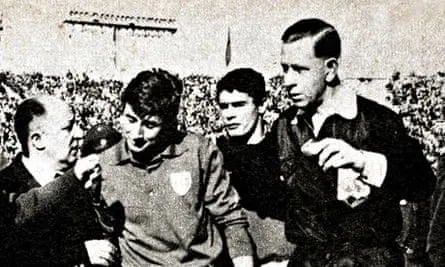
Commentators noted the absurdity of the situation, with Jimmy Hill stating in the Observer, “The Italians could not comprehend – and neither can I – why Sánchez was allowed to stay on the field despite a credible imitation of Rocky Marciano.” He criticized the officials, asserting, “The players will have to shoulder most of the blame, but the officials must confront their responsibility for this grotesque decision.”
Aston reflected on the match, saying, “I anticipated a challenging match, but not an impossible one. It did cross my mind to abandon the game, but I could not bear the thought of being responsible for the safety of the Italian players if I did.”
Hostility between the nations escalated, with Italians facing bans from local establishments. Jorge Pica, a member of the Chilean FA, stoked the flames by alleging that the Italians were under the influence of drugs, accusing them of entering the match solely to harm players. Meanwhile, the Italians filed a formal complaint against Aston’s biased officiating, depicting Chileans as “cannibals” and demanding military protection for their consulate in Rome.
The backlash against Aston’s officiating was fierce, particularly in Italy, where one journalist referred to him as “an unmentionable English vermin.” Former German FA president Peco Bauwens remarked, “I have never seen an English referee so feeble.” Aston, however, maintained, “I have self-respect; otherwise, I would have chosen the easy path and abandoned the match.”
As the World Cup continued to be marred by violence, Aston and fellow referee Bob Davidson approached FIFA president Sir Stanley Rous, voicing their concerns about the escalating brutality. Davidson asserted, “All referees who witnessed this game and who have seen the general viciousness in many matches want to inform Rous that they haven’t traveled all this way to manage this sort of behavior.”
The Mirror concluded, “The World Cup competition is heading towards ruin and disgrace unless Sir Stanley Rous and his committee act swiftly and decisively to rectify it.” Rous acknowledged the referees’ demands, assuring them that he intended to tackle the issues. However, FIFA’s subsequent actions were disappointingly minimal, suspending Ferrini for just one match and issuing mere reprimands to David and Sánchez.
Despite the lack of substantial changes, representatives from all 16 teams were summoned to a meeting at the Carrera Hotel in Santiago, where Rous stressed the importance of restoring the tournament’s integrity. He voiced his concerns, stating, “What will the children think when they witness the abominable behavior of top players? We must protect the reputation of this tournament; this is not about winning at any cost.”
FIFA’s attempts to remedy the situation proved ineffective. Four years later, during the 1966 World Cup, Pelé was brutally sidelined in Brazil’s second match, claiming in his autobiography that, “I have heard it said since, and I firmly believe it, that Sir Stanley Rous instructed referees to go easy on the ‘virile’ game played by the European teams.”
Even in Chile, the culture of violence persisted. During the semi-final between Czechoslovakia and Yugoslavia, the Swiss referee had to intervene as chaos erupted on the field. In the other semi-final, Chile faced Brazil, where two players, including the talented Garrincha, were sent off amidst violence, leaving the player visibly distressed after the match.
As the Brazilian FA awaited news of Garrincha’s availability for the final, match officials faced pressure from their home countries to downplay their accounts of the incidents. The outcome became a tangled web of deceit and corruption, culminating in a conclusion that embodied the tournament’s lawlessness.
What the Observer wrote: coping with the rough stuff
By Jimmy Hill, the Coventry City manager, 10 June 1962
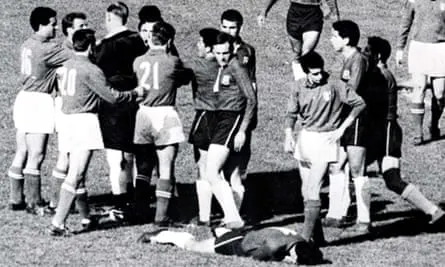
Some say Ken Aston should be awarded the V.C. for his brave efforts to control the chaos between Chile and Italy last Saturday, while others argue that both nations should face indefinite bans from international competition. Can we, 9,000 miles away and well-informed through television, yet less hysterical than those whose judgment is clouded by the smoke from the battlefield, find a rational perspective amid the week’s events?
The match was so rough that even seasoned players were taken aback, with punches frequently thrown and boots flying with reckless abandon. One cannot downplay the utter lack of sportsmanship displayed by the players, but this should not serve as an excuse to tarnish soccer in this country.
Just days earlier, the English players had been criticized for being “too gentlemanly” to succeed in the World Cup. Now, that same fault has transformed into a virtue, with friendly handshakes exchanged with the Hungarians after their impressive performance being seen as a sign of strength, not weakness.
Given the intense scrutiny faced by players and officials for failing at the international level, it’s no wonder the “win at all costs” mentality prevails. The World Cup is a grueling competition for men. Football demands physicality, skill, and artistry, where clashes are inevitable, and rough play has historically been part of the game. However, tempers should remain in check, and tactics should never descend into violence.
The Italians began aggressively but quickly fell into disarray. No professional player, whether from Latin America or Europe, loses their sense of fair play without cause. The Italians needed to win to stay in the tournament. Ferrini had already been dismissed. David, Italy’s right-back, faced Sánchez, who was shielding the ball, attempting multiple clearances. It was rugged play, but only marginally illegal since he did play the ball.
Sánchez retaliated with a sharp left hook, and once order was restored, the Italians were baffled—myself included—why Sánchez was permitted to remain on the field while one of their own was sent off for a less serious infraction.
From that moment, control was lost, both on the field and among the officials. Allowing Sánchez to stay on the pitch after such a blatant infringement was a glaring error. It’s possible that Mr. Aston failed to see the incident as the ball rolled away, but the linesman, standing nearby, could not have missed it.
While players must bear the brunt of the blame, officials must also acknowledge their role in this farcical decision. To make matters worse, David himself was sent off later for a dangerous challenge, despite having made contact with the ball.
Mr. Aston displayed admirable restraint and determination to see the match through, but one must wonder whether such effort was warranted. His bravery in officiating cannot be questioned, but it would have been commendable to send off a Chilean player.
Typically, a referee can reinforce a decision with a few well-chosen words to an offending player, but when both parties speak different languages, this advantage is lost. The whistle becomes the only means of communication for the referee’s authority and competency.
We must soon consider implementing filmed evidence in future inquiries, similar to practices in racing. If the camera can help identify and penalize underhanded players, the sooner it is utilized, the better.
In my opinion, those guilty of misconduct during Saturday’s match should be made to watch a film of their actions repeatedly. If that doesn’t evoke shame, nothing will.