


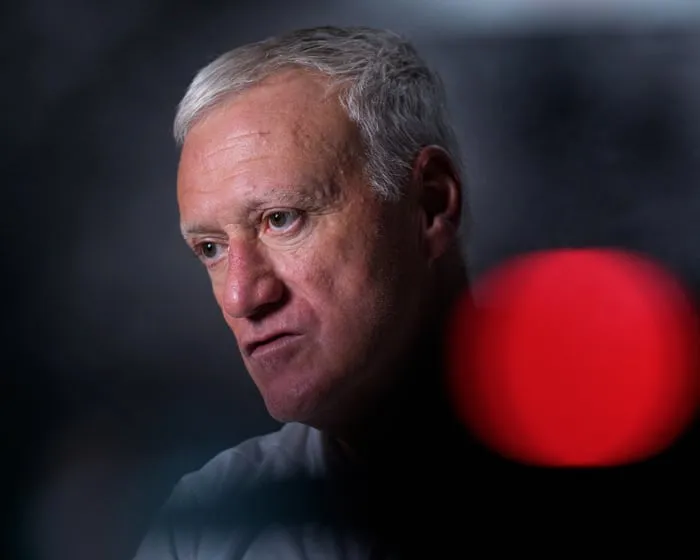
As you stroll along the lush path leading to the Château de Clairefontaine, a striking three-meter replica of the World Cup trophy greets you, adorned with two stars symbolizing France’s World Cup victories. Didier Deschamps has played a pivotal role in both triumphs, first as captain in 1998 and then as manager in 2018.
The 1998 World Cup final marked France’s inaugural win, but since then, Les Bleus have reached four finals in the past seven competitions, with Deschamps being part of three of them. He now approaches another opportunity in North America, shaped by a legacy of success. Over his 14-year managerial career, Deschamps has led France to three significant finals. “We’re among the favorites,” he asserts during our conversation. “This label doesn’t intimidate me. Our current status seems justified due to our previous achievements and results.”
During our discussion, his assistant Guy Stéphan pokes his head through the door with a lighthearted comment: “You’ve got the best,” prompting Deschamps to chuckle in response: “He is always very objective.” Given Deschamps’ illustrious career as both a player and a coach, Stéphan’s remark is hard to dispute.
However, Deschamps acknowledges a sense of subjectivity in perceptions. “There may be more recognition abroad,” he comments. “Having traveled extensively, I can sense the difference in sentiment between international perspectives and those within France.” Concerns expressed in France often revolve around the team’s playing style. With a slight laugh, he remarks, “It depends on what you mean by ‘playing style.’ Internationally, that’s one narrative, but domestically, France has been labeled as a team with a defensive approach, yet we’ve still achieved results.”
Legacy is not a primary concern for Deschamps. He emphasizes that “it doesn’t matter” to him, indicating a focus on the present and future, particularly with the World Cup on the horizon. “Afterward, everyone will form their own interpretations and feelings about our journey,” he adds.
Public opinion differs from how his peers view him. Gareth Southgate, once under his tutelage, and Deschamps have exchanged messages with notable figures such as Thomas Tuchel, who he respects greatly, as well as Brazil’s Carlo Ancelotti and former Germany coach Hansi Flick. With three finals and a Nations League title under his belt, Deschamps has become a cornerstone of modern international football.
Yet, he insists there is no magic formula for success. “I believe in adaptation … I tell myself, ‘Based on who I’m working with, I adapt.’ This leads to necessary changes … It’s not about altering things just for the sake of it,” he explains.
Adaptation also plays a crucial role in managing people. “The generation I began with in 2012 is not the same as today … the new generation requires more communication,” he explains, having navigated a transition in the France squad.
Since the defeat to Argentina in the 2022 World Cup final, several prominent players, including Hugo Lloris, Olivier Giroud, Raphaël Varane, and Antoine Griezmann, have stepped away from international play. “The baton has been passed,” he states, designating Kylian Mbappé as the successor to Lloris, the player with the most caps for France.
“Kylian, who is now our captain, listened and observed before taking on this role. He doesn’t mirror Hugo’s approach; their personalities are distinct. He assumes leadership on and off the pitch, understanding that when he speaks, he represents all players,” Deschamps articulates. He also defends his deployment of the Real Madrid star: “If I’m foolish, then many others must be too for playing him centrally in various teams over the last two years at Real and last year at PSG… for the past three years, he has occupied a central position.”
Mbappé’s performance at Euro 2024 was disappointing, exacerbated by a nose injury sustained in the opener against Austria. Deschamps also noted that his preparation for the tournament was less than ideal. “He arrived after having a very challenging last six months at PSG with limited playing time,” he remarked. As Mbappé approaches the World Cup, he is just one goal away from Giroud’s all-time scoring record for France, which serves as a strong motivation for Deschamps, whose decisions are often examined and critiqued, yet are usually justified.
For Mbappé to surpass Giroud’s record, Deschamps must strike the right “balance,” a term he reiterates throughout our conversation on a rainy afternoon. “During the 2022 World Cup, we already fielded four attackers [from the start],” he clarifies, addressing concerns that transitioning from a 4-3-3 to a 4-2-3-1 formation could jeopardize Les Bleus’ famed defense.
He highlights Griezmann’s role in the midfield during the last World Cup as the fourth attacker in that setup. His replacement is Michael Olise. “He may be a bit reserved, but once on the field, he is exceptional,” Deschamps praises. “Today, he shines and stands out among the best players at the World Cup.”
Deschamps faces tough choices, especially among forwards. Players like Mbappé, Olise, Ousmane Dembélé, Rayan Cherki, Désiré Doué, Bradley Barcola, Marcus Thuram, Jean-Philippe Mateta, and Maghnes Akliouche cannot all be included in the lineup.
“It’s about managing the disappointment of those who won’t start,” he notes. “It’s always a challenge because every player believes they are superior to the one occupying their position … any professional footballer will acknowledge that competition is part of our lives, but when it pertains to themselves, it becomes more difficult to accept.”
Consequently, echoing Tuchel’s sentiments, Deschamps emphasizes that selecting merely the best 26 players for the World Cup isn’t the goal.
As he approaches 58 in October, Deschamps understands this dynamic well. He asserts that international management differs significantly from club management, and none of his World Cup counterparts possess the level of experience he has gathered.
“If I’m still in this position today, it’s due to the French team winning numerous matches. Otherwise, my tenure could have ended prematurely, whether by my choice or a decision made for me,” he reflects. Ultimately, it was his decision. As he confirmed in January 2025, Deschamps will step down following Les Bleus’ campaign this summer.
This isn’t retirement, but the former Juventus, Monaco, and Marseille manager is not yet contemplating his next steps. “I won’t make any decisions until after the World Cup,” he states, while acknowledging that offers have come his way.
When discussing the possibility of taking a break, Deschamps asserts he has “the freedom to choose.” His last extended hiatus from the game was not without its challenges. “I took a break from Juventus in 2007. During that time, I was on nearly every shortlist. But my son told me, ‘The issue is that you always fall short.'” He doesn’t necessarily need the World Cup to enhance his visibility in the football world.
Although Deschamps claims not to be concerned with his legacy, as he left the Château de Clairefontaine for the final time on Sunday, it is clear he has already established one.