


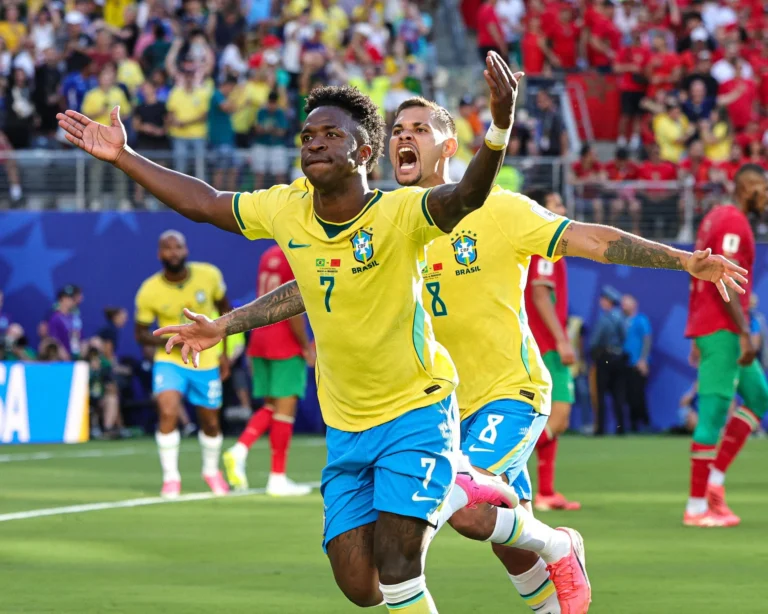
Vinícius Júnior is not sporting the iconic Brazil No. 10 jersey during this World Cup. Currently, that revered number, worn by legends such as Pelé, Zico, Rivellino, Rivaldo, and Ronaldinho, belongs to Neymar.
This iteration of Neymar is a mere shadow of his former self. Now aged 34, he managed just enough at Santos to secure a spot in Carlo Ancelotti’s squad after two lackluster years in Saudi Arabia. Ancelotti had options like João Pedro, Richarlison, Savinho, Gabriel Jesus, Igor Jesus, or even Antony, but he chose Neymar. Unfortunately, Neymar is sidelined once again due to a calf injury, casting a shadow over Brazil’s campaign as it has in each of his previous four World Cups.
Neymar’s presence is a constant factor for Vinícius Júnior as well.
Although Vinícius has emerged as Brazil’s standout player at 25, he has yet to fully claim his role within the team. His past performances in significant international tournaments have been marked by frustration, and he has netted only nine goals in 49 appearances leading up to this, his second World Cup.
He has not yet taken the spotlight from Neymar, whose jersey was donned by many Brazilian supporters during their draw with Morocco on Saturday.
As he limped past the enthusiastic Brazilian fans before the match, Neymar confirmed his enduring relevance, despite not being part of the matchday squad. Sporting a backward cap, he resembled the young star who once captivated audiences, although injuries have diminished his abilities over the last decade. He received the cheers he craved, even from the sidelines, attempting to impart some wisdom to a team he could no longer influence directly.
As the only group-stage match of this World Cup featuring two of FIFA’s top-10 teams unfolded, the moment was ripe for Vinícius to assert his leadership.
He rose to the occasion under the watchful eyes of Brazilian legends Ronaldo, Kaká, and Roberto Carlos, delivering a performance for his coach Ancelotti, who has guided Vinícius from a promising talent to a global superstar.
Vinícius was named man of the match, albeit somewhat generously, given the impressive display by Morocco’s 18-year-old playmaker Ayyoub Bouaddi. His equalizing goal in the 32nd minute jolted Brazil from their initial lethargy.
Throughout the first half, Brazil’s players often gestured to their fans, who significantly outnumbered the Moroccan contingent, pleading for more support. They might as well have asked themselves for more intensity, as they appeared stunned that the semi-finalists from the last World Cup—who have not reached this stage on foreign soil in nearly 25 years—were underperforming.
“The team was a bit anxious and at the beginning nerves were all over the place,” Ancelotti admitted after the match. “In the second half we did a lot better.”
Despite Brazil still finding its footing, Vinícius proved to be a persistent threat on the wing. In the 14th minute, he sprinted down the sunlit flank, outpacing his club and international rival Achraf Hakimi, and delivered a cross that Igor Thiago narrowly missed.
Later, Vinícius created space in the Moroccan penalty area after receiving a clever pass from Bruno Guimarães. He skillfully maneuvered to improve his angle, turned Neil El Aynaoui inside out, and fired a shot past goalkeeper Yassine Bounou, leveling the score after Ismael Saibari’s delightful goal in the 21st minute.
This was the only goal of the match, emerging from a play that had an expected goals value of just 0.1.
“I believe I can improve a lot, I managed to score a goal, but I didn’t have 100% of my best technical part,” Vinícius reflected post-match.
After this, Brazil found its rhythm while Morocco set up a deep defensive line. Most of Brazil’s attacking threats continued to originate from Vinícius’s left side. He navigated space effectively, but teammates often failed to join him in the attack to capitalize on his crosses—something that may become a recurring issue in Ancelotti’s striker-less system. Subsequently, Vinícius broke free into space behind Hakimi again and set up Raphinha, who squandered the chance.
“When you’re up against Vinícius, it’s hard to defend,” Morocco’s manager Mohamed Ouahbi lamented.
Vinícius was not without faults; he lost possession frequently and attempted several plays that didn’t yield results. However, on this night, he rose to the occasion for his country when they needed a spark and a goal, delivering both as the Real Madrid star.
For now, this performance will serve Brazil, a five-time champion, well. There is something fitting about a player named Viní stepping up in North Jersey.