


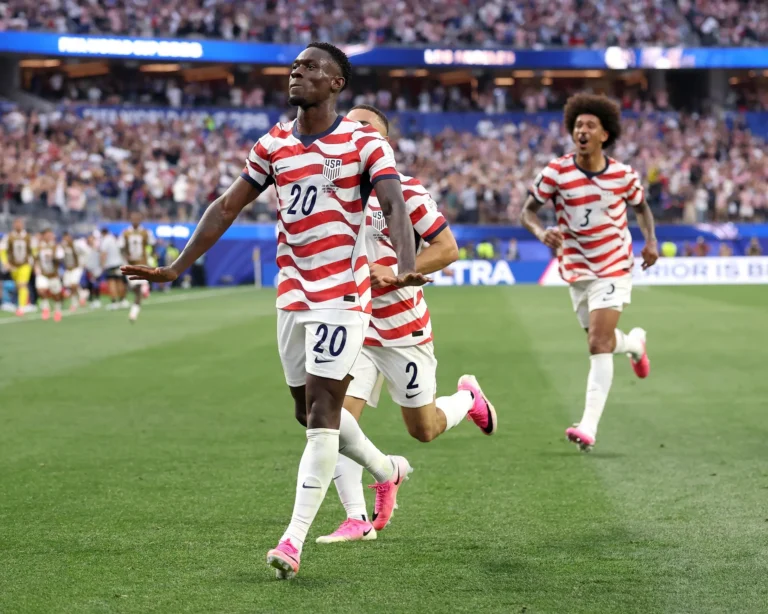
Despite conceding an early goal in their match on Friday, Paraguay provided the United States with considerable space to exploit. As Malik Tillman and Weston McKennie took control in midfield, their disorganized opponents struggled to establish a cohesive defensive stance. The US’s effective off-ball movement further complicated Paraguay’s efforts, leaving their defense scrambling to react.
“I just tried to run in behind,” McKennie reflected following the US’s 4-1 triumph. “I think I realized early on that they were struggling to follow my deep runs. If it’s not broken, don’t fix it. I keep trying to do it until they figure something out. I was able to find more space than usual, and it was fun. I really enjoyed to get on the ball as much as I did.”
The first half showcased the US’s midfield dominance, with Tyler Adams and the more advanced McKennie and Tillman effectively controlling the game. Paraguay found it challenging to position themselves properly within the passing lanes. In those infrequent moments of pressure, the US was unafraid to recycle possession, confident in the capabilities of their defense.
Throughout the 2022 World Cup, the US team often resembled a cohesive club side, largely due to their midfield trio’s synergy. Adams and McKennie were complemented by Yunus Musah in what was dubbed the “Honestly, I wasn’t second guessing myself. That was the main thing. Playing with pain’s OK as long as I’m not second-guessing myself.” midfield, a dynamic unit that consistently moved the ball and adapted defensively. Although Musah’s form has dipped, other players like Tillman, Johnny Cardoso, Sebastian Berhalter, Tanner Tessmann, and Aidan Morris have risen to the occasion, easing concerns for coach Mauricio Pochettino.
Midfield Evolution and Team Dynamics
While the roster has changed, the spatial dynamics on the field remain constant. The spaces McKennie exploited on Friday were not merely a result of Paraguay’s tactical missteps but represented an evolution in Pochettino’s strategy, facilitated by the development of the US’s top talents since the World Cup.
By the time Copa América 2024 arrives, the midfield is expected to be the USMNT’s most reliable asset. Previous strategies allowed teams to set up a low-to-mid defensive block, which often left the US struggling to penetrate the attacking third. The system had been tailored to funnel play through Christian Pulisic, a tactic that opponents effectively countered.
A silver lining from the Copa grouping was the affirmation of Chris Richards’s capabilities. After two seasons with Crystal Palace, he became a regular starter following the arrival of coach Oliver Glasner in February 2024. Richards’s partnership with Tim Ream kept the US competitive, though it wasn’t sufficient to secure wins against Panama and Uruguay.
Richards and Balogun Shine in Recent Matches
Richards has since taken his game to new heights, becoming crucial for Palace after Marc Guéhi’s departure. He logged the most minutes during the club’s successful FA Cup campaign and played a significant role in their UEFA Conference League triumph this past season.
Confident from his achievements and recovery from an ankle injury, Richards performed flawlessly against Paraguay, setting a World Cup record with 83 passes at a 100% success rate. He collaborated with Adams to dissect Paraguay’s setup before distributing to Ream or Alex Freeman to initiate forward movements.
Meanwhile, Folarin Balogun has emerged as a vital addition to the squad. His choice to represent the US, despite having options with England and Nigeria, is a significant boost for a team that lacked a reliable striker from 2016 to 2023. Known for his finesse, Balogun is also capable of outmuscling defenders, creating opportunities for teammates.
Having honed his skills at Arsenal’s academy, Balogun possesses exceptional movement and an astute understanding of the game. As McKennie and Tillman navigated the channels, Balogun adeptly positioned himself to receive passes, challenging Paraguay goalkeeper Orlando Gill with relentless offensive pressure.
Looking Ahead: Challenges and Opportunities
Despite concerns regarding the team’s readiness for the World Cup amid inconsistent performances under Pochettino, the US showed improved fluidity in their play. After weeks refining their tactics, they comfortably controlled the game, prompting appreciative applause from fans at Los Angeles Stadium.
Notably, the journey of this generation of US players hasn’t always been smooth. Musah’s move to Milan hindered his development, as he struggled to find stability amid frequent coaching changes. Similarly, Gio Reyna’s limited opportunities have affected his growth.
Yet, the US now possesses the caliber of players it has often lacked. They have Richards, a defensive stalwart pivotal to his club’s FA Cup and Conference League victories, and Balogun, who, despite some dry spells, placed fourth in Ligue 1 for goals.
Opponents will face Balogun while also contending with Pulisic, who led Milan in scoring last year and has been in excellent form since the Senegal friendly in late May. Reyna reminded fans of his potential, while McKennie and Adams have solidified their roles as key midfielders in their respective clubs.
Admittedly, numerous nations can match the US in talent. Turkey, a formidable opponent in Group D, boasts skilled attackers in top European leagues, with Hakan Çalhanoğlu orchestrating play and Merih Demiral anchoring the defense. By the round of 16, the US may find itself in an underdog position, facing heavyweights like Belgium, France, or Spain.
Nonetheless, there is ample time for the US to build momentum as they prepare for these challenges. Fans can be grateful for birthright citizenship; without it, the US would still be searching for a striker like Balogun, who has the ability to stretch defenses and facilitate play for his teammates.