


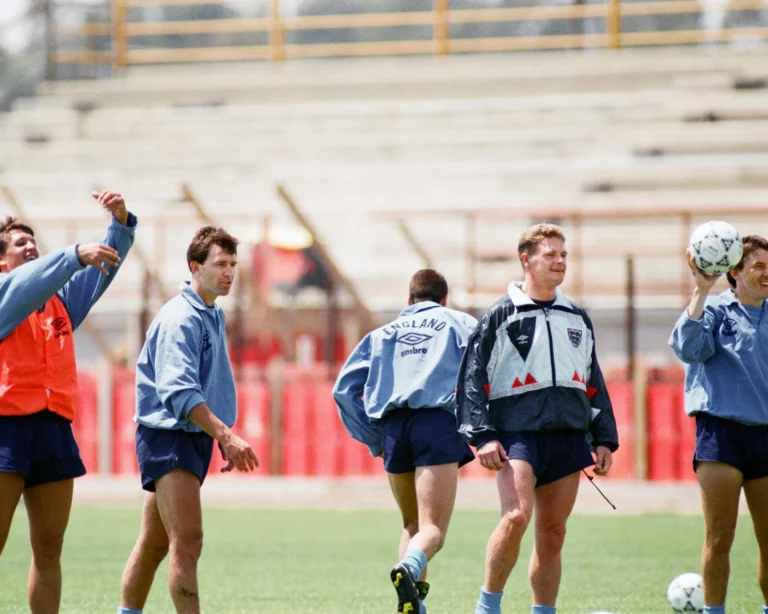
As Italia 90 approached, England faced a mix of anticipation and trepidation. Gazza’s emotional journey, the team’s struggles, and the overall intensity of the World Cup loomed ahead. Meanwhile, Prof John Brewer, the Football Association’s inaugural head of human performance, was busy employing cutting-edge technology to evaluate the fitness levels of Bobby Robson’s squad. Utilizing a BBC microcomputer, a dot-matrix printer, and bulky Polar heart-rate monitors, Brewer was ahead of his time.
Initially, some team members viewed Brewer’s methods with skepticism. However, after conducting a bleep test at Lilleshall before their departure for Italy, and again upon arrival and after two weeks of training in the searing heat, Brewer proved to the players their bodies had adapted sufficiently to handle the demanding climate and maintain their dynamic style of play.
What Brewer initiated 36 years ago now seems almost primitive. By 2026, English players sport ultra-light wearables that monitor blood oxygen levels, skin temperature, and sleep patterns, alongside hyperbaric chambers for recovery. Yet, conversing with Brewer evokes memories of an exhilarating World Cup and marks a pivotal shift in English football’s approach to sports science.
Not everything unfolded seamlessly, however. Prior to Italia 90, Brewer successfully advocated for an increased carbohydrate intake for players before matches. He recalls the shock of witnessing a trolley laden with swordfish steaks presented just hours before their opening game against Ireland.
“Bob and I looked at it and said: ‘What on earth is that?’” Brewer reminisces. “But the England doctor, John Crane, stood up and said: “I want to give the boys what they want.’ We told him that it was not the time or the place. But the attitude from the medical team was to ignore the evolving sports science. It had been accepted in other sports, particularly running, but football saw itself as different.”
Brewer noted that the medical team often disregarded the evolving landscape of sports science, which had gained acceptance in other sports, particularly athletics, but seemed alien in football.
This mindset extended to alcohol consumption as well. Robson enforced a ban on alcohol two weeks prior to the tournament but occasionally permitted players to indulge. Nevertheless, some players – whom Brewer chooses not to identify – broke curfew and overindulged.
Interestingly, Brewer found that most England players who had experience playing abroad, such as Chris Waddle and Trevor Steven, were more open to nutritional guidance. Paul Gascoigne, who remarkably reduced his body fat to around 10% for Italia 90, was also a temporary advocate for these changes. “I think he probably was the fittest he was in his career,” Brewer notes. “Gazza was quite stocky in build and there’d been a bit of criticism about his weight. But when he came to Lilleshall, I measured his body fat, and the results spoke for themselves. He didn’t have a high body-fat percentage compared to the rest of the squad.”
Brewer frequently engaged in one-on-one discussions with Gascoigne, who sought reassurance about his dietary choices. “Yes, he was the life and soul of the party and the other lads used to play up to that, but he was fully professional – football was everything to him,” Brewer adds.
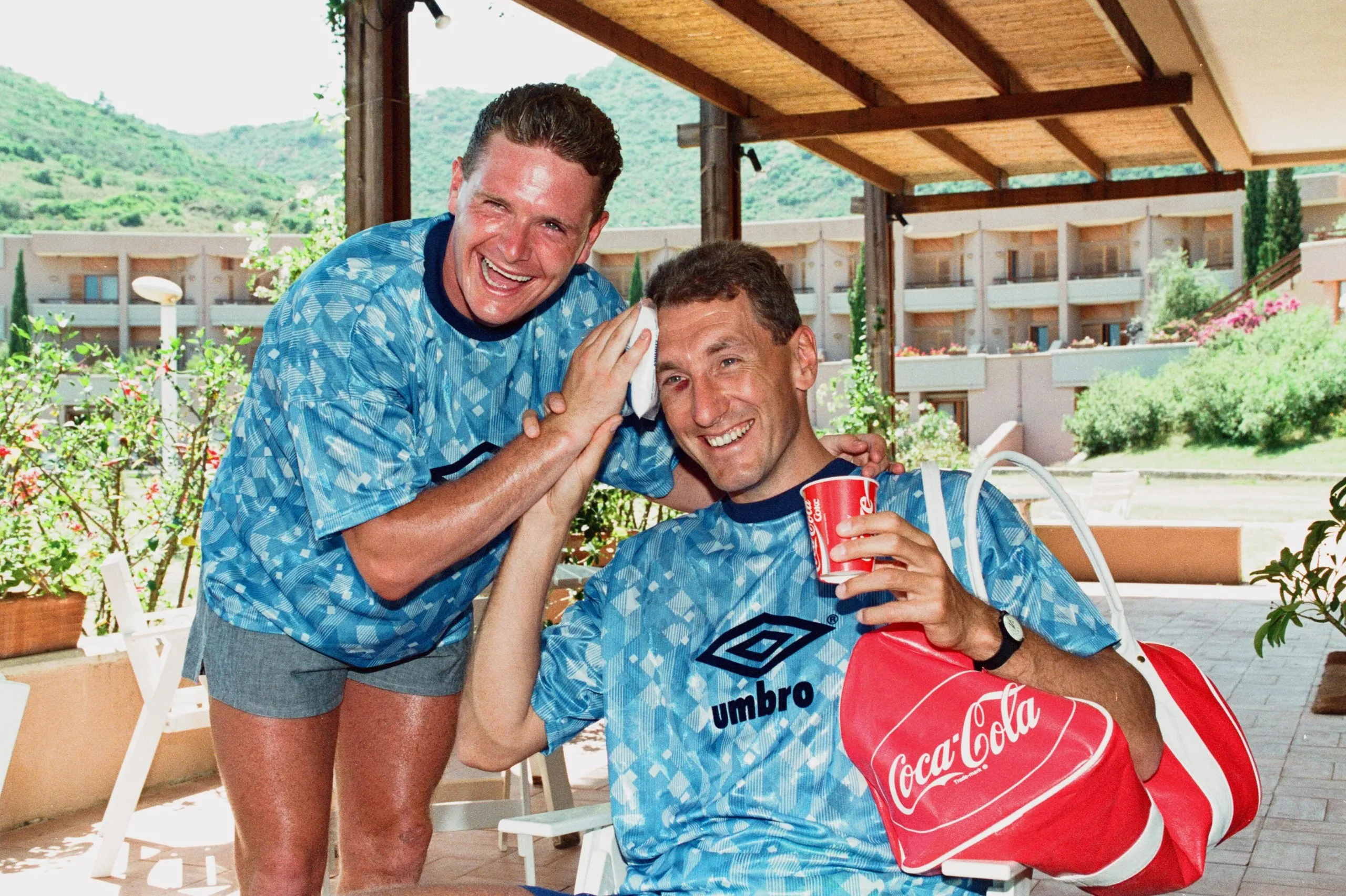
With a background in high-performance athletics, including work with double Olympic champion Seb Coe, Brewer’s insights on training were largely embraced by Robson and his coaching staff, who were willing to adapt to his innovative suggestions. These strategies, which now seem standard, included warming up without the ball to elevate body temperature and enhance muscle flexibility. “Because at the time it was a case of: ‘Let’s just knock the ball about a bit and then do a few little doggies’ – as they liked to call them – ‘or sprints and we’re ready to go,’” he recalls.
Additionally, Brewer encouraged substitutes to stretch and warm up periodically rather than remain seated throughout the match. He also advocated for squad players to train more rigorously between matches to sustain their fitness levels – a principle that benefited David Platt when he stepped in for the injured Bryan Robson. Some of Brewer’s recommendations were surprisingly basic; for instance, he noticed players typically did not hydrate on the bus ride back from training, prompting him to mix electrolyte drinks for them.
Reflecting on his time with Robson, Brewer regards him as an admirable figure both as a person and as a manager. During this period, the FA’s director of coaching, Charles Hughes, pushed for a more direct style of play based on statistical analyses indicating that most goals were scored within fewer than five passes. Yet, Robson had the wisdom and respect to pursue a more progressive approach.
“It was a strange dynamic between them,” he explains. “Charles was very much into his statistical analysis about the need to play a long‑ball game, which I think was quite flawed, but while Bobby listened and took on board the stuff around preparation, fitness, training and nutrition, he did his own thing when it came to football. “In the end Charles left the FA as a frustrated, disillusioned character. I’m sure to his dying day, he believed that had his ideas been fully accepted England would have won a World Cup in 1994, 1998 or 2002.”
Brewer continues, “Players are fitter nowadays. They have to pay even more attention to their training and diet because the frequency of high-intensity games is much higher than it ever has been.”
Now retired, Brewer still closely follows developments in football and sports science. “When I set up the FA human performance centre, clubs used to send their players to us for their pre‑season sport science and fitness testing. From July onwards we would get three or four teams a week, including the likes of Liverpool. Obviously that would never happen today because they’ve got their own teams of people.”
“And when it came to testing, I had a BBC microcomputer, a dot-matrix printer, and a couple of very ancient Polar heart-rate monitors that I had to download individually in order to get the data. We thought it was cutting edge. But compared to today it was pretty basic stuff.”